Rawal Commission Report Reveals Singh Durbar Land Encroachment

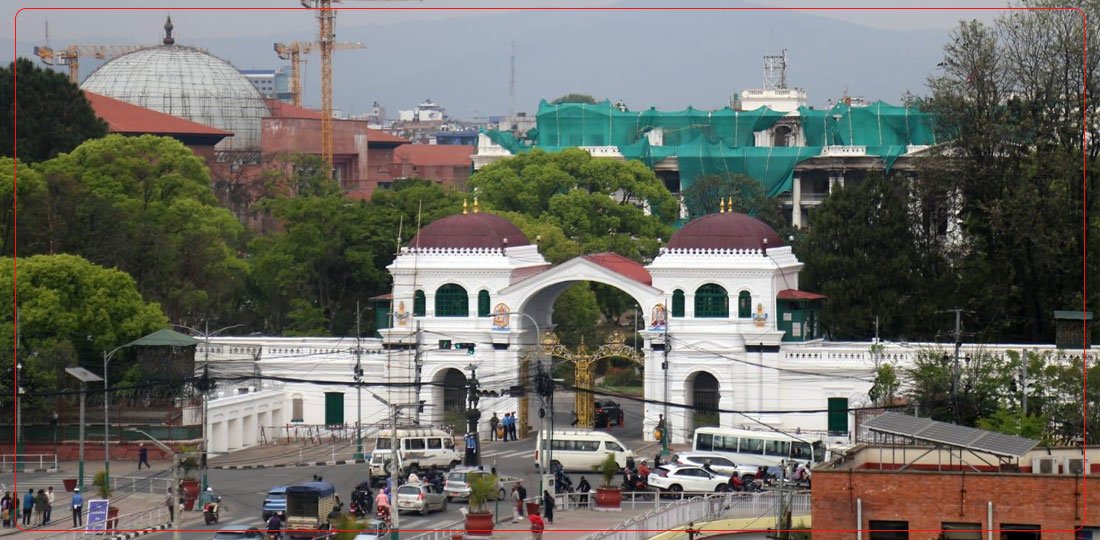
Kathmandu. In the name of saving the personal property of former government employees, 42 ropanis 6 anas of Singh Durbar land has been included in public roads. This has been revealed by the report of the high-level investigation commission formed under the chairmanship of former secretary Rambahadur Rawal, which was formed by the then His Majesty's Government in 2049 BS to protect government and public land.
According to this, the Rawal Commission report points out that out of 693 ropanis 9 anas of land in the Singh Durbar area, seat number 1105/20, plot number 97, 42 ropanis 6 anas of land was included in the road by opening roads in the north, south, east, and west directions from the main compound of Singh Durbar in 2047 BS.
According to the commission's report, 1,859 ropanis 14 anas 2 dams 3 paisa of land has been encroached upon only within the Kathmandu Metropolitan City.
In 2039 BS, the then government had prepared a master plan to expand the Singh Durbar area. The Singh Durbar Secretariat Reconstruction Committee, including the then Home Minister Yogprasad Upadhyay and Minister of Physical Planning and Construction Achyutraj Regmi in the then Prime Minister Krishna Prasad Bhattarai's government, decided to expand the road against the master plan.
Although the government had prepared a master plan for Singh Durbar to further systematize the land in the Singh Durbar area, it has been found that road structures have been built by encroaching on the land in the Singh Durbar area against the plan.
Instead of further widening the area of Singh Durbar according to the 2039 master plan, the work of shrinking the area of Singh Durbar in the name of saving personal structures in the name of road construction has been done.
Road construction was carried out by demolishing the wall of Singh Durbar to save personal houses and land while expanding the road to the north-east. The plan was reversed after the Council of Ministers decided to expand the road from New Plaza to Anamnagar in 2047 BS.
According to the report, until 2047 BS, there was a small canal and a footpath from Ghattighulo to Hanumansthan. That was like a dirt path. Under the Singh Durbar master plan, a standard was prepared to acquire equal land from both sides of the road while constructing the road to the east (Anamnagar).
To save the private land and fields of individuals on the east side of Singh Durbar, 100% of the land was taken only from the Singh Durbar side. The commission claims that in the area outside Singh Durbar, which belonged to high-ranking government employees at that time, they got the master plan reversed and built roads by encroaching on government land.
Why was Singh Durbar's land encroached upon?
If the work had proceeded according to the Singh Durbar master plan, a lot of private land would have been acquired from Anamnagar to Putalisadak New Plaza. The Singh Durbar area would have been further expanded compared to now. However, because the land of high-ranking employees living from Anamnagar to New Plaza would have been acquired during the expansion of the Singh Durbar area, the road was expanded by demolishing the wall of Singh Durbar due to the cleverness of the then secretaries. In 2047 BS, the Singh Durbar master plan failed due to a single decision of the then Council of Ministers.
The then government has a major role in the failure of the master plan. The first reason for the failure of the master plan is that the expansion of the road by encroaching on Singh Durbar's land was also advanced because the land of then high-ranking employees and the royal palace priest were involved.
Near the east gate of Singh Durbar was the house of the royal palace priest, Nayab Badagurujyu Madhavprasad Bhattarai. If half of the government land and half of the public's land had been used for the road expansion plan, many houses would have certainly been demolished.
Then Joint Secretary of the Ministry of Home Affairs, Padmaraj Subedi, had acquired land near Anamnagar. If the master plan had been implemented, half of the house built in Anamnagar would have been demolished. To save his property, he took the support of other secretaries. Similarly, former secretary Sitaram Khanal's house was also near the east gate of Singh Durbar. On one hand, there was the work to be done according to the master plan made in 2039 BS. On the other hand, when the risk of losing his property built on 4 anas increased if that master plan was implemented, he drew the government's attention, saying that it should not be implemented immediately, as implementing the master plan would displace hundreds of people.
A secretary at that time said, 'Mr. Khanal was then a secretary in the Council of Ministers Secretariat. Due to Mr. Khanal's cleverness, the land of many ordinary people was saved from encroachment. On one hand, his role was seen in saving his and the public's land.'
The former secretary questioned, 'Whether Mr. Khanal's work is considered personal interest or what, it can be understood in any way. At that time, the government was not in a position to provide compensation for land encroachment, so he might have wanted government land to be encroached upon rather than his own land.'
Then Joint Secretary of the Parliament Secretariat, Radheshyam Bhattarai, also had land connected to Singh Durbar. Ranbahadur Shrestha, who was then an assistant secretary of the government and later promoted to secretary before retiring, also had 5 anas of land. If the government's master plan had been successful, the place where his house is now would have been a road.
If the work had been done according to the master plan, the land and houses of hundreds of ordinary people, including high-ranking officials, from Anamnagar to Putalisadak New Plaza would have turned into roads. However, due to the cleverness of high-ranking officials, not only was the government's master plan not completed, but Singh Durbar also ended up shrinking.
This specific news has been automatically translated by AI. As a result, there may be some inaccuracies or language errors.