Travelogue: A Journey Through South India

We embarked on a journey to Kochi from Madgaon railway station in Goa on January 7, 2025. After a short wait amidst the station's hustle and bustle, the 'Rajdhani Express' arrived before us. We hurried to our compartment, and the train began its journey towards its destination with a chug-chug sound.
As the train moved forward, greenery and small settlements alternated as scenes outside our windows. We were chatting, laughing, and making every moment of the journey memorable and enjoyable among friends.
The hot food brought by the train staff in between made the journey even more flavorful. Thus, amidst laughter and fun, our journey continued until we reached Ernakulam Junction railway station, the busy heart of Kochi, around nine o'clock that night. Finally, with tired bodies and excited minds, we headed to the hotel to rest for the day.
The next morning, like a new dream, we set off for another destination—Punnapada Lake. A world that gives the feeling of water and sky embracing each other.
A houseboat, resembling a small house floating on water (a boat specially built to be used as a house and for people to live in), was waiting for us. It not only provided three well-equipped rooms for three families and delicious food but also took responsibility for providing guests with the joy of water sports.
Houseboat on the water, we inside the houseboat. Sometimes we stood on the roof and observed the green shores, sometimes we sat at the dining table and spread waves of laughter. Sometimes we relaxed on comfortable sofas, and sometimes we sat by the window and captured those moments in photos and videos.
There, standing, it doesn't just feel like looking at a statue. It feels like a saga of courage, sacrifice, and duty is speaking silently.
That night, our light, pure, and joyful hearts flowed with the water. That golden experience not only covered distance but also planted seeds of enthusiasm and unforgettable memories within all our hearts.
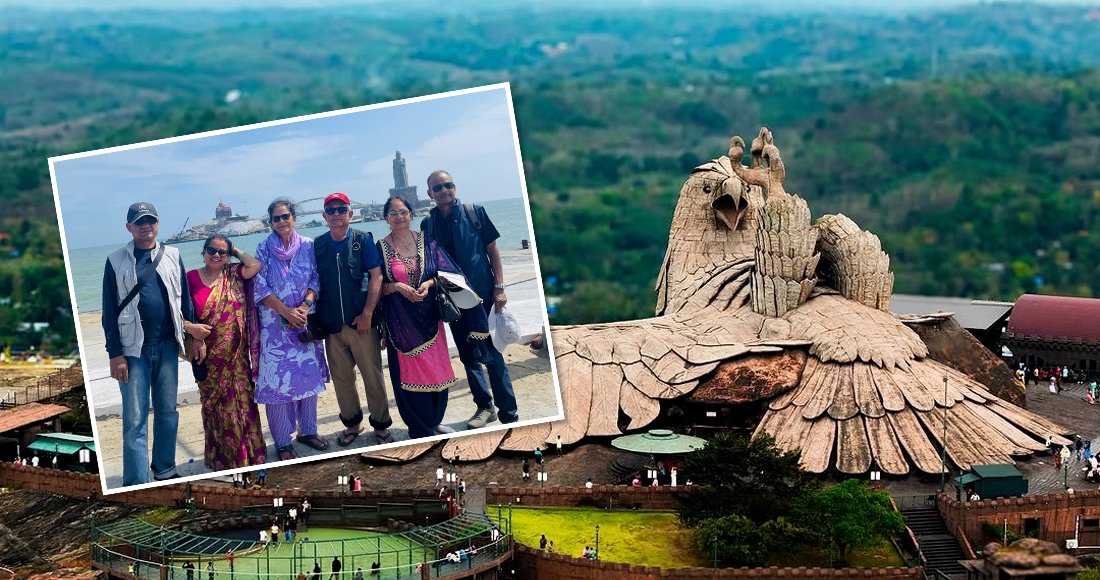
The next day, after reaching Kollam, we got the opportunity to see the world's largest bird statue. That magnificent Jatayu statue, standing on a hilltop covered with greenery within a 65-acre area, was about 200 feet long, 150 feet wide, and 70 feet high.
Although the steep climb under the midday sun of South India was not easy, the colossal figure, built in a broken-winged state, seemed grand and meaningful, leaving the mind stunned. According to a story described in the Hindu scripture Ramayana, when Ravana was abducting Sita and taking her through the sky, Jatayu bravely tried to stop him. In the process, Jatayu was seriously injured by Ravana's attack and fell to the ground, and later, as Ram's army came searching for Sita along the same path, Jatayu gave information about where Ravana had taken Sita before breathing his last. This giant monument has been built based on this popular belief.
There, standing, it doesn't just feel like looking at a statue. It feels like a saga of courage, sacrifice, and duty is speaking silently. The expanse of nature seen from the mountain peak and the steadfast figure of Jatayu leave a deep impression on the mind, as if the voice raised against injustice remains immortal forever.
The next day, we traveled about thirty kilometers from Thiruvananthapuram in South India to the beautiful beach called Poovar. The beautiful boat ride there delighted our hearts. As the boat slowly moved on the calm water, the tall coconut trees standing around seemed to welcome us, swaying with the wind.
The blue reflection of the sky sparkled on the water. Small island-like landmasses, floating hotels-restaurants, and freely flying birds—all these sights naturally filled the mind with wonderful peace and joy.
The view after getting off the boat was even more captivating. On one side, the calm backwaters, on the other, the open expanse of the vast Arabian Sea, and in between, a beach adorned with golden sand.
The scene, which looked like a beautiful painting made by nature with its own hands, completely captivated the mind. Although that moment was difficult to describe in words, its sweetness remained in the heart forever.
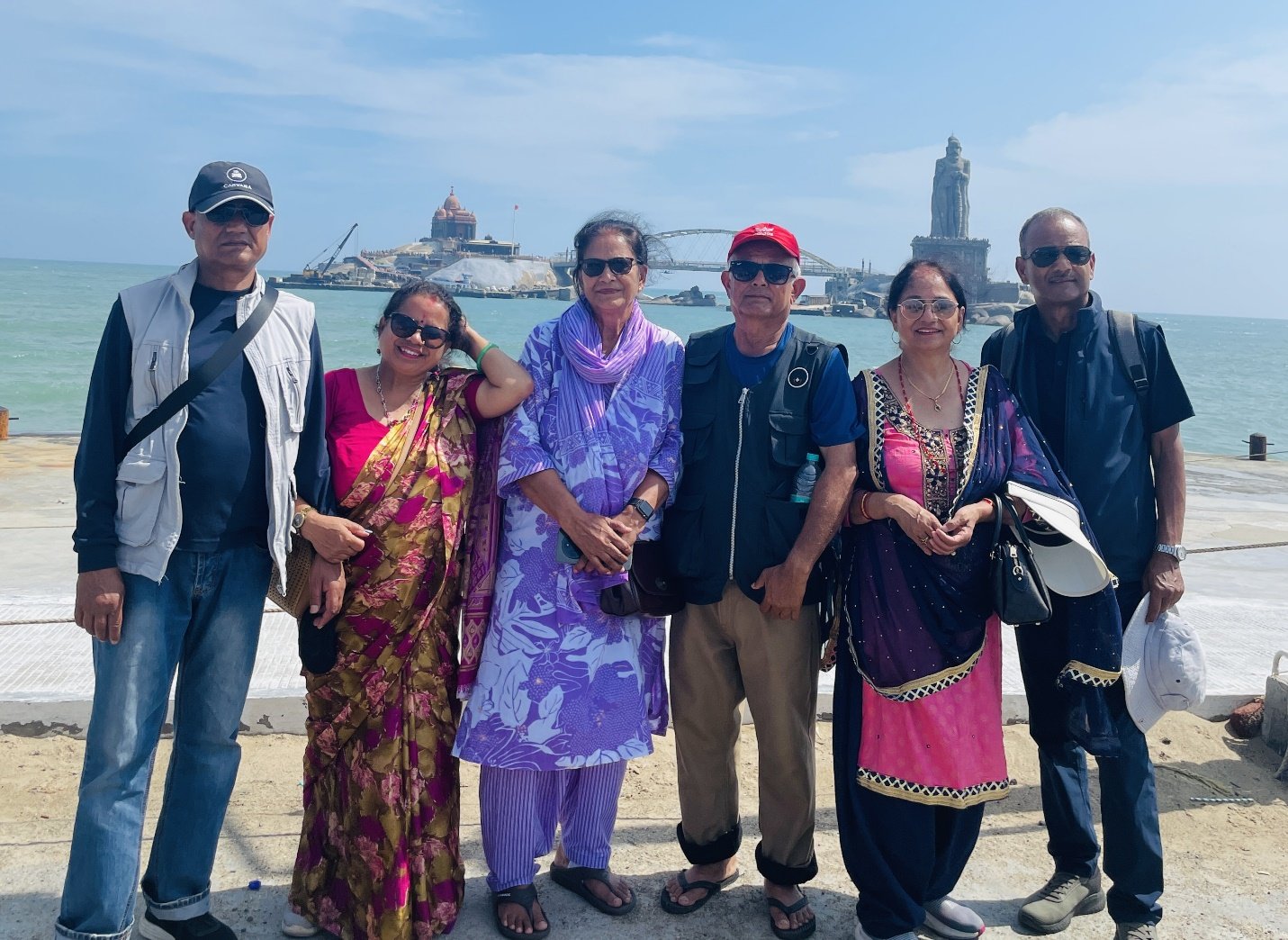
The next morning, we reached the famous Kanyakumari temple, where the Bay of Bengal, the Arabian Sea, and the Indian Ocean are seen embracing each other. Standing on the open seashore there, we had not imagined that the morning would be so cold, so we had not worn warm clothes.
Although our bodies were getting cold, our minds were warmed by the enthusiasm to watch the sunrise. We were not the only 6 Nepalis; thousands of travelers like us were lined up there waiting for the beautiful view. But by chance, a black cloud that appeared out of nowhere at the time of sunrise covered the sky completely, and we could not even see the golden smile of the sun.
Disappointed, we lined up to enter the Kanyakumari temple.
Reaching the rock standing in the middle of the sea, the blue water spread all around and the open sky captivated the mind.
After paying the fee for keeping shoes at the main entrance, we kept our shoes. After moving forward in the line, we had to pay a separate fee for the bag we carried on our back and all the items in our hands.
Then, after moving a little further, we heard the rule that men have to remove their upper garments. For this reason, some of our friends turned back, but we two couples felt it was not right to return without entering the temple after coming so far.
As we got closer to the place of worship, we had to pay Rs 20 per person to enter. Coincidentally, we had some change in our pockets. The crowd, the queuing system, and the management there seemed truly exemplary. That afternoon, after waiting in another long line, we bought tickets to visit the 'Vivekananda Rock Memorial'.
Reaching the rock standing in the middle of the sea, the blue water spread all around and the open sky captivated the mind. When our bare feet touched the hot ground, it felt like a jolt from the heat, but that small discomfort was forgotten by the beauty of the view.
Although paying the entrance fee repeatedly by standing in line was a bit inconvenient, the grandeur of the vast sea and the colossal monument before our eyes made us forget all the fatigue. Visiting Swami Vivekananda Rock Memorial, Gandhi Memorial, and the church there, the trip to Kanyakumari concluded memorably with the beautiful sunset.
The next day, we reached Rameswaram, one of the four Dham pilgrimage sites. Frightened by the crowd of pilgrims we saw and experienced in Kanyakumari, we headed to the temple in the evening instead of the morning. After a short wait, we got the opportunity to have darshan of Ramanathaswamy.
Applying the ash vibhuti on our foreheads and to each other not only brought joy from within but also a feeling of peace and devotion. It is believed that after killing Ravana, Lord Rama established a Shivling here and worshipped to be freed from the sin of Brahmahatya.
The twenty-two kunds inside the temple are called 'Twenty-two Tirthas'. There is also a religious belief that Lord Rama created water in these kunds with his arrows and washed his arrows.
The most talked-about feature of the Rameswaram temple is its long corridor, which is considered one of the longest temple corridors in the world. The intricate carvings on the pillars and the paintings adorning the walls present an excellent example of South Indian architecture.
The next day, we reached Ram Setu, which stretches between Tamil Nadu and the Mannar Island of Sri Lanka, and all our hearts were filled with joy. According to the story in the Hindu scripture Ramayana, Ram Setu is remembered as the bridge built by Lord Rama over the sea with the help of the Vanara army to reach Lanka.
It can be considered not just a chain of stones and sand, but also a silent record of faith, belief, and cultural memory.
From there, we reached the former President of India Abdul Kalam Memorial Hall. In the memorial hall built at the burial site, we concluded the Rameswaram trip after seeing the blend of Mughal architecture, Kalam's biography, education, scientific achievements, models of missiles and rockets, and a statue exactly like the living Abdul Kalam.
In the evening, we reached the Brindavan Garden in Mysore, a beautiful garden connected to the Krishnarajasagara Dam and the Kaveri River. Amidst the greenery spread in a terraced style, as evening fell, the light of the lamps and the rhythmic dance of the musical fountain began.
After staying in Madurai this day, we reached the beautiful hilly town of Ooty, located in the lap of the Nilgiris, the next day. That city, adorned with the gentle touch of cold air, hills covered with greenery, countless tea gardens, and British-era buildings, truly looked like a bride adorned.
The view, disappearing and reappearing amidst the morning fog, gave immense freshness to the mind.
After that, we headed towards Karnataka and reached the historic city of Mysore. The grand Mysore Palace there dazzled our eyes. The artistic structure of this palace, completed in 1912 during the reign of Krishnaraja Wodeyar IV, the golden throne, the royal chambers, old weapons, costumes, and paintings bring history alive before your eyes.
Amidst the immense crowd of tourists, each well-decorated room seemed to whisper a story.
In the evening, we reached the Brindavan Garden in Mysore, a beautiful garden connected to the Krishnarajasagara Dam and the Kaveri River. Amidst the greenery spread in a terraced style, as evening fell, the light of the lamps and the rhythmic dance of the musical fountain began.
The wonderful confluence of water, music, and light made the atmosphere dreamlike. That moment, beyond words, was truly filled with sweetness.
After a delightful visit to Chamundeshwari Temple and the zoo, the journey concluded with a two-night stay in Bengaluru, the capital of Karnataka. The overall journey was very satisfactory. The places visited were one by one attractive and memorable. We express our sincere gratitude to Himalaya Exploration Tour and Travels for the management of this beautiful journey.
This specific news has been automatically translated by AI. As a result, there may be some inaccuracies or language errors.