Kathmandu Valley Public Transport System to Undergo Major Restructuring

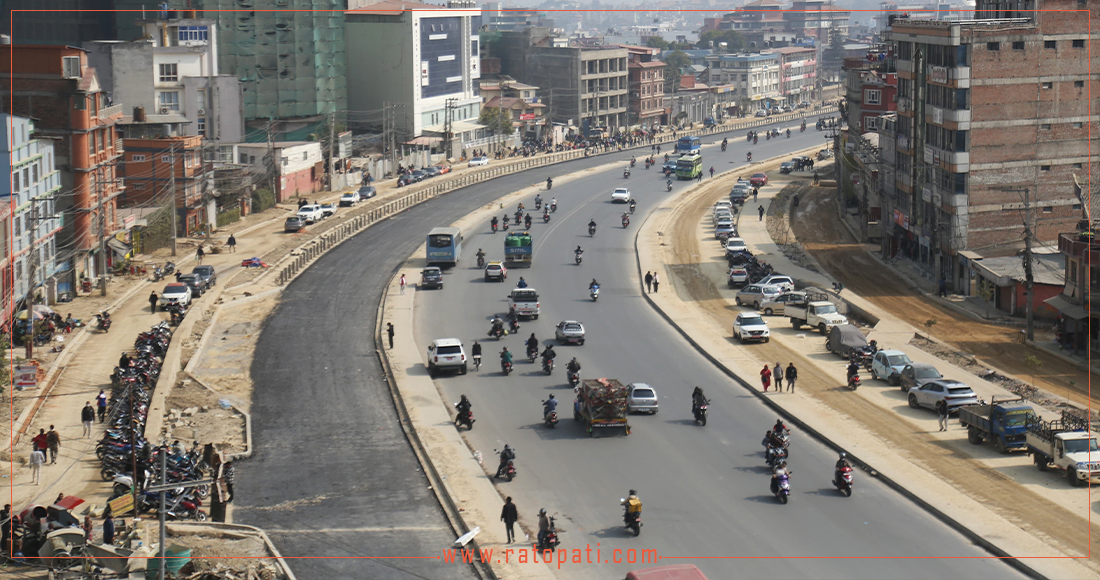
Kathmandu. The government has put forward a comprehensive restructuring plan to make the chaotic public transport system of Kathmandu Valley organized, modern, and environmentally friendly. The report prepared under the 'Kathmandu Sustainable Urban Transport Project' (KUTP) has proposed a new strategy to address the main problems in the valley's current transport sector such as route duplication, high volume of small vehicles, weak regulation, and low quality of service.
The Ministry of Infrastructure Development (formerly Ministry of Physical Infrastructure and Transport) has launched this plan with the support of the Asian Development Bank (ADB) and the Global Environment Facility.
The report has pointed out many serious problems in Kathmandu's transport sector. According to the report, currently, the operation of many small vehicles (microbuses and tempos) on the same route has increased road congestion and routes are overlapping. There is unhealthy competition among transport entrepreneurs, the quality of service is low, and the vehicles are old and unsafe.
Furthermore, the lack of proper management of bus parks and terminals in the city center has further increased traffic jams. The report concludes that the government's regulatory role in the current system is weak and the syndicate system is dominant.
This report has proposed various strategies to improve Kathmandu's air quality, create a better environment for pedestrians, and make public transport reliable. It mainly emphasizes route management, vehicle modernization, and institutional reform. The report suggests replacing old and small vehicles with modern, low-emission, and disability-friendly large buses.
To organize transportation, the report proposes dividing the valley's routes into three tiers. Under this, primary routes will operate 12-meter long large buses or 18-meter articulated buses on main roads, for which eight main routes have been identified. Secondary routes will operate 9 to 10-meter medium-sized buses, while tertiary routes are arranged for inner and narrow roads. Small vehicles and electric tempos will provide service on tertiary routes and will act as 'feeder' services connecting passengers to the large bus routes on the main roads. This system is believed to easily connect the residential areas of the valley with the main commercial centers.
- Which roads fall under which category of routes?
According to the report, about 200 old routes in the valley will be abolished or modified and divided into three categories: primary, secondary, and tertiary. The main goal of this plan is to replace small and inefficient vehicles with large and modern buses according to passenger volume.
The 'primary routes' at the highest level of this plan include main roads with high passenger traffic, where 12 to 18-meter long large buses will operate. This includes the ring road (both right and left sides), the section from Narayan Gopal Chowk-Maharajgunj-Lazimpat-Ratnapark to Satdobato, and the section from Narayan Gopal Chowk via Ratnapark to Suryavinayak in Bhaktapur.
Similarly, the route from Jorpati-Boudha-Chahabil-Kamalpokhari to Naikap, the section from Jorpati-Gaushala-Tripureshwor to Ekantakuna, the route from Koteshwor-Airport-Chahabil-New Buspark, and the section from Koteshwor-Tinkune-Maitighar-Kalanki have also been included in the primary routes. A strategy has been adopted to arrange separate 'bus lanes' to prioritize buses on these routes.
'Secondary routes' at the second level will connect various suburban areas to the city's main centers or primary route interchanges, where 9 to 10-meter medium-sized buses will operate. This category includes routes like Budhanilkantha-Narayan Gopal Chowk, Baluwatar-Putalisadak-Koteshwor, and Kirtipur (Newbazar)-Balkhu-Tripureshwor-Chappal Karkhana.
Similarly, routes such as New Buspark-Gongabu-Thamel-Ratnapark-Airport, Gokarna-Boudha-Purano Baneshwor-Tinkune, Nagarkot-Koteshwor, Sanga-Koteshwor, Sisneri-Satdobato, Godawari-Satdobato, and Chapagaon-Satdobato have also been classified as secondary routes. Additionally, the routes from Pharping-Purano Buspark, Thankot-Kalanki, and Sitapaila-Ratnapark also fall into this category.
The 40 'tertiary routes' at the third level will provide 'feeder' services on inner settlements and narrow roads, prioritizing small vehicles and especially electric tempos. This includes routes connecting northern areas like Ranipauwa, Dharmasthali, Phutung, Tokha, and Dhapasi to the New Buspark.
Similarly, routes such as Kapann-Chahabil, Sakhu-Jorpati, and in the south, Lubhu-Koteshwor, Lele-Satdobato, and in the west, Ramkot-Ratnapark and Ichangu-Teku have been designated. Especially in Kathmandu's historic inner city (Sohrakhutte-New Road-Durbar Square area and Lagantol area), there is a plan to operate only small electric vehicles for the convenience of pedestrians.
Similarly, the report suggests replacing old and small vehicles with modern, low-emission, and disability-friendly large buses. To reduce the crowd in the old buspark and Ratnapark in the heart of the city, a new inter-city terminal is proposed to be built in Koteshwor. Modern bus stops will be built every 400 to 600 meters for the convenience of passengers, and separate 'bus lanes' will be arranged on main roads to prioritize buses. This aims to reduce passenger travel time and save fuel.
- Syndicate End, Institutional Reform and Technology Emphasis, Pilot Project to be Started
The report proposes integrating the current scattered small transport entrepreneurs into 'operating companies' or cooperatives. A separate 'Public Transport Directorate' will be established under the Department of Transport Management. Furthermore, empowered bodies like the Kathmandu Transport Management Committee and Kathmandu Valley Bus Agency will be formed, entrusting transport operation to the private sector and regulation to the government.
According to the plan, a new inter-city bus terminal will be constructed in Koteshwor to reduce the congestion at Ratnapark and Old Buspark. Separate lanes will be arranged for buses on main roads. The report mentions the construction of an integrated fare system (smart card ticketing) and modern bus stops for passenger convenience.
The report states that two routes will be improved as models in the initial phase. In the first phase, the Balkhu-Gwarko and New Buspark-Airport routes will be improved as pilot projects to start this comprehensive plan. Electric vehicles with a capacity of 15 seats will be operated on the Balkhu-Gwarko route. The New Buspark-Gongabu-Airport route will be improved as a secondary route.
The government claims that if this plan is fully implemented, it will save $34 million in annual operating costs and reduce road congestion by 12 percent.
This specific news has been automatically translated by AI. As a result, there may be some inaccuracies or language errors.
-(2)_QJLjKxR87n.jpg)