2026 World Cup Opening Match Sees Three Red Cards, Sparking Debate

Mexico City. The days when many red cards were seen in the World Cup football were thought to be history. However, the first match of the 2026 World Cup has proven this assumption wrong. The football world has started a new debate after seeing three red cards in the opening match itself. In the match played on Thursday, Mexico defeated South Africa 2-0, but more than the result of the match, the referee's decision and the red cards became the topic of discussion.
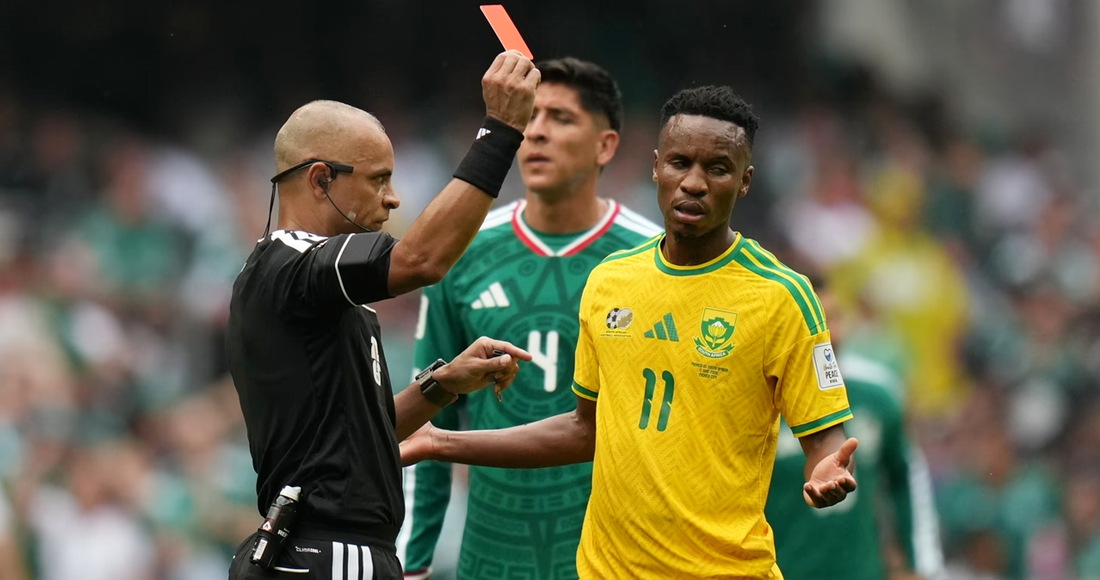
In the course of the game, South Africa's YaYa Sithole and Themba Zwane had to leave the field, and in the final moments of the game, Mexico's Cesar Montes was also sent off with a red card. In the last two World Cups held in Russia (2018) and Qatar (2022), only four red cards were given throughout the entire tournament. However, with three red cards already shown in the first match this time, the previous record appears to be in danger.
This is the first time in 20 years that three players have received red cards in a single World Cup match. Previously, in the 2006 World Cup, 28 players received red cards, and the record of four red cards given in a single match between Portugal and Netherlands still stands. The question is being raised everywhere whether the current World Cup is returning to the old days of a shower of cards.
- How Justified Are The Decisions?
With the arrival of FIFA's Head of Referees, Pierluigi Collina, efforts have been made to make decisions in football more just and flexible. Collina's belief is that players should be kept on the field unless they commit a clear red card offense.
Especially in situations where a clear goal-scoring opportunity is denied, the rule of giving a penalty has been made very lenient. That is why very few red cards were seen in the last two World Cups. However, the opening match this time has given a different signal.
South Africa's Sithole tripped Mexico's attacking midfielder Bryan Gutierrez, after which referee Wilton Sampaio sent him off the field. Since Gutierrez was in a clear position to score, regardless of Sithole's intention, he was seen to have denied a clear goal-scoring opportunity. Many have considered this decision correct.
However, the second red card received by South Africa's Zwane became quite controversial. On the advice of the Video Assistant Referee (VAR), the referee gave him a red card for violent conduct. Zwane and Mexico's Roberto Alvarado collided without the ball, with Alvarado falling to the ground holding his head. Colombia's VAR official Nicolas Gallo asked the referee to look at the screen in the stadium. Although the replay showed Zwane's hand touching Alvarado's head, it was not clear whether it was intentional or accidental. Generally, when checking for violent conduct, a clenched fist is considered a sign of aggression, but Zwane's hand was open. This decision seemed very harsh and is being commented as not in line with the true spirit of VAR.
- Collina's New Policy and Montes's Card
Mexico's Cesar Montes's third red card in the final moments of the game also initially appeared controversial. As South Africa's Khuliso Mudau was advancing at high speed, Montes stopped him with a bad tackle.
From the first glance, it was estimated that only a yellow card would suffice as Mudau was outside the inner area. However, the referee showed a direct red card. Looking at the replay for the second time, it was seen that Mudau had control of the ball and could have taken a direct shot at goal, and there were no other defenders. Therefore, referee Sampaio's decision can be considered technically correct.
A similar incident occurred last season in a match between Crystal Palace and Bournemouth in the Premier League, where the referee gave a yellow card, but later the Premier League's main match incidents committee determined it should have been a red card. This also confirms that the decision against Mexican player Montes was correct.
FIFA Head of Referees Collina had emphasized controlling time-wasting and players' misconduct on the field before the tournament. He has taken a strict stance against players covering their mouths during disputes with opponents, leaving the field in protest of decisions, and obstructing set-pieces. The decision regarding Zwane might also be part of this new policy.
This World Cup is a long tournament of 104 matches. Even though three red cards were shown in the first match, there is no need to panic based on this alone, assuming the entire tournament will be under strict referee control and a shower of cards will occur. It would be appropriate to consider this opening match incident as a rare coincidence or a statistical anomaly.
This specific news has been automatically translated by AI. As a result, there may be some inaccuracies or language errors.