Foreign Minister Clarifies PM's Border Remarks, Details India Visit

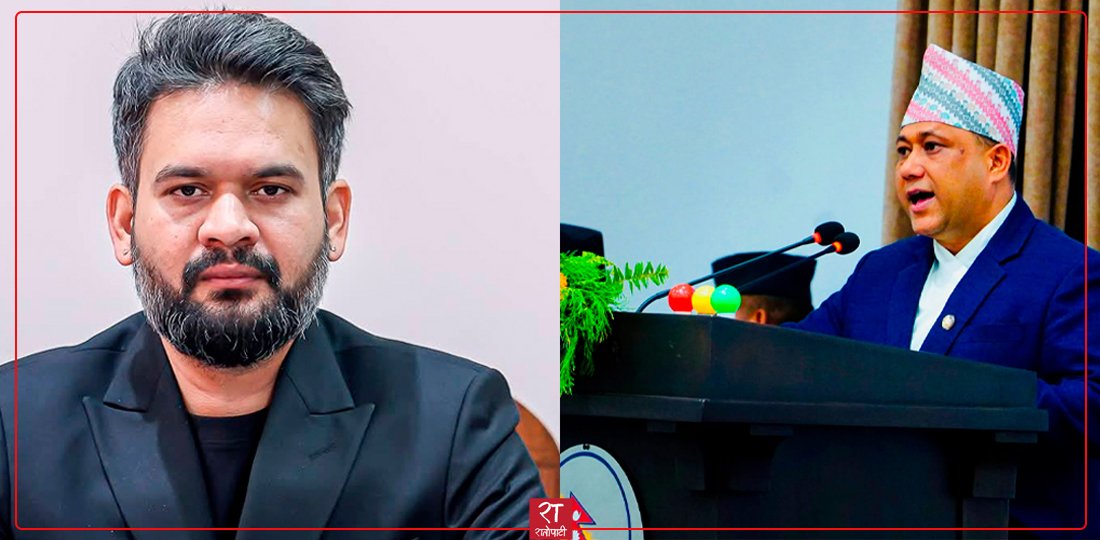
Kathmandu. Foreign Minister Shishir Khanal has clarified the remarks made by Prime Minister Balen Shah regarding the border. He also informed the House about his recent visit to India. The full text of his statement made during Wednesday's meeting is as follows:
Honorable Speaker, I seek permission to provide information regarding the recent visit to India and the address made by the Honorable Prime Minister to this esteemed House on Jestha 17, 2083, concerning the Nepal-India border and other issues.
Honorable Speaker, I returned to Kathmandu on Jestha 24, 2083, after completing a three-day official visit to India at the cordial invitation of India's External Affairs Minister, His Excellency Dr. S. Jaishankar. I believe that this first high-level visit, representing the new government formed after the elections held last February, has made a significant contribution to further strengthening the friendly and multifaceted bilateral relations between Nepal and India.
During the visit, on June 6, 2024, an official meeting with India's External Affairs Minister, His Excellency Dr. S. Jaishankar, and delegation-level talks were held in New Delhi. Comprehensive and fruitful discussions were held between the delegations of both countries on all aspects of Nepal-India bilateral relations. During the bilateral talks, concrete discussions were held on issues such as trade and economic cooperation, connectivity, energy partnership, water resource management, common security, border management, sports, and enhancement of people-to-people relations. Both sides expressed their commitment to further strengthen bilateral relations. Discussions were also held on various regional and international issues.
Significant discussions were also held on reviewing the progress of projects being implemented under bilateral cooperation between Nepal and India and on ways to make them more effective. During the meeting, we made three joint declarations:
a. The operation of cross-border payment P2P transactions has commenced under the Memorandum of Understanding signed between NCHL and NPCI in June 2023.
b. The handover of 72 health sector-related projects and 12 cultural sector-related projects reconstructed with India's development assistance after the earthquake in Nepal has been completed.
c. A Memorandum of Understanding between the School of Engineering, Center for Digital Public Infrastructure and Artificial Intelligence at Kathmandu University and the Digital India Bhashini Division for the co-construction of a national digital infrastructure for the 'Voice First' language translation platform.
During the visit, I also met and held discussions with India's National Security Advisor, Mr. Ajit Doval. In that meeting, views were exchanged on the common security concerns of Nepal and India, border management, and various aspects of the strategic partnership between the two countries. During the visit, I had the opportunity to address a group of eminent persons at a special program organized by the India Foundation in New Delhi. In that program, I highlighted the priorities of Nepal's foreign policy and interacted with the participants focusing on issues of common interest such as energy, trade, and borders.
Similarly, I visited the Nepali Embassy in New Delhi, interacted directly with the embassy staff about their recent activities, and instructed them to work with commitment to protect the interests of Nepal and Nepalis in India. I also informed the media present in India about our priorities during a media interaction program organized at the embassy.
Honorable Speaker,
Now I would like to mention something about the address of the Honorable Prime Minister and the issue of the Nepal-India border. The Honorable Prime Minister, while mentioning the border of Nepal during the question-and-answer session in the House of Representatives of the Federal Parliament on Jestha 17, 2083, stated that the government is committed to resolving the problem through bilateral talks. The Ministry of Foreign Affairs had already provided detailed information regarding the statement made by the Honorable Prime Minister on the same day.
The official stance of the Government of Nepal regarding India's operation of the pilgrimage route through Nepali territory of Lipulek has also been clarified by the Ministry of Foreign Affairs on Baishakh 20, 2083. Nepal's diplomatic note sent on this matter has also been responded to by the Government of India through a diplomatic note. Both countries have expressed their commitment to resolve border-related disputes through diplomatic means and mutual discussion.
As you all know, Nepal and India share an age-old open border. The current Nepal-India international border is established and guided by the Treaty of Sugauli of 1816. Surveying remains to be done in the Susta and Limpiyadhura, Lipulek, and Kalapani areas along the Nepal-India border. Apart from these places, problems of cross-border occupation and encroachment of the no-man's-land exist in some other locations.
The issues mentioned by the Honorable Prime Minister in Parliament are primarily related to the encroachment of the no-man's-land and cross-border occupation. When determining the Nepal-India border, the 'fixed boundary principle' has been adopted in riverine border areas, leading to cross-border occupation where citizens of one country cultivate land and reside within the territory of the other country.
To systematically and scientifically demarcate the long border between Nepal and India, border mechanisms and technical teams from both countries are active in constructing and repairing border pillars in surveyed areas, and in collecting data on encroachment of the no-man's-land and cross-border occupation. The work of the technical committee, which has been stalled for a long time, is currently active in the border areas, and data collection is being carried out jointly.
The study by the technical committee has shown that in some places, land currently under Nepal's use and occupation may fall into India, and land currently under India's use and occupation may fall into Nepal. Both sides claim the land under their respective use and occupation. The statement made by the Honorable Prime Minister in Parliament is linked to this technical reality and cross-border occupation. The main question here is how to resolve the border issue. Therefore, in the spirit and sentiment of the close relationship between Nepal and India, we are committed to resolving this issue through diplomatic negotiations based on historical treaties, agreements, and maps.
The Honorable Prime Minister mentioned the name of the friendly nation, the United Kingdom (UK), while responding to the issue of Nepal's border in the Federal Parliament on Jestha 17, 2083, because Nepal's demarcation is directly related to the Treaty of Sugauli of 1816. We are not seeking third-party mediation; the Honorable Prime Minister merely indicated that if there were any additional reference materials from the then-situation, they could naturally be helpful in resolving the problem, and if necessary, they would be utilized. I want to clarify in this esteemed House that the Nepal-India border is a bilateral issue. Thank you.
This specific news has been automatically translated by AI. As a result, there may be some inaccuracies or language errors.
_8xHho19k4P.jpg)