Foreign Minister Visits New Delhi for Three-Day Trip
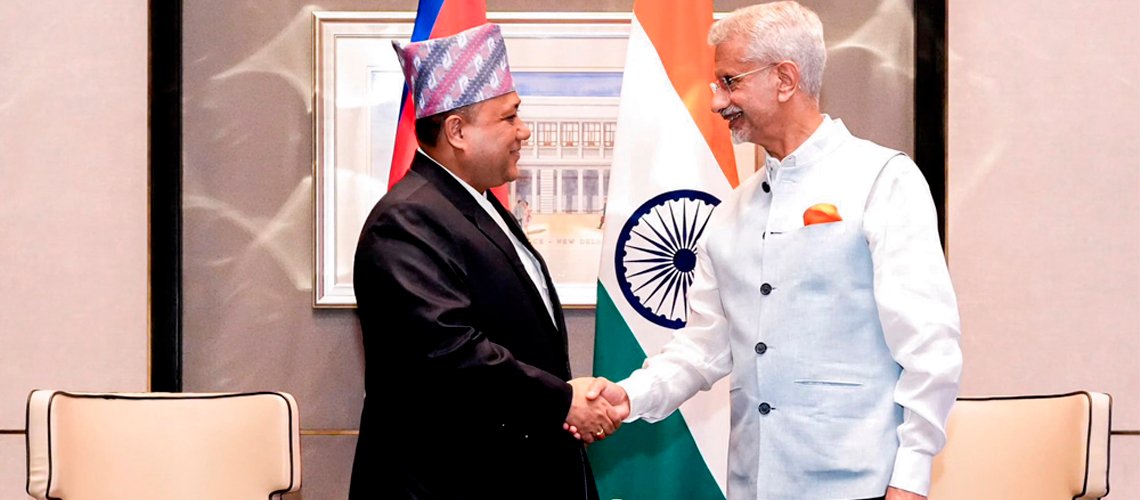
New Delhi. Foreign Minister Shishir Khanal is in New Delhi for a three-day visit this week. He has brought a clear message that the government of Prime Minister Balen Shah is ready to set aside years of political conflict with India and build a relationship based on practicality, measurable results, and mutual development.
In a special interview with NDTV's Senior Executive Editor Aditya Raj Kaul, Khanal spoke about Nepal's newest and electorally successful political force, the Rastriya Swatantra Party (RSP). Acknowledging the reality that Nepal has lost crucial years of development while India has progressed rapidly, he presented a vision for advancing the relationship between the two neighboring countries anew.
This diplomatic initiative is underpinned by a significant political transformation within Nepal. The RSP's resounding electoral victory earlier this year was energized by a GenZ movement led by the youth.
It was a wave of public anger that demanded accountability, transparency, and an end to entrenched corruption in Nepali politics. 'The extreme frustration among the youth with the traditional politics that was merely happening in the name of politics fueled the GenZ movement,' Khanal told NDTV. 'They raised questions of accountability and transparency. They wanted a corruption-free Nepal.'
The RSP, formed just about four years ago, had already established itself as a distinct force by boycotting parliament for 90 days prior to the elections, demanding an investigation into corruption scandals. When the elections came, voters, especially young Nepalis, appreciated that continuity.
Focusing on two main promises – good governance and rapid economic transformation – the party garnered unprecedented public support. Khanal, who entered politics from the business sector instead of a traditional political background, argued that the RSP government is different precisely because of this outsider image.
'Many of us who join the party are non-political and primarily from a business background,' he said. 'This means we are largely free from some of the ideological baggage of the past.'
Showing rare diplomatic clarity, Khanal did not hesitate to admit the reality that Nepal has not benefited from India's economic growth over the past decade. 'While India has developed rapidly in the last few years, we have remained stagnant,' he said. 'Looking at the last three decades alone, there are very few instances where Nepal's Gross Domestic Product (GDP) has grown by more than 5 percent. While India has been achieving 8 to 9 percent economic growth every year, we believe we should also have achieved double-digit growth.'
He attributed some of the reasons for this stagnation to the frequently changing coalition governments in Kathmandu. According to him, such governments tended to use international relations as a tool for domestic political consumption.
'We were always compelled to form coalition governments, and those governments changed very quickly. Due to that conflict, many international geopolitical issues were also used for domestic consumption,' he said.
He emphasized that the RSP would not repeat this trend. 'We want to be very conscious about how we present ourselves on the international stage. We want our relationships to be based on facts and evidence, not emotions,' he added.
Discussing the fundamental aspects of new partnerships, Khanal presented an agenda covering five priority areas during his meetings with Indian External Affairs Minister S. Jaishankar and National Security Advisor Ajit Doval. Energy is at the top of this list. Nepal, with its immense hydropower potential, now wants to move beyond getting stuck in individual projects and move forward with a comprehensive sectoral framework.
'We have had very good cooperation in the energy sector in the last few years, but there is still room for improvement,' Khanal said. He mentioned that a trilateral agreement between India, Nepal, and Bangladesh could facilitate the delivery of Nepali green energy to Dhaka using India's transmission lines, the first phase of which has already begun as a pilot.
The second priority is expanding connectivity. Khanal specifically discussed the railway line between Janakpur and Ayodhya, new air connectivity via Nepal's newly built Bhairahawa and Pokhara airports, and the upgrading of road infrastructure.
'We want to see India and various cities and towns in Nepal better connected by road, rail, and air,' he said.
In the digital sector, Khanal expressed optimism about a payment agreement based on UPI. This agreement, formalized during his visit, will enable seamless cross-border digital transactions. He also pointed to collaboration between Nepali universities and Indian institutions for Artificial Intelligence (AI) language models for regional languages as a potential near-term project.
Education and technology complete these agendas. As the most ambitious plan, Khanal has proposed the idea of establishing campuses like IIT or AIIMS in Nepal. This proposal would mark the beginning of a completely new chapter in educational cooperation between the two countries.
Speaking about high-level visits, Prime Minister Balen Shah, who prefers direct dialogue with citizens over media appearances, has received an invitation to visit India. Khanal confirmed the invitation but stated that Prime Minister Shah is currently focused on achieving results from the new government's first budget, presented just recently, and is therefore concentrating on domestic work.
'The Prime Minister is currently very focused on the domestic agenda and wants to show results soon,' Khanal said. 'We hope for an exchange of high-level visits from both sides.'
For now, the Foreign Minister's visit is laying the groundwork.
This specific news has been automatically translated by AI. As a result, there may be some inaccuracies or language errors.