Civil Mall Ownership Dispute Traps Legal and Financial Cycles

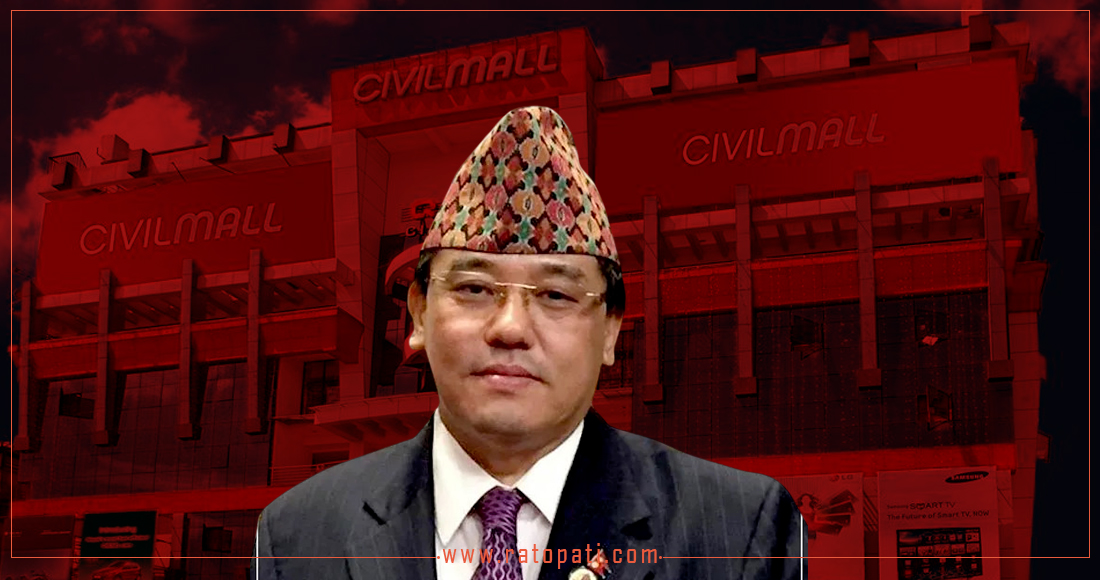
Kathmandu. The ownership dispute of Civil Mall (Civil Business Complex Pvt. Ltd.) located in the heart of Kathmandu, Sundhara, has become entangled in a legal and financial quagmire due to the opaque working style and misconduct of the then chairman of the problematic Civil Saving and Credit Cooperative, Ichchharaj Tamang.
Tamang and another main director, Lalkaji Gurung, have made this case controversial amidst the ownership of 1.7 million shares, management of billions in loans, and the process of returning depositors' funds. This dispute is entangled from Civil Mall's director Gurung and the problematic cooperative management committee office to government bodies and courts.
- Dispute Rooted in 50 Percent Shareholding
According to the share registration book of the Company Registrar's Office and Civil Business Complex (certified on Ashad 26, 2063 BS), Civil Cooperative clearly holds 50 percent (1.7 million shares) ownership in this company. Of the remaining 50 percent, 900,000 shares are in the name of Lalkaji's wife Meena Gurung and 800,000 shares are in the name of Lalkaji Gurung. However, Lalkaji Gurung has been claiming that the cooperative has no actual investment in it.
Initially, the land where the mall is located was in Lalkaji Gurung's name. But after the plan to build a mall there, he collaborated with Tamang. According to Gurung, 170 million rupees were initially borrowed from the cooperative to build the mall. In return for securing the loan, 50 percent of the shares were transferred to the cooperative's name, with an agreement to return them as soon as the loan was repaid.
- Cooperative Loan Settled by Bank Loan
The decision of Civil Cooperative on Poush 15, 2064 BS mentions the amount of loan disbursed in this manner as 483.2 million rupees. The cooperative's 419th meeting decided to pay off 446.4 million rupees of the loan held by the complex through a loan from Prime Commercial Bank and to release the land upon repayment of the remaining amount by taking a project loan from the same bank. On Chaitra 16 of the same year, the cooperative also wrote to the Land Revenue Office, Kalanki, requesting the release of the land, stating that the entire loan had been repaid.
If the agreement was as Lalkaji stated, the shares should have been delisted after the loan was repaid. But that did not happen; he claims that Ichchharaj ignored the delisting issue despite repeated requests.
Although not delisted at the Company Registrar's Office, the shares of Civil Mall were not included in the cooperative's assets. The cooperative's 18th annual report of 2075 BS does not mention any shares of Civil Mall as the cooperative's asset.
A বেনামী (unnamed) complaint was also filed at the then Division Cooperative Office regarding this matter. The complaint alleged that the then chairman of the cooperative, Ichchharaj Tamang, in collusion with the auditor, had embezzled the cooperative's assets by making the investment in Civil Mall disappear from the annual report.
The cooperative refuted the allegations in its response. In its reply, the cooperative itself sent an official letter stating that it had no share investment in Civil Mall.
- Depositors' Money and Government Intervention
After Civil Cooperative was declared problematic, the Problematic Cooperative Management Committee initiated the process of utilizing its 50 percent shares to return depositors' funds.
Accordingly, on Kartik 19, 2082 BS, the committee wrote to Civil Business Complex directing it to deposit half of the mall's rent into the cooperative's account. However, the complex refused to deposit the rent, stating that the cooperative had no ownership in it.
Two months later, on Magh 25, 2082 BS, the committee, based on its ownership claim, sent two directors to the complex. The complex's articles of association provided for two directors from the cooperative, and the committee sent two directors citing its management of the cooperative in its problematic state. However, reiterating the same claim, they were also not allowed to participate in the board of directors.
On Chaitra 17 and 19, 2082 BS, the District Administration Office, Kathmandu, issued strict directives to Lalkaji Gurung not to obstruct work and to submit details of shop rent rates, employee information, and bank accounts within three days.
As soon as government bodies initiated action, Lalkaji Gurung and his wife Meena Gurung approached the court for legal recourse. Most recently, on Baisakh 7, 2083 BS, the High Court again issued an interim order not to implement the letters from the Problematic Cooperative Management Committee and the administration, putting the recovery process of billions of rupees of depositors in uncertainty again.
- Committee and Lalkaji's Own Claims
Currently, the Problematic Cooperative Management Committee claims 50 percent share ownership in Civil Mall. The committee's chairman Shivaprasad Sigdel states that the process for returning depositors' funds was initiated after the 50 percent share appeared in the name of the cooperative in the records of the Company Registrar's Office. However, he says that its auction is facing problems due to it being mortgaged at the bank before the cooperative and due to court orders.
Meanwhile, Complex director Lalkaji Gurung claims that there are currently no shares in the cooperative's name. He claims that the cooperative's audit report and the response given to the then Division Cooperative Office clearly show this. He also states that he has been trapped in millions due to the misconduct of the then chairman Ichchharaj Tamang.
This specific news has been automatically translated by AI. As a result, there may be some inaccuracies or language errors.
_jWnD0U1v7e.jpg)

_sVPoPmyQBl.jpg)
_QZuk60cL2q.jpg)
_GOnEFa1Iut.jpg)