Two Elephants Found Dead in Indonesian Forest Area


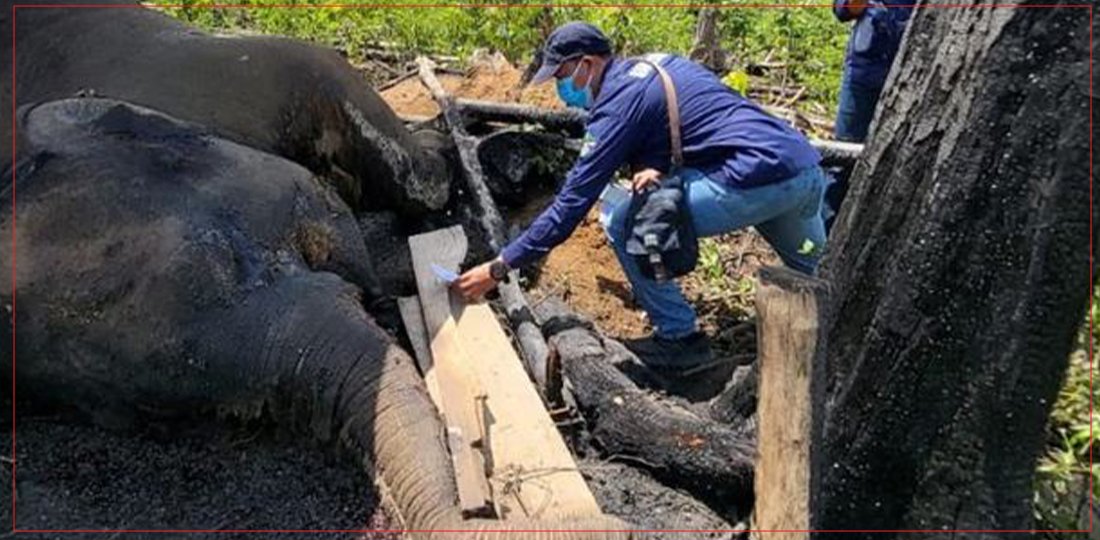
Two elephants were found dead in a 'production forest' (a forest area managed for commercial purposes) in South Sumatra, located in the Bengkulu province of Indonesia.
An adult elephant and its calf were found lying next to each other, with their tusks intact. The intact tusks make it highly unlikely that they were killed by poachers.
An investigation is still underway into the cause of death of a tiger found near the location where the elephants were discovered in late April.
However, according to conservationists, this is not a new or isolated incident. An estimated seven wild elephants have died in Bengkulu alone since 2018.
Sumatran elephants (Elephas maximus sumatranus) were once numerous around the Seblat area of Bengkulu. However, rapid deforestation and poaching due to agriculture and palm oil cultivation led to this species being listed as 'critically endangered' by the International Union for Conservation of Nature (IUCN) in 2011.
According to wildlife conservationists in Bengkulu, the elephant population has declined even more rapidly since then. Ali Akbar, director of the environmental organization 'Kanoropy Hijau Indonesia', states, 'In 2010, the average elephant population in this area was between 100 and 150. Today, their numbers in the Seblat area do not exceed 50, putting their existence in a very critical state.'
Human-elephant conflict incidents are increasing as elephants are continuously displaced from their natural habitats. Elephants enter agricultural land in search of food and wander into human settlements.
According to Professor Burhanuddin Masyud of the Bandung Institute of Technology, at least 1,585 hectares (4,000 acres) of Sumatran elephant habitat have been destroyed between January 2024 and October 2025 alone.
'What is happening in Bengkulu is not just deforestation, but a direct attack on the symbiotic balance between elephants and the environment, their ecology, and their reproductive system. The impact will be multifaceted and long-term,' he wrote in a recent article.
Although investigations into the recent elephant deaths are ongoing, local media reports indicate that the licenses of two timber companies operating in the area have been revoked.
Use of Thermal Technology
Following the discovery of the two elephant carcasses in late April, the 'Bengkulu Natural Resources Conservation Agency' (BKSDA) under the Ministry of Forestry began monitoring the Seblat area using thermal imaging drones.
According to Agung Nugroho, head of BKSDA, the objective is to determine the actual number of elephants and the condition of their habitat. This will help in formulating plans for 'controlling encroachment, securing short-term habitats, and improving governance for long-term conservation.'
_AfK7ZAgJmL.jpg)
The drones surveyed an area of several square kilometers in the early morning, when the air temperature is low and the elephants' body heat is easily detectable. Monitoring was conducted in specific areas where elephants frequent, with evidence of dung and footprints ranging from one to three days old. Agung hopes that thermal imaging will reveal the number of calves in herds, indicating the health and reproductive status of the elephants.
'Having a large number of elephants in a herd ensures their long-term genetic continuity. A small herd size and the absence of calves are alarming signs that the population is unhealthy. In such situations, strategies like ensuring corridors for inter-herd contact or translocating elephants from other herds become necessary,' says Agung.
To protect them from poachers, the agency has kept the exact locations where elephants were sighted confidential. Recent scanning has identified a herd of 17 elephants, including four calves.
Wahdi Azmi of the Indonesian Elephant Conservation Forum, also a member of the IUCN's Asian Elephant Specialist Group, states that thermal drones help in understanding the distribution of elephant herds, their movement patterns, potential conflicts, and detecting their presence in remote areas. 'However, monitoring alone will certainly not be enough if the root of the problem is not addressed,' he says.
According to Egi Ade Saputra, director of the conservation organization 'Genesis Bengkulu', concrete steps must be taken for the rehabilitation of the area after monitoring. 'It is time to revoke the logging and palm oil plantation permits, declare the Seblat area a wildlife sanctuary, and restore its ecosystem to its original state,' he says.
The Way Forward
This month, Minister of Forestry Raja Juli Antoni pledged to strengthen conservation efforts in a meeting with experts. He said, 'We are serious about saving the Sumatran elephant population, and this task is not easy.'
Commitments were also made at the meeting to implement a 'early warning system' for communities around elephant habitats and to map corridors connecting these areas. According to Agung Nugroho, head of BKSDA, establishing a sanctuary is one of the various plans being considered in Bengkulu.
_aIVfXxzfVu.jpg)
Harry Siswoyo, a wildlife conservation campaigner from 'Lingkar Inisiatif Indonesia', says that involving local communities is crucial for the success of this effort, as many locals perceive elephants as 'harmful creatures' that destroy crops.
'We need to conduct extensive campaigns among local communities to change their perspective on the importance of elephants in the ecosystem,' he says.
Elephants are called 'ecosystem engineers' because their movement and behavior play a vital role in shaping forest structure, opening natural pathways, creating space for new vegetation, and dispersing seeds.
'Elephant conservation is not just about saving animals; it is also about maintaining the continuity of the ecosystem that sustains the future of humankind,' says Wahdi Azmi.
He adds that in the future, conservationists must move beyond traditional methods of resolving human-elephant conflict and work towards creating an environment where both humans and elephants can coexist more safely and sustainably. 'This requires science, policy, land management, technology, multi-sectoral cooperation, and long-term community engagement.'
This specific news has been automatically translated by AI. As a result, there may be some inaccuracies or language errors.