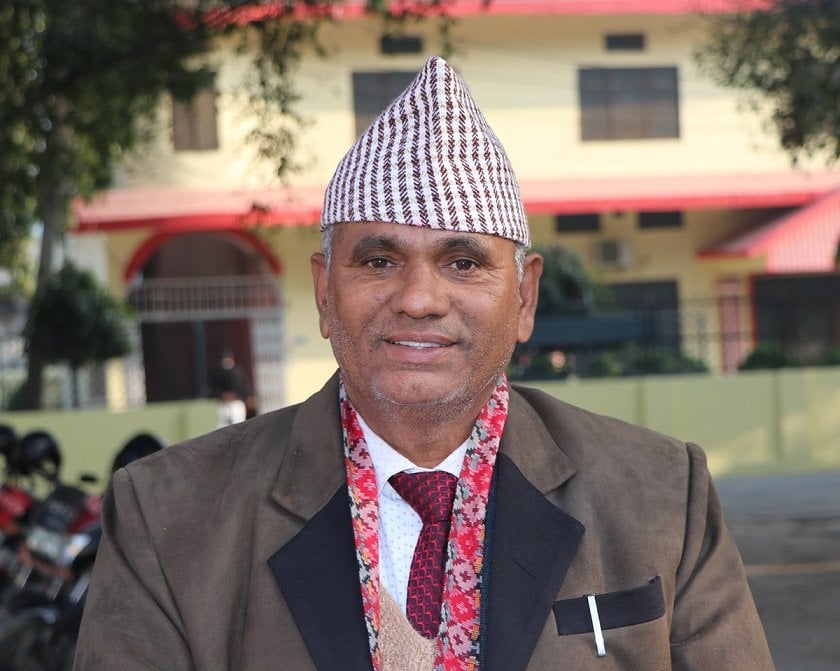
Human Rights Commission Report Puts Rabi Lamichhane in Difficult Position
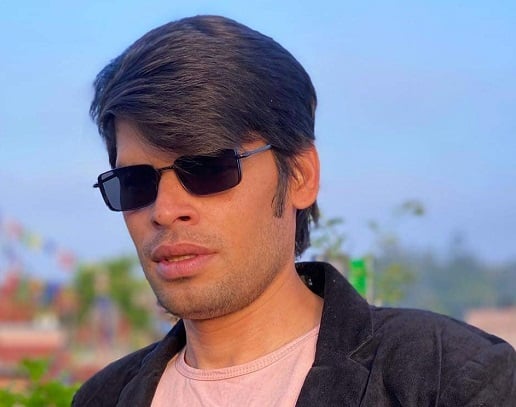

Kathmandu. The report of the investigation committee formed by the National Human Rights Commission regarding the Genji movement held on August 23 and 24 last year has put National Independent Party (NSP) Chairman Rabi Lamichhane in a difficult position.
During the Genji movement, Rabi was in Lalitpur's Nakhkhu Jail on charges of cooperative fraud and organized crime. Taking advantage of the movement, he came out of jail and addressed the crowd of supporters. As soon as Rabi came out of jail, inmates escaped from various jails across the country, including Nakhkhu.
At that time, Rabi fell into trouble as the incident of breaking out of jail came under the purview of the commission's investigation.
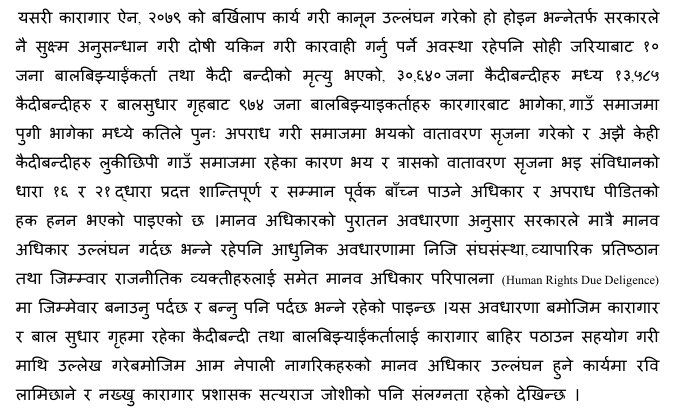
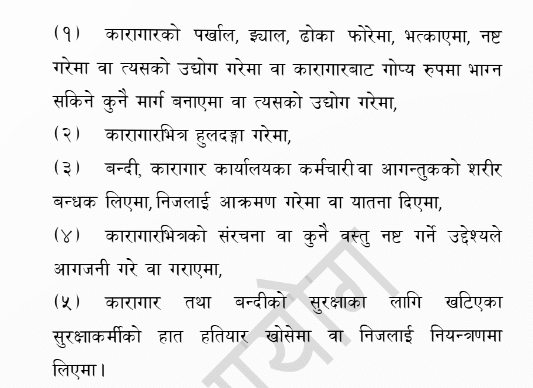
According to the report released by the commission on Wednesday, such an act is a violation of the constitutionally guaranteed rights of crime victims and is also an offense under Section 49 of the Prison Act 2079. Section 15 of the fact and analysis section of the report states that Rabi and prison administrator were involved in the violation of citizens' human rights by helping prisoners and juveniles in prisons and juvenile reform homes to be sent outside the prison.
'...It is seen that Rabi Lamichhane and Nakhkhu Prison Administrator Satyraj Joshi were also involved in the violation of the human rights of the general Nepali citizens as mentioned above by helping the prisoners and juveniles in prisons and juvenile reform homes to be sent outside the prison,' the report states.
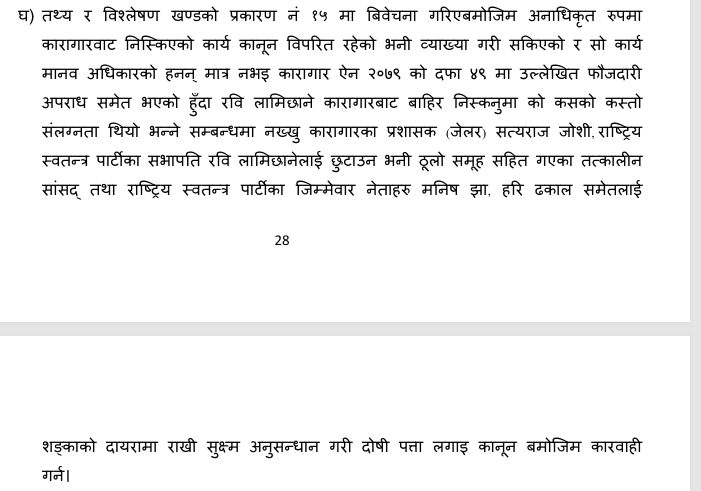
In Section 14(d) of the recommendation section, it is recommended that since the act of leaving prison unauthorized is against the law and is also a criminal offense mentioned in Section 49 of the Prison Act 2079, Rabi's spokesperson Manish Jha and Hari Dhakal, who played a role in bringing Rabi out of prison, should be brought under suspicion and investigated to identify the culprits and take legal action.
'...Since the act is not only a violation of human rights but also a criminal offense mentioned in Section 49 of the Prison Act 2079, the report states that the then Member of Parliament and responsible leader of the National Independent Party, Manish Jha, Hari Dhakal, who went with a large group to get Rabi Lamichhane out of prison, should be brought under suspicion and investigated minutely to identify the culprits and take legal action,' the report states.
The report of the constitutional commission formed by the constitution has depicted his role as suspicious, putting NSP Chairman Rabi under moral and legal pressure on the eve of the National Convention. Section 49, Sub-section 'B' of the Prison Act 2079 states that escaping from prison or attempting to escape shall be punishable by five years imprisonment or a fine of fifty thousand rupees or both.
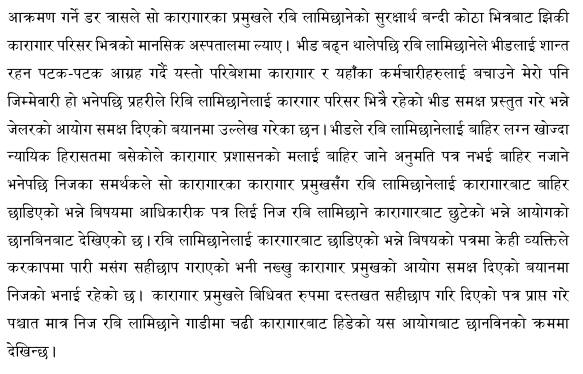
Previously, the high-level investigation commission led by former judge Gauribahadur Karki, formed by the government itself, had not implicated Rabi. That commission had acquitted him based on Rabi's own statement. The Karki commission's report also mentions that he got into the car and left prison after the prison administrator was coerced into signing.
Former Home Minister and advocate Om Prakash Aryal said that according to the commission's report, Rabi could face criminal charges. However, he said that the report would not create difficulties for him to work as the party chairman.
'He (Rabi Lamichhane) can be prosecuted under the criminal code. However, it will not be considered moral turpitude. The commission's report will not affect his work as party chairman,' Aryal said.
However, advocate and NSP MP Yagyamani Neupane claimed that the law was misinterpreted regarding Rabi. He claimed that while the commission had recommended action against former Prime Minister KP Oli, former Home Minister Ramesh Lekhak, and others, no such recommendation was made in Rabi's case.
'Being at the scene of the crime and committing a crime are different. Being at the scene of the crime means an investigation will take place, but the commission has not recommended action against Rabi sir,' Neupane said.
The commission has brought not only Chairman Rabi, spokesperson Jha, and secretariat member Dhakal but also 12 other elected MPs under the purview of the investigation. Persons mentioned in Section 30 of the fact and analysis section are recommended to be investigated and prosecuted if found guilty as per Section 10 of the recommendation section.
Other NSP MPs brought under investigation include Ganesh Karki, Sulabh Kharel, Bablu Gupta, Krishna Karki, Dr. Toshima Karki, Rajiv Khatri, KP Khanal, Deepak Bohara, Jwala Sangraula, Purushottam Yadav, Sudhan Gurung, and Ashika Tamang.
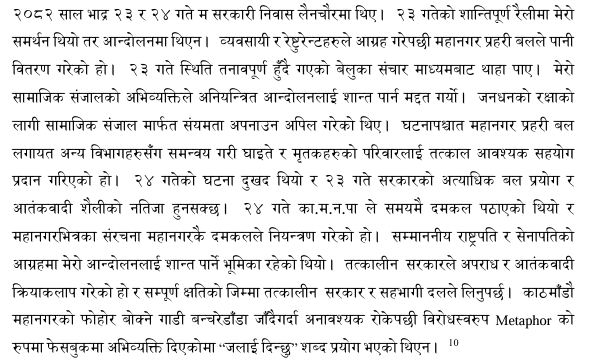
While party chairman Rabi and 15 MPs have been brought under investigation, senior leader and Prime Minister Balendra (Balen) Shah has been given a clean chit by the commission. Balen was accused of inciting Genji youths during the movement and making provocative statements on social media.
On August 24, when the state was in a state of statelessness, he called on the protesting parties to stop destructive activities and negotiate with the Nepali Army. He had set a condition that the previous parliament should be dissolved before entering into negotiations with the army. Balen was questioned by both the Human Rights Commission and the Karki Commission.
However, the fact that the party chairman is under investigation and the senior leader has received a 'clean chit' is seen as related to the power balance within the NSP. Before the election, there was an agreement that Rabi would run the party and Balen would run the government.
The first convention of the NSP has been announced to be held in Chitwan on June 7, 8, and 9. Leaders have been saying that Rabi will be unanimously made the chairman at the convention.
Balen is leading the government with a nearly two-thirds majority on the strength of the Genji movement. Before the election, Rabi and Balen had agreed that Rabi would lead the party and Balen would lead the government.
However, as the Human Rights Commission's report has opened the way to take action against Rabi, there is a natural suspicion that Balen will now dominate both party power and state power.
Political analyst Mumaram Khanal, however, considers this a mere coincidence. 'This might just be a coincidence. It doesn't seem like Balen is misusing power to capture party power,' he said. 'Balen does not appear to be directly involved in all the incidents. The question is why the metropolis did not send a fire engine. He is also a person who speaks less at that time. Such statements have not been heard. He may have been acquitted because there was no evidence of involvement.'
Khanal said that Rabi being under investigation in the commission's report could be a cause for concern.
He said, 'The commission's job is to recommend investigation and action against those involved in the crime. It is unlikely that action would be recommended without any basis. Coming out of jail is also a violation of human rights. It falls under criminal offense.'
However, Khanal said that although the report may not have a major impact, it could lead to restrictions on foreign travel.
Advocate Yagyamani Neupane accused the report of being exaggerated to create a rift between Rabi and Balen. 'Balen Shah has not given any instructions anywhere, nor has he asked to protest. No party has given a statement about his involvement. When his name is not mentioned, some people think that the party and the government will not agree. They will not agree. They want to spread rumors that they will attack each other,' he said. 'Even when they are seen together, one interpretation is made, and when they are not seen, another interpretation is made. All this is just exaggeration.'
This specific news has been automatically translated by AI. As a result, there may be some inaccuracies or language errors.