Financial Irregularities Increasing in Bagmati Province


Hetauda. Financial indiscipline in Bagmati Province is increasing year after year due to the lack of financial discipline.
According to the report recently published by the Office of the Auditor General, the financial discipline of the Bagmati Province government has been seen to be weakening.
The report of the Office of the Auditor General mentions that billions of rupees have been found as irregularities in various government bodies and local levels of the province in the audit of the fiscal year 2081/082.
In the fiscal year 2081/082, a total of 83 billion 15 crore 63 lakh 78 thousand rupees of 209 government bodies and committees of the province were audited. Of this, 69 crore 37 lakh 94 thousand rupees were found as irregularities. The Auditor General mentioned in the report that the irregularities accounted for 0.83 percent of the total audited amount. With the remaining irregularities from last year and the newly added irregularities, the updated (total remaining) irregularities of Bagmati Province have reached 5 billion 28 crore 6 lakh 94 thousand rupees, the report states.
According to the report of the Auditor General, the largest portion of the established irregularities needs to be regularized. Out of the total irregularities, 45 crore 1 lakh 85 thousand (64.89 percent) irregularities need to be regularized, while 4 crore 39 lakh 82 thousand (6.34 percent) irregularities need to be recovered. 19 crore 96 lakh 27 thousand (28.77 percent) irregularities are pending advances.
Among the provincial government ministries, the Ministry of Physical Infrastructure Development has the highest irregularities.
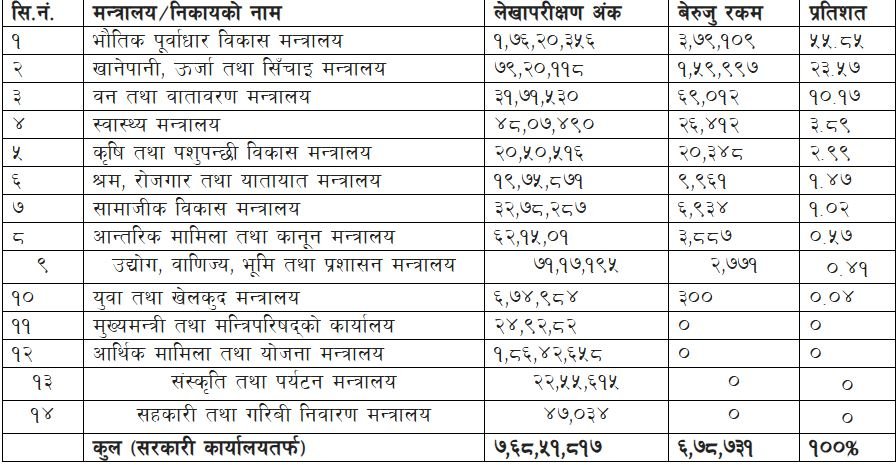
Out of the total government office irregularities of 67 crore 87 lakh, the ministry alone has 37 crore 91 lakh 9 thousand rupees (55.85 percent) of irregularities. The Ministry of Water Supply, Energy and Irrigation has 15 crore 99 lakh 97 thousand (23.57 percent), the Ministry of Forests and Environment has 6 crore 90 lakh 12 thousand (10.17 percent), and the Ministry of Health has 2 crore 64 lakh 12 thousand rupees in irregularities.
Details of Ministry-wise Irregularities (Amount in Thousands)
Irregularities Becoming Dire in Local Levels
Auditing of 11 local levels under Bagmati Province shows a higher rate of irregularities than the provincial government. Out of a total audit of 2 kharba 45 billion 32 crore of local levels, 3 billion 18 crore 57 lakh 24 thousand rupees (1.29 percent) were found as irregularities.
According to the report of the Auditor General, among the local levels with the highest percentage of irregularities are the rural municipalities of Sindhuli, with Tinpatan Rural Municipality having the highest irregularity rate of 4.75 percent. Out of Tinpatan's 1 billion 93 crore audit, 9 crore 19 lakh irregularities were found. Similarly, Hariharpurgadhi Rural Municipality has 4.60 percent irregularities. Out of Hariharpur's 1 billion 44 crore audit, 6 crore 64 lakh irregularities were found, while Indrasarovar Rural Municipality of Makwanpur has 3.79 percent irregularities.
Tarakeshwar Municipality of Kathmandu has 3.60 percent irregularities, while Golanjor Rural Municipality of Sindhuli has 3.54 percent irregularities.
Kathmandu Metropolitan City has 61 crore 97 lakh (2.19 percent) irregularities in its audit of 28 billion 29 crore, while Lalitpur Metropolitan City has 4 crore 68 lakh (0.44 percent) irregularities in its audit of 10 billion 67 crore. Hetauda Sub-Metropolitan City has 6 crore 49 lakh (1.17 percent) irregularities in its audit of 5 billion 57 crore.
Why are Irregularities Increasing?
According to the report of the Auditor General, irregularities in the province and local levels are increasing due to the tendency to procure directly without adhering to the Public Procurement Act and regulations. Although the province has a policy not to implement projects less than 1 crore, the report mentions that budgets are still being scattered on small and fragmented projects.
The report states that irregularities are increasing due to ministries not preparing and implementing internal control systems, lack of effective monitoring of grants and projects, and the tendency to transfer and freeze large amounts of budget at the end of the year.
Specifically, bodies operating development projects such as physical infrastructure and water supply need to control procurement done without competition, expenses without bills and receipts, and increasing advances.
This specific news has been automatically translated by AI. As a result, there may be some inaccuracies or language errors.