Diplomatic Shift: Nepal's New Government Rethinks Foreign Policy Amidst Global Changes


Kathmandu. Foreign Minister Shishir Khanal has created a new stir in the diplomatic arena by stating that diplomatic changes are necessary to face the challenges posed by the rapid changes in global geopolitics, climate crisis, and technological development.
Addressing the Foreign Service Day on Jestha 10, Minister Khanal emphasized the need to reform the foreign service in a timely manner and focus on economic diplomacy. This statement by Minister Khanal makes it clear that the government is keen on changing its foreign policy.
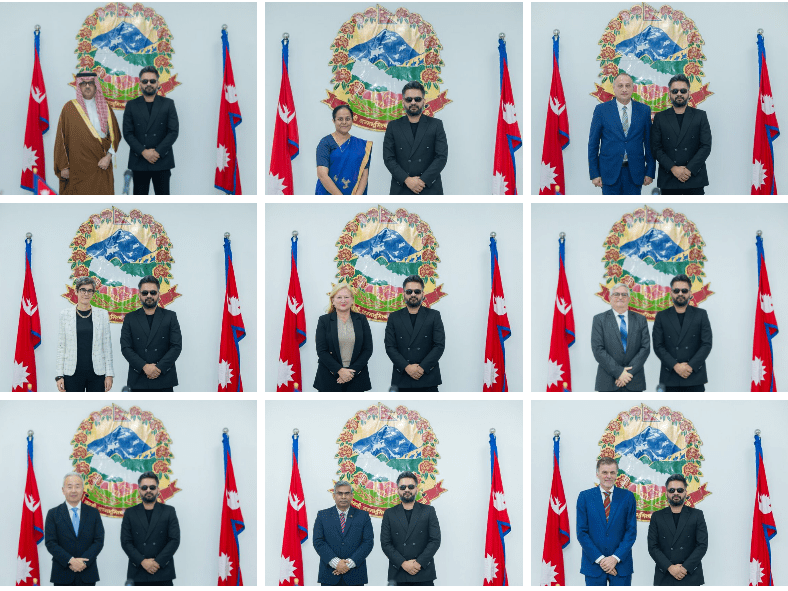
Two months have passed since the formation of the government led by Balendra (Balen) Shah, but the Prime Minister has not had a one-on-one meeting with any diplomat. He has also not met diplomats visiting Nepal from various countries. Not only this, but there is also an undeclared ban on foreign trips by ministers and members of parliament.
Unlike in past governments, MPs, leaders, and ministers are not currently traveling abroad. It is said that the foreign trips are being controlled on the instructions of Prime Minister Balen himself.
_JCAkdZIw7U.jpg)
In the past, ministers, diplomatic officials, and MPs visiting Nepal from various countries used to visit leaders of all political parties at their homes. This tradition has now been broken.
Not only this, but 17 Nepali embassies abroad are without ambassadors. The government has suspended honorary consuls general. The Ministry of Foreign Affairs is working on reducing the number of Nepali missions abroad. These activities indicate that Prime Minister Balen has made a new beginning by breaking past diplomatic traditions. Accordingly, it is said that the Ministry of Foreign Affairs is moving forward with the idea of changing the foreign policy.
A high-ranking official from the Ministry of Foreign Affairs said, 'Since Balen became Prime Minister, many past traditions have been broken, which is a new and good sign in the diplomatic field. To do something new, old things must be broken.' He also said that work is being done to restructure the Ministry of Foreign Affairs.
Prime Minister Balen held a collective discussion with ambassadors from various countries on Chaitra 24. On Jestha 12, he held a joint meeting with non-resident ambassadors and mission chiefs from European Union (EU) member states. Apart from this, he has not met any diplomats.
Some have criticized Prime Minister Balen's actions. They argue that diplomatic relations are necessary even for daily work, and for a developing country like Nepal, diplomatic relations should be strengthened.
Sources say that Prime Minister Balen has refused to meet high-level diplomats visiting from abroad due to his protocol.
Former Foreign Minister and Nepali Congress leader NP Saud said that protocol is not everything in diplomacy. He said, 'Sometimes, for the benefit of the country, protocol has to be broken.'
Former Minister Saud clearly stated that the lack of high-level dialogue with the two neighboring countries and other major powerful nations in recent times is not in the country's interest. He said that restricting meetings based on protocol is not beneficial for the country.
He said that some matters in diplomacy are handled only at the Prime Minister's level. He added that while it is not necessary to meet everyone, in some situations, meetings should be held by breaking protocol in consideration of the country's interests. He clarified that a prolonged period of communication breakdown with neighboring countries would have long-term consequences.
Representatives from these countries could not meet the Prime Minister
Recently, representatives from countries including the United States, China, and the UK visited Nepal as representatives of their respective governments. These representatives from countries visiting Nepal could not meet Prime Minister Balen. However, they met with Foreign Minister Khanal and Finance Minister Swarnim Wagle, among others.
On Jestha 16, US Deputy Assistant Secretary of State for Public Diplomacy, Sarah B. Rogers, is scheduled to arrive in Nepal for a three-day visit. Although she also expressed a desire to meet Prime Minister Balen, a time has not yet been set.
Foreign Ministry Secretary Vikram Misri from India was scheduled to visit Nepal. However, it is reported that the visit was postponed after Prime Minister Balen refused to meet him. Secretary Misri was coming to Nepal to extend an invitation to Prime Minister Balen to visit India on behalf of Indian Prime Minister Narendra Modi. However, it is reported that his visit was postponed after Prime Minister Balen refused to meet him. However, neither Nepal nor India has officially commented on the postponement of the visit. Instead, both countries have stated that the visit will take place at an appropriate time.
_I0r9DcUNWN.jpg)
Dr. Mrigendra Karki, Executive Director of the Center for Nepal and Asian Studies at Tribhuvan University, said that diplomatic relations or other relations are determined based on the respective capabilities of the countries.
Stating that it is important to understand on what basis Nepal has done this, he said that Prime Minister Balen's reluctance to communicate with diplomats has not sent a good message. He said, 'Prime Minister Balen must now break the communication blackout.'
Questioning whether communication breakdown increases or decreases capability, he clarified that how the US shapes its foreign policy depends on its capabilities. He said, 'How India shapes its foreign policy depends on its capabilities. Similarly, Nepal's foreign policy depends on its capabilities. Nepal's capability to not communicate at all has not yet been established.'
Government's Commitment
The government's 19-point commitment paper, released on Jestha 1, also signals a change in foreign policy.
The commitment paper states, 'While prioritizing Nepal's sovereignty, territorial integrity, and national interests, a balanced and dynamic diplomacy will be adopted to transform the changing global geopolitics and the rise of neighboring powers into opportunities for Nepal's development. A scientific performance audit system will be implemented to measure the performance and effectiveness of Nepal's diplomatic missions.'
The commitment paper aims to promote national interests by transforming Nepal into a 'buffer state' and 'vibrant bridge' while protecting Nepal's sovereignty and national interests, through trilateral economic partnership and connectivity. It is mentioned that Nepal will be established as an independent, neutral, peace-loving, and non-aligned nation in the international arena.
Stating that military alliances, arms races, and wars hinder peace, the commitment paper says that a policy of maintaining equal distance and balanced proximity with all will be adopted. The government has already indicated in the commitment paper what kind of foreign policy it intends to formulate.
'Since it is a new government, there is no compulsion to adhere to old norms,' said Dr. Kalyanraj Sharma, an expert on Nepal-China relations. 'The government has been in office for two months. Let's give it time to work. Let's wait and see for some time. Prime Minister Balen has brought some changes in his style of working in the diplomatic field, which does not seem bad. We have to wait for the results now. It is not time to criticize yet.'
He said that the current government appears to be focused on work. He clarified that it seems unwilling to get bogged down in trivial matters and that it appears to be trying to do something new, which is why it seems unusual.
This specific news has been automatically translated by AI. As a result, there may be some inaccuracies or language errors.