Human Rights Commission Report Omits Key Incidents from 'GenZ' Protests

Kathmandu. The investigation report on human rights violations during the 'GenZ' movement, made public by the National Human Rights Commission on Wednesday, appears to have omitted a review of some serious and prominent incidents. The commission's report remains silent on the assault on Nepali Congress's then-President Sher Bahadur Deuba at his Budhanilkantha residence on Bhadra 24, the role of Balendra (Balen) Shah, then-Mayor of Kathmandu Metropolitan City (currently Prime Minister), and the inactivity of the Nepali Army despite the destruction of public and private property.
_Fn0KWds4W6.jpg)
The 29-page report, while holding the then political leadership primarily responsible, exhibits a peculiar silence regarding the controversial roles of key figures and prominent events of that time. Some have raised questions, citing these three prominent incidents as being overshadowed in the report.
The report does not mention the incident on Bhadra 24, where protestors entered the residence of then-Congress President Deuba in Budhanilkantha and physically assaulted Deuba and his wife, Dr. Arzu Rana Deuba (then Minister of Foreign Affairs). The report merely states in point number 13 that 'protestors entered the private residences of political party leaders and cadres, causing assault and arson.' The serious physical assault on the former Prime Minister and the president of the largest party in the House of Representatives at that time, and the 'beating' he received, is not detailed.
Congress General Secretary Pradip Paudel stated that the Human Rights Commission's report does not cover all issues. 'Not all issues have been covered. Many events that have now been made public are still not covered by this report. There is still no basis to say that it was completely impartial and the report is complete,' General Secretary Paudel told Ratopati. 'Arguments can also be presented that it is incomplete, does not cover all events, and is biased in some places.'
When asked if the report also did not mention the then-Congress President, General Secretary Paudel said, 'It should have been included, it was not. Many other issues are not included.'
The report specifically recommends investigation into many leaders of the then ruling party and the main opposition. However, the report is entirely silent on the role of Balendra (Balen) Shah, who was the Mayor of Kathmandu at that time and is currently the Prime Minister. Although Balen was at the center of the movement, the report raises no questions about his accountability in managing the movement, the deployment of security mechanisms, and the political situation at the time, which political observers have described as 'mysterious.'
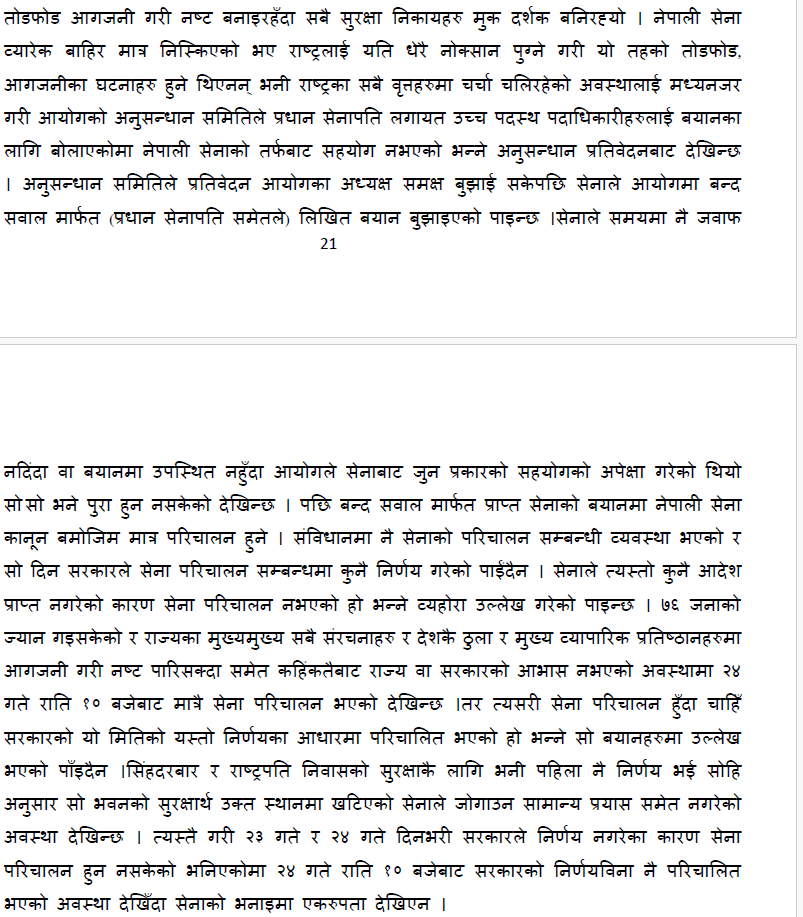
Instead of questioning why the Nepali Army did not come out of its barracks in time despite the violent demonstrations that resulted in the deaths of 76 people, the commission's report defends the army. Pages 21 and 22 of the report mention that the army did not cooperate, citing a lack of government orders. Although high-ranking officials, including the Chief of Army Staff, initially refused to appear for statements when summoned by the commission's investigation committee, they later sent written responses, appearing to evade the issue by stating 'there was no government order.' However, the report makes no recommendations to bring the army's highest command under the purview of action. The report does point out the army's failure to protect highly sensitive state areas (Singha Durbar, Shital Niwas). The commission appears to have interpreted the army's actions not as a serious human rights violation but as a normal 'lack of coordination.'
The commission released its 29-page investigation report on the 'GenZ' movement, which occurred on Bhadra 23 and 24, 2082, on Wednesday. The report states that 42 people died in Kathmandu and 5 in Sunsari-Jhapa due to security forces' gunfire during the Bhadra 23 and 24 protests, totaling 47 deaths. The report also includes the deaths of 19 more people due to arson on Bhadra 24.
Human rights activist Charan Prasai says that many issues are missing from the commission's report. He stated that the report has significant shortcomings.
'The report appears lenient towards the army. The assault on the Deuba couple is omitted,' human rights activist Prasai told Ratopati. 'Everyone knows about the role of Balen, who was the Mayor of Kathmandu Metropolitan City at the time. His name was not mentioned even in the background of the report.'
Prasai said that the government could conduct further investigations based on the report. 'The commission's recommendations must be implemented. There are shortcomings in the report. The government should conduct further investigations based on the report and bring those left out into the purview of action,' he said. 'The government can conduct further investigations.'
When asked if Prime Minister Balen could also be investigated in the government's investigation, Prasai said, 'If a mistake has been made, there is no immunity based on holding a position. The constitution considers everyone equal based on law. If the government investigates, it does not mean Balen will be kept out just because he is the Prime Minister.'
This specific news has been automatically translated by AI. As a result, there may be some inaccuracies or language errors.