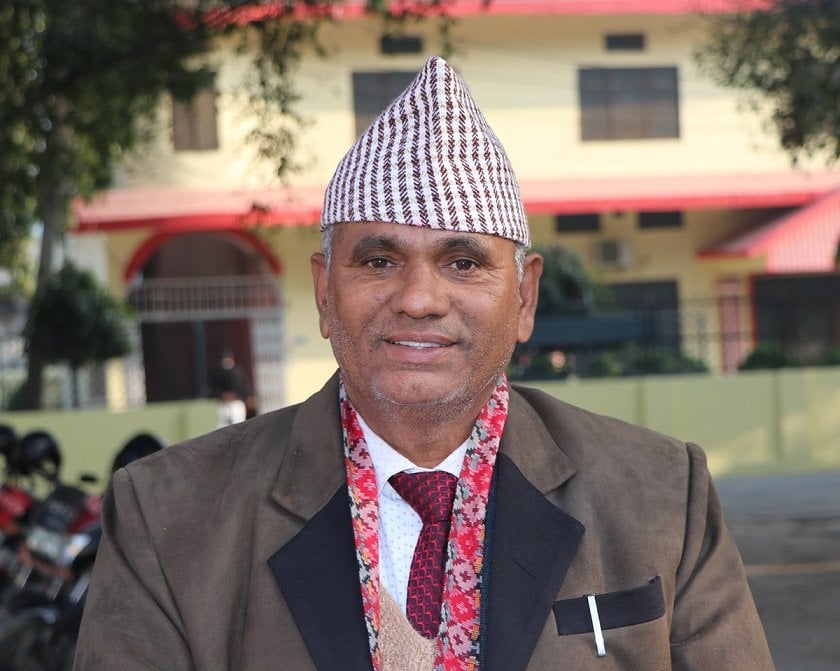
Rastriya Swatantra Party MP Prakashchandra Pariyar Discusses Social Justice and Republic


Kathmandu. Rastriya Swatantra Party (RSP) MP and ruling party chief whip Prakashchandra Pariyar has stated that he entered politics for social justice and human equality. His experience is that the entire Dalit community of the country faces the same suffering as he has, having endured the grip of caste discrimination and state oppression for a long time. Additionally, Chief Whip Pariyar has the pain of losing family members to bring a republic to the country.
While being interviewed by RSS focusing on the Republic Day to be celebrated on Jestha 15, he recounted the sad incident of losing his brother Dayaram Pariyar at the age of 22 in the indiscriminate firing by the state during the People's Movement of 2062-063. Pariyar says that he started his political journey with this pain after that People's Movement. The continuation of that journey has now brought him to the position of MP and chief whip of the Rastriya Swatantra Party. Pariyar, who has already established himself as a popular journalist, is an advocate for an egalitarian inclusive state.
Pariyar, who used to voice his concerns for an inclusive state through journalism, is now a member of the legislature that makes laws. Currently holding the responsibility of MP and chief whip of the Rastriya Swatantra Party (RSP), he stated that the republic came to Nepal due to the country's needs and the people's desires. Here is an edited excerpt of the conversation held with RSS correspondent Madhu Shahi about the past, present, and future prospects of republican Nepal.
How do you recall the political changes from the restoration of democracy to the democratic republic in Nepal?
I believe the foundation of the democratic republic was laid with the end of the 104-year autocratic Rana regime. The Congress party founder BP Koirala led the revolution of 2007 to lead Nepal and Nepalis into an open society through a democratic system. At that time, the issue of the people of Nepal being able to write their constitution through representatives they elected was raised. In time, the then king and the palace thwarted this. The autocratic rule of the monarchy for a long time had, in a way, stifled the state power itself. That rule never allowed the people's rights and meritocracy to flourish from that time onwards. As a result, Nepali society and the people were in a state of suffocation. Only in a democratic republic is there a system that opens the door for the possibility of even the son of a common person to become the 'Head of State'. The practice of only individuals from a certain caste or family being the Head of State has ended. The Nepali people, tired of extreme discrimination, oppression, and exploitation, felt the need to choose their own governance system and process. Consequently, the republic emerged. That republican governance system and form are now providing other rights of the people, including ethnic rights, in the country. Among governance systems, the democratic republic is the most unparalleled system to date.
As you mentioned, the country now has a democratic republican governance system. How effectively do you think it has worked for the people?
Democracy and republic have opened a golden opportunity for the people to become rulers of the people. In a country like Nepal, which is multi-ethnic, multi-lingual, multi-cultural, and full of diversity, the people have gained the right to build a country according to their own colors. As a result, Ram Baran Yadav, a son from the Madhes, had the opportunity to become the first President. Bidya Devi Bhandari from Bhojpur became the second President and the first female President of Nepal. Even now, the son of the people, Ram Chandra Poudel from Tanahu, is the President. All these opportunities have been opened by democracy and the republican governance system. This is a positive aspect, and it means that the power of the state is in the hands of the people. This is also the beautiful aspect of democracy.
Speaking of the republic, how do you see the Nepali people engaging in the struggle for the establishment of the republic?
I have already briefly mentioned that the voice for a republic in Nepal arose from 2007. That voice progressed peacefully and in phases. The people's desire and plan for the establishment of the republic moved forward through various stages, including movements, people's revolutions, and rebellions. Specifically, the armed rebellion by the then Maoists in 2052 and the People's Movement of 2062-063, where seven parties and Nepali civil society directly participated, saw the Nepali people struggle for the republic. The reason for that rebellion was that the then-centralized Shah monarchy did not promote Nepal's diversity, did not embrace Nepal's constitution, and did not protect and promote the supremacy of the citizen and equality, which created extreme dissatisfaction. It was a dictatorial rule where only those born into a certain family could be the head of state. The people raised their voices against such rule and the exploitation it caused and felt the need to become their own rulers. Ultimately, this voice gained strength, received the support of all the people, and the republic was established in the country.
How do you interpret the achievements gained by the people and the country after the establishment of the democratic republic?
In my opinion, the Nepali people have lost nothing after the advent of the republic. On the contrary, it would not be wrong to say they have gained a lot. The most important thing is that the republic has paved the highway of egalitarian prosperity. It has awakened a sense of ownership towards the nation in individuals of any caste, community, class, gender, or religion, sect, and community. The republican journey of Nepal has defeated the negative thinking and tendency that only citizens of a particular caste, religion, language, community, culture, or specific family can embark on the journey of prosperity. We raised our voices against such thinking, behavior, and tendencies, and we ourselves engaged in the struggle. This campaign has also proven the fact that all citizens, as well as the general public, are the architects of the nation's destiny and future, and the state power and authority of the country lie and will lie in their hands. This is also an achievement of the republic. Therefore, emphasizing an egalitarian inclusive state structure is the strong aspect of the republican governance system. This is also the core meaning and spirit of the republic.
How do you evaluate Nepal's republican governance system after the Gen Z movement?
The republic is a means, not an end. How one understands this system depends on an individual's perspective. However, among governance systems, democracy holds great importance. The republic is a governance system that believes in the rule of law, the rule of procedure, and an equal judicial system. Among these, the democratic republic is an even more specific form. We need to explain this democratic republican governance system, which carries such a proud meaning, to the people in their homes, to the youth generation, and even to future generations. It is necessary to reflect the values and principles of the republic in the curriculum, films, literature, songs, music, and culture through relevant activities. Therefore, if we talk about alternatives to the republic, I believe the alternative is also the republic.
How can the current government's working style be considered a governance style in line with the republican system?
The current government is a government formed by embracing the Constitution of Nepal 2072. The fact that the Gen Z movement was born from the consciousness of young people who felt the need to dismantle the foundation of years of mismanagement and distortion is clear to everyone. Youth shed blood during the movement. We have seen the Nepali people carry out an unprecedented 'vote revolution' in history. It is under the leadership of the RSP that the government is currently in power due to that vote revolution. The people have great faith in this government. Immediately after taking the oath of office, this government has been striving for programs that deliver results. And, the current government is positive in addressing some constitutional obstacles or responding to the questions raised by the Nepali people. However, the government is also in the process of making this republic's values and principles more result-oriented and impactful in a phased manner. Therefore, there is no reason to distrust the government's republican working style, nor has any been observed.
The republic was achieved through the great struggle and sacrifice of the Nepali people. What should political parties do in the coming days to make this system more result-oriented and in favor of the people?
The republic is not just a state governance system or method in itself, but it is also a democratic culture. This is a governance system that has come after a long struggle and wait by the Nepali people. The Nepali people, political parties, and leaders are making efforts to promote and advance the democratic republic. The current government is emphasizing good governance, which is considered the fundamental basis of the republic. The demand put forward by Gen Z youth in the form of a movement last August was also for good governance and 'delivery'. The government is engaged in both these tasks, and the results are being seen one after another. The government is making efforts to achieve timely and people-oriented development and to ensure no compromise on good governance and transparency. The government is committed to purifying the state structure and culture that have been spoiled by mismanagement and to work for the benefit of the people. Since the transformation of Nepali society that was envisioned in the past has not been achieved by the republic, the current government is moving forward in accordance with the people's demands and the core meaning and spirit of the republic. Therefore, to make this system more result-oriented and in favor of the people in the coming days, all political parties must provide support and cooperation to the government.
This specific news has been automatically translated by AI. As a result, there may be some inaccuracies or language errors.