Government Prioritizes Electricity Transmission Infrastructure Development


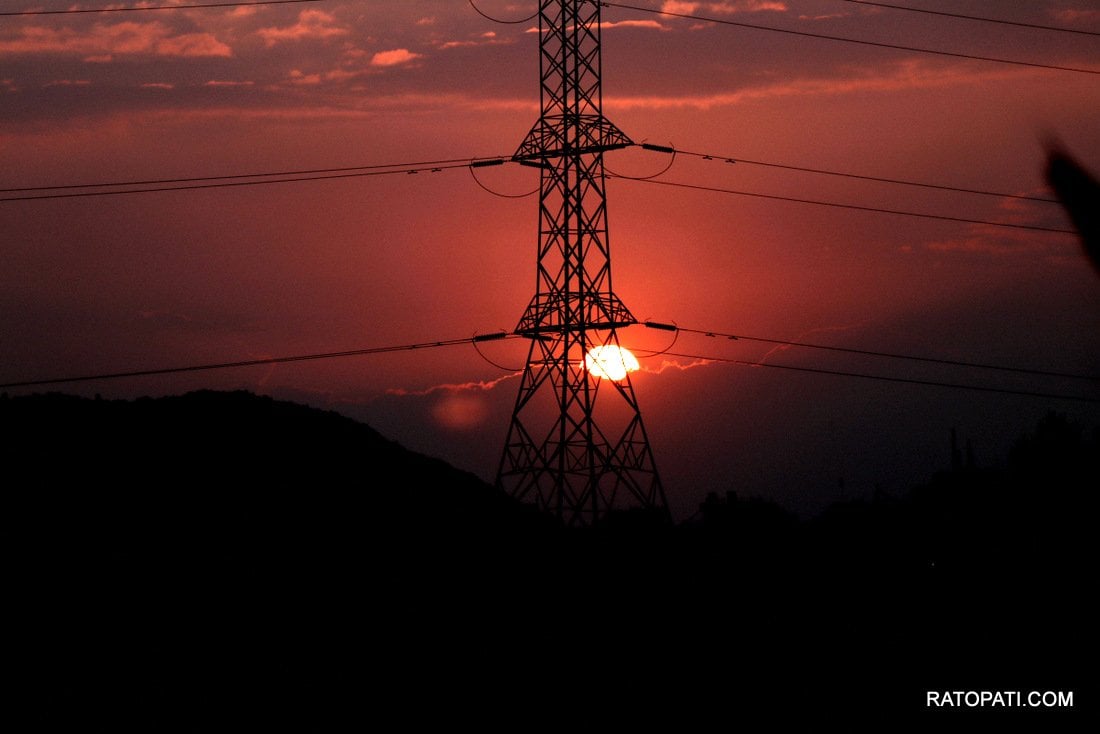
Kathmandu. The government has given high priority to the construction of transmission lines along with electricity generation. With an ambitious goal of generating 30,000 megawatts of electricity in 10 years, the government has put forward a new transmission 'blueprint'.
In the past, due to focusing only on electricity generation, there have been instances where generated electricity goes to waste due to lack of transmission infrastructure. However, the current government is set to revise the previous policy.
Previously, the government had put forward an energy roadmap to generate 28,500 megawatts of electricity by 2035. However, the current government has revised the roadmap and increased the target by an additional 1500 megawatts.
That is, an ambitious goal has been set to generate 30,000 megawatts of electricity within the next 10 years. To achieve this goal and deliver the generated electricity to the market, the government has made transmission line construction its main agenda.
Since taking charge of the ministry, Minister for Energy, Water Resources and Irrigation, Biraj Bhakta Shrestha, has expedited the construction of transmission line projects that have been stalled for a long time and are in a dilapidated state.
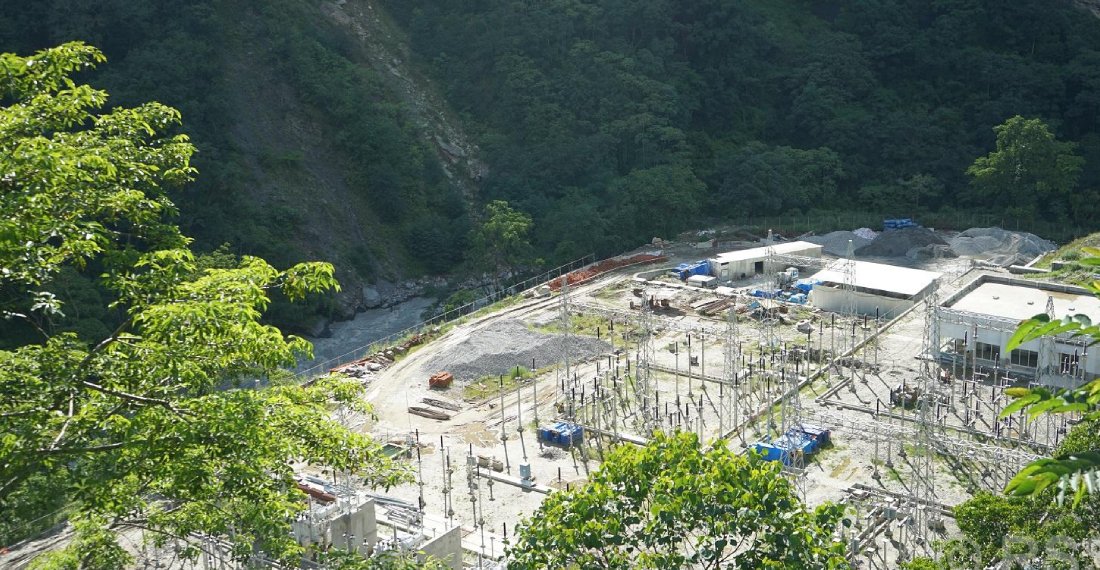
The construction process of the GIS substation in Balkumari, Lalitpur, which has been obstructed for a long time, has moved forward, and the land acquisition process has been completed.
Similarly, the work of erecting towers on the western section of the Hetauda-Dhalkebar 400 KV transmission line, which has been obstructed for years, has also progressed. Construction of this transmission line, which started in 2012, had 14 towers unbuilt in the Hetauda's Hatiya area due to local obstruction.
The government, which has now given high priority to transmission infrastructure, which was constrained by budget shortages, has also released the 'Energy Consumption Growth and Export Strategy, 2083'.
According to Minister Shrestha, infrastructure is essential not only for hydropower generation but also for consumption and export, which is why the government has been actively pursuing stalled projects.
'Accordingly, construction of stalled transmission line projects in various areas has been resumed,' said Minister Shrestha.
- Budget as requested
The biggest hurdle in electricity infrastructure construction was budget and resource assurance. However, the Ministry of Finance has stated that an effort will be made to overcome this in the upcoming budget.

Minister of Finance, Dr. Swarnim Wagle, clarified that the government has given high priority to transmission line construction. He stated that the government's policy is to complete projects that have been pending for a long time.
'In the past, there was a tendency to spread the budget thinly without completing projects. But this time, we have allocated sufficient funds to complete projects where 70 to 80 percent of the work is already done,' said Finance Minister Dr. Wagle.
He said that 11 transmission lines have been identified this year, and the government has prioritized the budget for these projects.

He said that budget will be allocated with a clear goal of completing transmission lines on time, similar to drinking water and irrigation projects.
According to Sarita Dwadi, Secretary at the Ministry of Energy, Water Resources and Irrigation, initially, the budget ceiling for the Nepal Electricity Authority was only 32.42 billion rupees. However, as the budget was insufficient to advance transformative projects like transmission lines, the Authority's budget has now reached 63.88 billion rupees.
Similarly, Secretary Dwadi informed that the budget for the National Transmission Grid Company, established specifically for transmission line construction, was initially only 180 million rupees, but after special efforts, 3 billion rupees have been added.
_0qMjEzKwLg.jpg)
- Electricity Consumption: Half Domestically, Half Abroad
Nearly a decade after the end of load shedding, Nepal's hydropower generation capacity has reached 4,200 megawatts. In addition, projects with a capacity of about 5,600 megawatts are under construction. This means that a generation target of about 10,000 megawatts is already secured under the current circumstances.
The 10-year strategic roadmap prepared by the Ministry of Energy aims to reach a total installed capacity of 30,000 megawatts by 2035.
To manage this electricity, the government has adopted a clear domestic consumption and export strategy. According to the strategy, 15,000 megawatts of electricity will be exported to neighboring countries (India and Bangladesh), and the remaining 13,000 will be consumed domestically.
To transmit this vast amount of electricity, the government is preparing to complete more than two dozen high-capacity domestic and cross-border transmission lines across the country within the next 10 years.
_jZIehS7HiU.jpg)
In the fiscal year 2080/81, Nepal exported 1.9426 billion units of electricity to India, earning 16.9326 billion rupees.
Nepal has successfully transitioned from being a net electricity importer to a net electricity exporter for the first time. Nepal is now on its way to becoming a major energy exporter, a 'powerhouse', in South Asia.
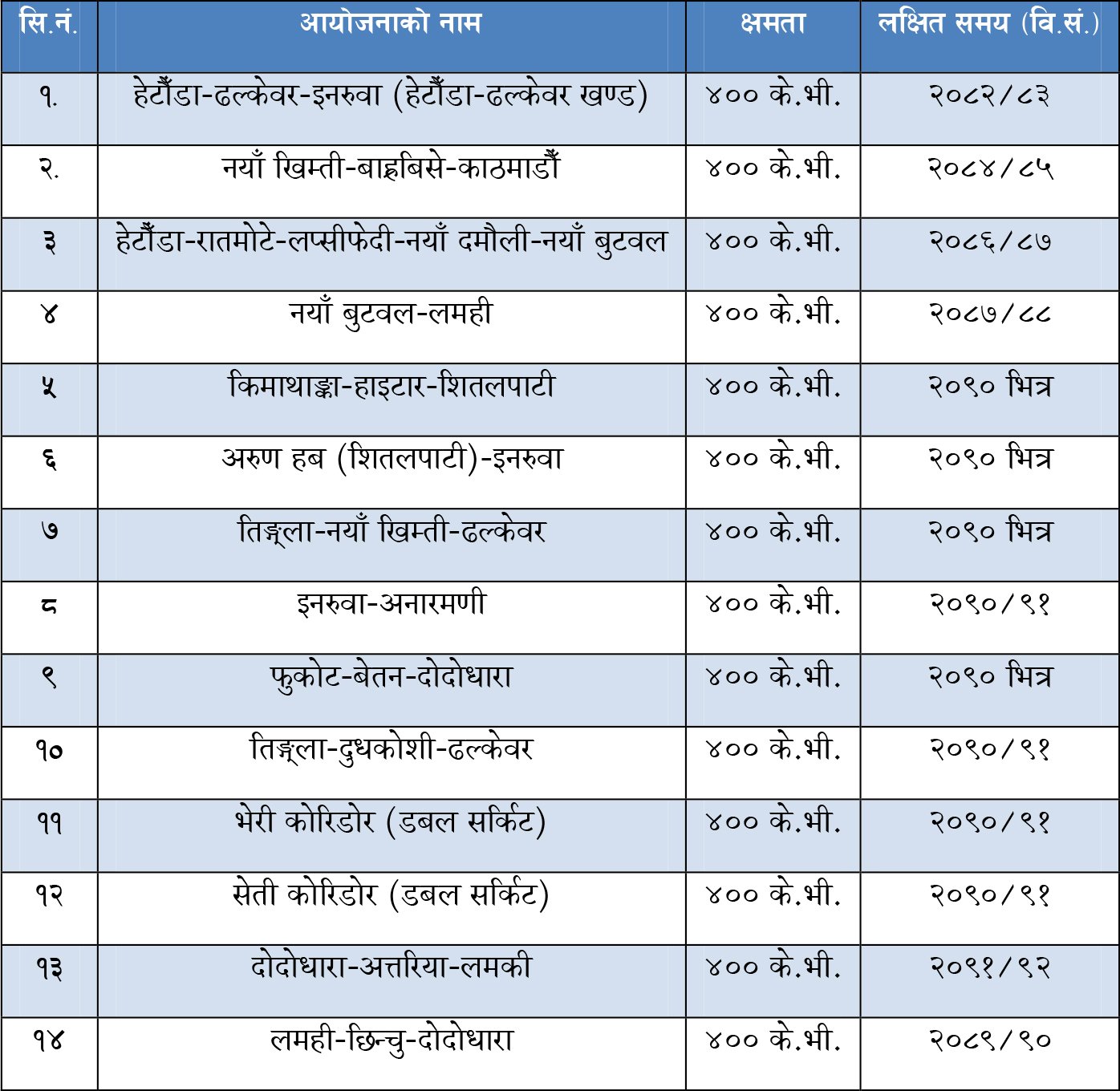
The government has proposed about a dozen and a half 400 KV capacity projects to transmit electricity generated across the country to industrial corridors and distribution centers.
- These are the projects:
As announced by the Finance Minister, the government will allocate about 10 billion rupees this year to complete the 11 projects that have reached the final stage. These 11 projects, targeted for completion within the current fiscal year, are as follows.
Electricity Trade and Cross-Border Transmission Lines
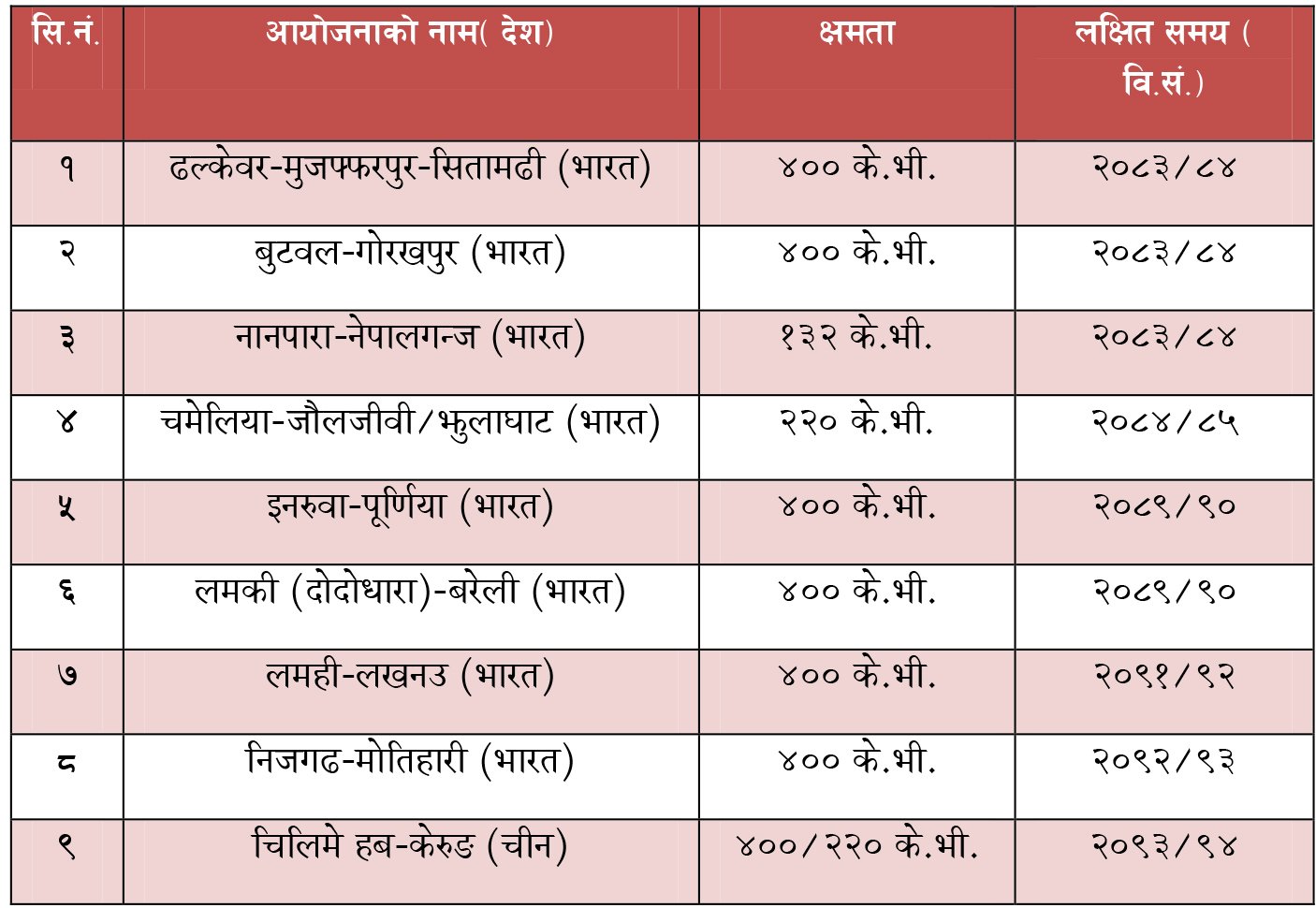
According to Secretary Dwadi, the government is focusing on cross-border infrastructure to increase domestic consumption and sell surplus electricity in the regional market. A recent meeting of the technical teams (JTT) of Nepal and India held in India has further accelerated this.
Cross-Border Transmission Line Projects
- 11 Projects to be Completed in the Upcoming Fiscal Year, Budget of 10 Billion
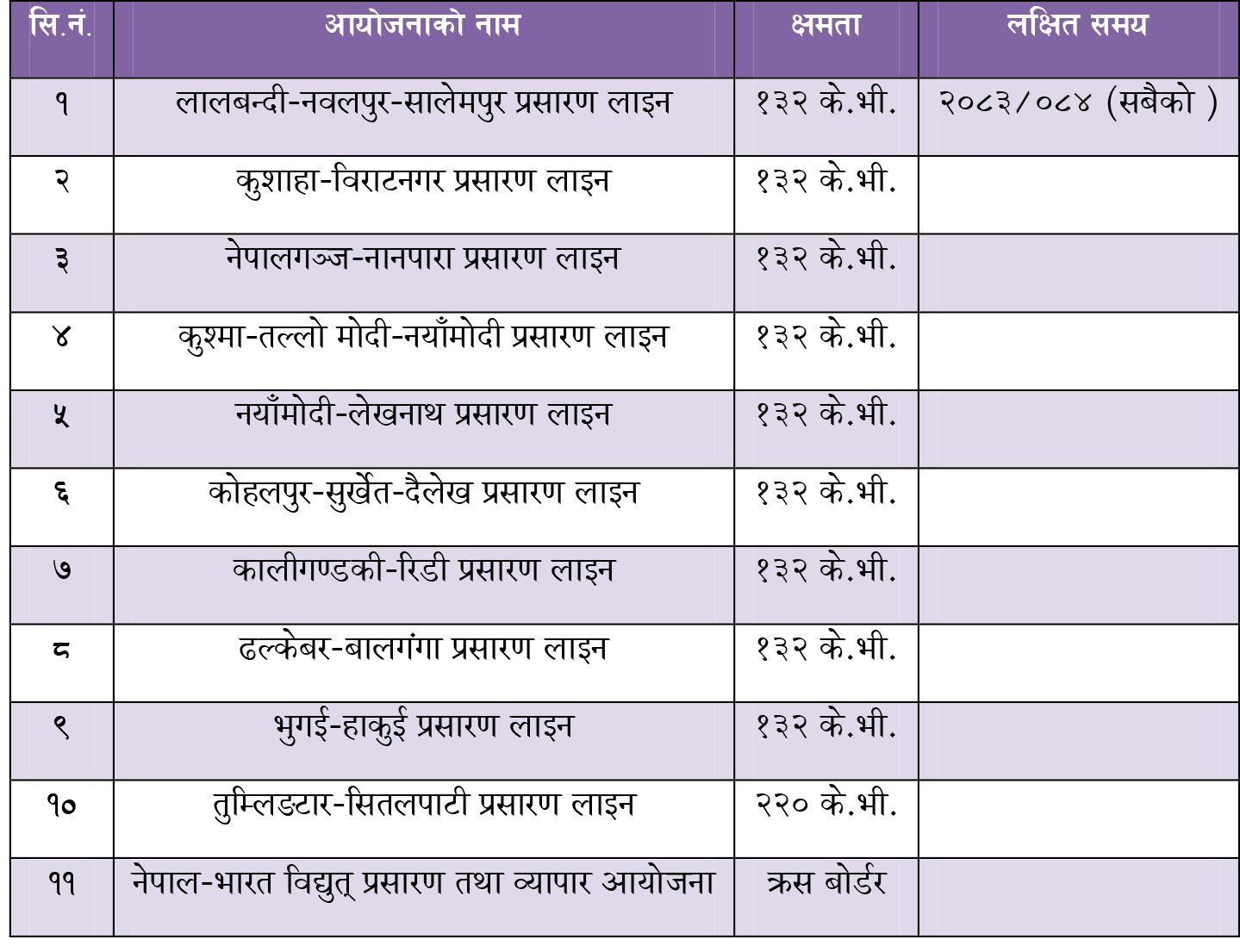
As announced by the Finance Minister, the government will allocate about 10 billion rupees this year to complete the projects that have reached the final stage. Finance Minister Wagle is preparing to advance 11 projects as a major priority in the budget for the upcoming fiscal year.
In addition to these 11 projects, the government is also planning to implement programs for urban beautification, underground cable management, AI, and smart grid modernization under the Ministry of Physical Infrastructure and the Prime Minister's Office.
11 Projects Targeted for Completion Within the Current Fiscal Year
- 11 Projects Worth 113 Billion Moving Forward from the Grid Company
The National Transmission Grid Company is developing 11 main transmission line projects in various phases, considering future electricity demand and exports. Among these, 3 are under construction, 4 are in PPP (Public-Private Partnership) model, and 4 are under study.
Upon completion of these projects, over 1500 circuit kilometers of lines will be added, with a capacity to transmit over 13,000 megawatts of electricity. An investment of over 113 billion rupees is estimated for this.
Among the under-construction projects, the Karnali Corridor (400 KV), which is 85 km long, has achieved 20% financial progress and 25% physical progress. Foundation work for 26 towers has been completed, and site clearance is underway at 39 locations in Kailali, Surkhet, Achham, and other districts.
Similarly, the physical progress of the Mewa Hub-Change (132 KV) has reached 70%, with the foundation digging for 40 towers and erection of 33 completed. The Daraundi Corridor (132 KV) has also achieved 60% physical progress, and permission for tree cutting in the forest has been obtained.
The financial model for the West Seti project under the PPP model is in the final stage, and the company registration process for the Tamor Hub-Change project has begun. Due to the unresolved land issue for the Lamabagar-Barhabise (220 KV) substation, the design work is ongoing. Coordination with investors is underway for the Kimathanka-Arun Hub (400 KV) and West Seti Corridor.
In addition, the Shitalpati-Dhungesangu, Humla-Phukot, Bheri Corridor, and Sanfebagar-Basti-Betan projects are in the stages of detailed study, environmental testing, and compensation determination.
The Grid Company has stated that 4 projects are currently under study. These include Shitalpati-Dhungesangu 220 KV, Humla-Phukot 400 KV, Bheri Corridor 400 KV, and Sanfebagar-Basti- Betan 132 KV, for which detailed surveys and environmental tests have been completed, and transmission permits have been obtained from the Department of Electricity Development.
- Projects to be Built by MCC Project
National pride projects are being advanced with the grant received from the Millennium Challenge Corporation (MCC) of the United States and investment from the Government of Nepal.
Under MCA Nepal, a 400 KV capacity transmission line of approximately 314 km and three high-capacity substations will be constructed in the Lapsiphedi-Ratamate-Damouli-Butwal section. This line will pass through 30 local units in 10 districts.
Through this project, Nepal will receive a grant of 500 million US dollars, and Nepal will add 130 million dollars. The Nepali section of the New Butwal-Gorakhpur cross-border transmission line will also be constructed under this. An estimated 400 million dollars will be spent on these projects.
- Formula to Increase Domestic Consumption: Induction at Home, EVs on the Road
While setting a target of 30,000 megawatts, the government has adopted a policy to displace LP gas to increase domestic consumption. The current per capita electricity consumption is 450 units, with a target to increase it to 1,500 units in the next 10 years.
There are plans to achieve 100% household electrification by 2092, provide subsidies for electric stoves (induction) by reducing subsidies on LP gas, and expand a network of charging stations across the country.
The government's policy is to gradually make electric buses (EVs) mandatory in public transportation. Replacing petroleum boilers used in industries with electrical systems will greatly help reduce the country's trade deficit.
- Hurdles: Land, Forest, and Procedural Complications
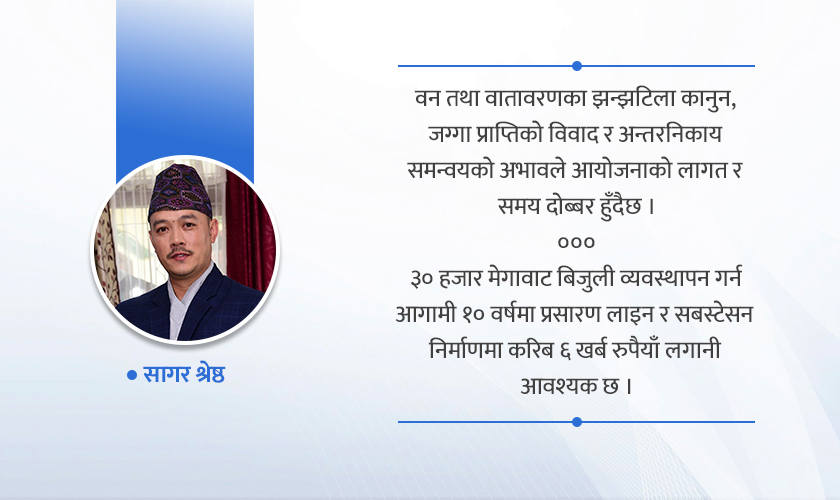
As beautiful as the government's goals and policies are, the reality of implementation is equally challenging. There are three main obstacles in transmission line construction. First, local obstruction due to the lack of a scientific basis for determining compensation for land acquisition and right-of-way tower pads and land under the lines causes projects to be delayed for years.
Second, there is a cumbersome process for cutting trees for electricity lines, which is divided into 11 stages from initial study to tree transfer. This file, moving from the Ministry of Forests to the Council of Ministers and back, doubles both the project cost and time.
Weaknesses in the Public Procurement Act. The system of selecting contractors who bid the lowest amount leads to a decline in work quality and contractors abandoning the work. Similarly, delays in quarterly budget releases cause contractors to halt work due to not receiving timely payments.
The dream of generating and transmitting 30,000 megawatts of electricity in the next 10 years will only come true when the legal obstacles related to forest cutting and land acquisition are resolved through a fast track.
This specific news has been automatically translated by AI. As a result, there may be some inaccuracies or language errors.


_jxKX1kXOlf.jpg)