Taxi Number Plate Trading Reaches NPR 1.5 Million Amidst Government Inaction

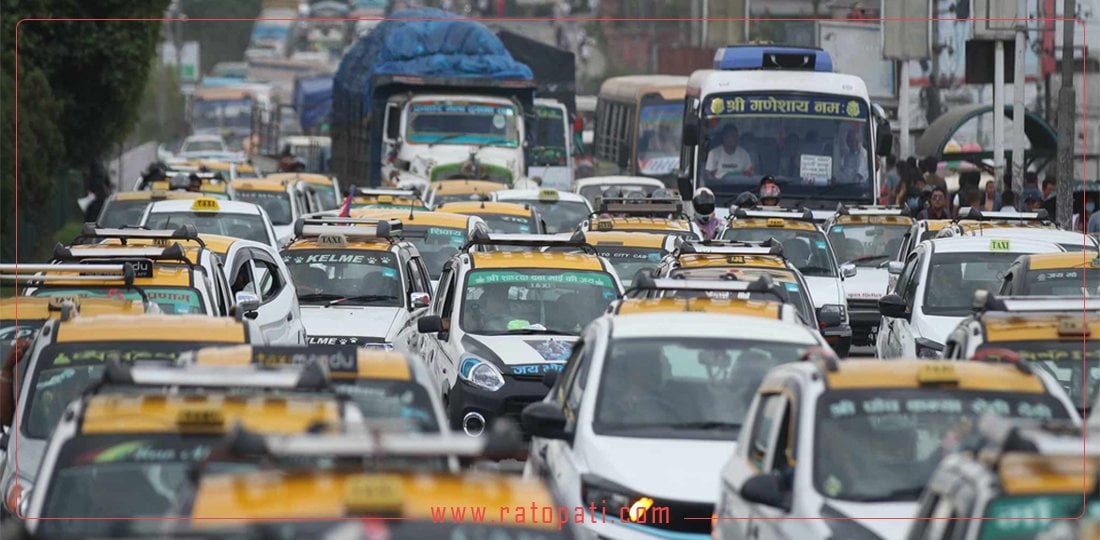
Kathmandu. There is a huge manipulation in the trading of taxi number plates. It has been found that the illegal trade of number plates, which costs NPR 500 in government fees, has reached up to NPR 1.5 million in Kathmandu due to the long-standing lack of new taxi registration process.
After Member of Parliament Mahabir Pun raised the issue of manipulation in the trading of taxi number plates in Kathmandu in the House of Representatives, the question of how the price of number plates has skyrocketed like land prices has now become a topic of discussion from the streets to the parliament.
Speaking during the emergency time of the House of Representatives meeting on Jestha 7, MP Pun claimed that taxi entrepreneurs and workers are being severely exploited. He also mentioned that the government charges 250 to 300 percent customs duty on taxi imports and an additional NPR 1.5 million is being illegally collected for the 'black plate'. He had also discussed this matter with the Director General of the Department of Transport and expressed suspicion of collusion from provincial governments to the department, demanding an immediate investigation and abolition of the practice.
Speaking again in a special time of the parliament on Jestha 12, MP Pun demanded the removal of the syndicate that has flourished due to the halt in the new taxi registration process in the valley. He informed that in 2057 BS, there were about 7,500 registered taxis, and after the 2072 BS earthquake, an additional 1,500 taxis were added, bringing the total number of operational taxis to around 9,000.
He argued that the significant increase in Kathmandu's population over the past two decades, without a corresponding increase in the number of taxis, has encouraged collusion and syndicates. Accusing the government of deliberately stopping new registrations, MP Pun strongly demanded that the government provide opportunities for citizens who wish to become self-employed by increasing the number of taxis.
Government Fee NPR 500, Market Price NPR 1.5 Million
It has been found that number plates are being traded illegally at a price 3,000 times higher than the government fee. Regarding the sale of taxi plates, former president of the National Federation of Nepal Transport Entrepreneurs, Vijay Bahadur Swar, has revealed details about the market reality and policy weaknesses.
According to the government's rule, taxis that have completed 20 years must be compulsorily replaced. However, even if the vehicle is scrapped, its number plate or registration right remains with the entrepreneur. Since new registrations are not opened, those who want to drive a new taxi are forced to buy the old number plate from the previous entrepreneur by paying a hefty sum.
According to him, when the government last opened new taxi registrations in 2072 BS, the application form fee was only around NPR 500 to 1,000. At that time, about 75,000 people applied, and a limited number of people received taxi numbers through a lottery. However, the government has completely stopped new registrations for the past 9 years.
'Since new number plates are not available, the demand for old number plates has become like that for land,' Swar says, 'Just as land is limited and prices skyrocket when demand increases, the same has happened with taxi number plates. This is not a price set by the government, but a transaction between entrepreneurs.' He mentioned that although he had heard of transactions up to NPR 11-12 lakh, the price of NPR 1.5 million could be due to the gap between demand and supply.
According to the government's rule, taxis that have completed 20 years must be compulsorily replaced. However, even if the vehicle is scrapped, its number plate or registration right remains with the entrepreneur. Since new registrations are not opened, those who want to drive a new taxi are forced to buy the old number plate from the previous entrepreneur by paying a hefty sum.
According to entrepreneur Swar, even when a 20-year-old vehicle is scrapped, the number plate retains its importance, hence entrepreneurs consider it their 'property'. While the general public sees this as a syndicate, entrepreneurs consider it a management weakness. Swar says, 'Competition in public transport should be based on need, not on numbers. If taxis are opened indiscriminately, Kathmandu's roads cannot handle it, but due to the lack of supply according to demand, such an unnatural price increase has occurred.'
Currently, there are about 12,000 taxis operating in the Kathmandu Valley. Although it was decided in 2072 BS to review the number of taxis every 10 years, this has not happened so far.
Proposal from Entrepreneurs for Solution
Entrepreneur Swar has given some concrete suggestions to the government to stop the unnatural financial dealings in this sector. He stated that based on the population density, road expansion, and passenger load since 2072 BS, a study should be conducted to determine how many taxis need to be added, and new registrations should be opened.
Entrepreneur Arjun Gautam has said that the price of taxi number plates has reached up to NPR 1.5 million due to the non-opening of new registrations. The government's failure to open new taxi registrations has created a monopoly and artificial shortage of old taxi number plates. While only petrol vehicles were used in the past, there is now an increasing attraction towards electric vehicles.
According to him, to make the trading of number plates transparent, the government itself should set a certain minimum or maximum price. Furthermore, a rule should be strictly implemented whereby if a new vehicle is not added within a certain period (e.g., 3 to 6 months) after scrapping an old vehicle, that number plate should be automatically canceled and come under the government's control.
Currently, the government prioritizes electric taxis (EVs). He stated that the registration system should be made more transparent by further organizing this. The authority for taxi registration and management in the Kathmandu Valley falls under the jurisdiction of the Bagmati Province government. Although the federal government makes policies, the delay in implementation by the provincial government has complicated the issue, according to entrepreneurs. This issue has been overshadowed due to elections, economic recession, and policy instability.
Why is the Government Seemingly Unaware While Number Plates Reach NPR 1.5 Million?
Entrepreneur Arjun Gautam has said that the price of taxi number plates has reached up to NPR 1.5 million due to the non-opening of new registrations. The government's failure to open new taxi registrations has created a monopoly and artificial shortage of old taxi number plates. While only petrol vehicles were used in the past, there is now an increasing attraction towards electric vehicles. Owners of old petrol vehicles are holding onto their number plates and selling them at high prices to new entrepreneurs, leading to a situation where one has to pay NPR 1.5 to 1.7 million.
'In 2072 BS, when new taxis were opened, the price of number plates was normal, but now due to the increase in petrol prices and the compulsion to switch to electric vehicles, the price of old number plates has skyrocketed,' Gautam said.
It is estimated that about 18,000 taxis are currently operating in the Kathmandu Valley. However, entrepreneurs say that the number of passengers using taxis has seen a sharp decline recently. On one hand, people's purchasing power has decreased, and on the other hand, the increasing use of ride-hailing apps like Pathao and inDrive has put taxi entrepreneurs in a difficult situation.
Gautam says, '10-15 taxis are sitting idle at every intersection. There are no passengers, yet entrepreneurs are unable to pay bank installments and support their families.'
Although entrepreneurs have demanded that the taxi meter system be organized and fares be adjusted, the government has not shown interest, they complain. Since Bhadra 24, the Department of Weights and Measures has stopped the renewal and sealing of meters, forcing taxis to operate illegally or face traffic penalties.
'We want to operate by meter, we are ready to provide service at the fare set by the government, but we don't even know where the government is,' Gautam expressed his anger, 'When you go to the ministry, the minister has changed; when you go to the department, work doesn't get done. The transport sector has become completely parentless.'
Action Can Be Taken Only Upon Complaint: Department
The Department of Transport Management has stated that taxi new registrations and the unnatural price of number plates, which has recently become a topic of discussion in parliament, are being sold illegally for up to NPR 1.5-1.6 million.
According to Mani Ram Bhusal, Director at the Department of Transport Management, the main responsibility for taxi management has now shifted to the provincial government. 'Taxi management is a matter for the province to handle; the department only prepares the necessary standards,' Bhusal said.
The Bagmati Province government is preparing to resume the new taxi registration process, which has been halted for about 11 years. Due to the halt in new taxi registrations in the Kathmandu Valley and other parts of the Bagmati Province since 2072 BS, the price of old taxi number plates has seen an unnatural increase, prompting the government to start preparations to open new registrations.
Director Bhusal clarified that the department cannot take action based solely on market rumors and informal information.
'We have also informally heard that taxi number plates are being sold for NPR 1.5-1.6 million,' he said, 'but so far, no one has filed a specific complaint or application stating that so-and-so took this amount or I had to pay so much. We cannot go around questioning people based on market rumors. Only if a victim files an official application can the department proceed with its action process.'
When asked about new taxi registrations and reviews, Bhusal said that further clarity will be available only after the new transport act comes into effect.
Bagmati Province Prepares to Open New Taxi Registrations
The Bagmati Province government is preparing to resume the new taxi registration process, which has been halted for about 11 years. Due to the halt in new taxi registrations in the Kathmandu Valley and other parts of the Bagmati Province since 2072 BS, the price of old taxi number plates has seen an unnatural increase, prompting the government to start preparations to open new registrations.
According to Ashok Kaple, Section Officer of the Taxi Branch at the Ministry of Labor, Employment, and Transport, Bagmati Province, the ministry has already realized the need to add new taxis. 'Previously, there was an informal practice of reviewing the number of taxis every 10 years,' Kaple said, 'New taxis have not been added since 2072 BS. The minister and the ministry are positive about opening this up, and it has also been included in this year's policy.'
Section Officer Kaple clarified that the price of NPR 1.5 million for the number plate is not set by the government but is a private transaction between entrepreneurs and individuals. He said, 'The government had a policy to limit small vehicles, which led to the halt in new registrations. The market price increased due to the compulsion of only being able to do exchanges.'
Furthermore, although informal agreement has been reached on opening new taxi registrations, a formal cabinet decision is yet to be made. This issue was included in last year's budget but could not be implemented.
'This time we have included it in the policy, and as soon as the government brings a formal policy, the way for new taxi registrations will open,' Kaple said.
This specific news has been automatically translated by AI. As a result, there may be some inaccuracies or language errors.


_jxKX1kXOlf.jpg)