Kathmandu-Terai/Madhesh Expressway Faces Delays Due to Khokana Section Dispute

_hdzzD6T0Uu.jpg)
Kathmandu. The construction of the national pride project, Kathmandu–Terai/Madhesh Expressway (Fast Track), has taken shape in many places along its 72.5-kilometer route. Tunnels are being 'breakthrough' rapidly and tall bridges are being erected on this expressway, which will connect Kathmandu to the Terai in 1 hour.
However, the dispute in the Khokana section of Lalitpur, considered the zero point of the project, remains unresolved. Years of compensation disputes, protection of archaeological sites, and issues with Guthi land are causing problems at the project's entrance.
According to the latest details released by the Nepali Army, the overall physical progress of the project has reached 46.88 percent. However, with only about 11 months remaining for the project's completion, 53 percent of the work is still pending. The Khokana section has become the biggest challenge for the army and the government, which are under pressure to complete the project within the stipulated time.
The government handed over the responsibility of the project to the Nepali Army on July 13, 2017, with the goal of completing it within four years. However, after failing to complete it within that period, the work is being carried out with extensions. The government has set a second revised target of completing the project by the end of March 2026, but as it seems unlikely to be completed within that timeframe, there is talk of further extensions.
3 Years Extension Needed
Infrastructure expert and National Planning Commission member Arjun Jung Thapa stated that given the current pace and technical difficulties of the project, there is no possibility of completing the work within 11 months. He said that it is impossible to complete the project within the government's deadline of March 2026, and even with accelerated work, it will take at least three more years. Thapa informed that the Fast Track, divided into a total of 11 packages, has only seen satisfactory progress in 3 packages so far. 'Some packages awarded three years ago have only 4 percent physical progress,' he said, 'at this slow pace, it does not seem possible to complete the work within the stipulated time.'
_XZk2F7ysaH.jpg)
According to him, the contract for the initial section from Pharsidole to Khokana has not even been awarded yet. He argues that even after the contract is awarded and work begins, it will take years to complete that section, making the entire project uncertain.
Furthermore, with the onset of the monsoon, work on various sections of the project has started to halt. Construction work is particularly affected in the Sisneri and Lalbakiya areas due to transportation and logistics problems. 'There is a place where seven bridges need to be built over the same river, and due to the rain, vehicles cannot even reach there,' Thapa said, 'although tunnel work can be done internally, geographical and seasonal conditions are hindering the construction of other structures.'
He stated that while the Nepali Army's management is good, the main problem is the selection of weak contractors. 'This is not the army's fault; weak contractors were selected due to our procurement laws and regulations,' he clarified, 'the army only manages; the project is delayed because the contractors working in the field are slow.'
Looking at the package-wise progress, packages 8 and 9 (tunnel sections) show less than 10 percent progress. Package 10 has 13 percent progress, and some other packages have progress ranging from 20 to 70 percent.
Exploring Alternatives for Khokana
There has been a long-standing obstruction by locals in the 6.5-kilometer section of Khokana in Lalitpur, the starting point of the project. The dispute in the 3.2-kilometer area, in particular, is yet to be resolved. Construction work has not been able to proceed due to demands for compensation distribution, Guthi land, and the preservation of cultural heritage.
As the dispute remained unresolved, the then government adopted a strategy to start work on the remaining sections, leaving the disputed area aside. Accordingly, a plan was proposed to construct a toll plaza (fee collection center) at Pharsidole, 3.3 kilometers away from Khokana, and build a concrete bridge connecting Dukuchhap-Pharsidole. However, implementing this alternative requires revising the Detailed Project Report (DPR). The revision was sent to the Prime Minister's Office last February. It has now been returned to the Ministry of Defense.
According to Manoj Kumar Acharya, spokesperson for the Ministry of Defense, the revised DPR for the expressway was sent to the cabinet after the consent of the Ministry of Physical Infrastructure and Transport and the Ministry of Finance. However, due to a change in government, the file returned to the ministry without a decision. 'Due to a change in government in the interim, the file has been returned to the ministry for re-submission,' he said, 'it is currently with the ministry and will be resubmitted to the cabinet soon.'
Spokesperson Acharya stated that preparations are underway to proceed with the work by addressing the disputed 2-3 kilometer section later, even if the zero point is not changed immediately.
Impressive Progress in Tunnel and Bridge Construction
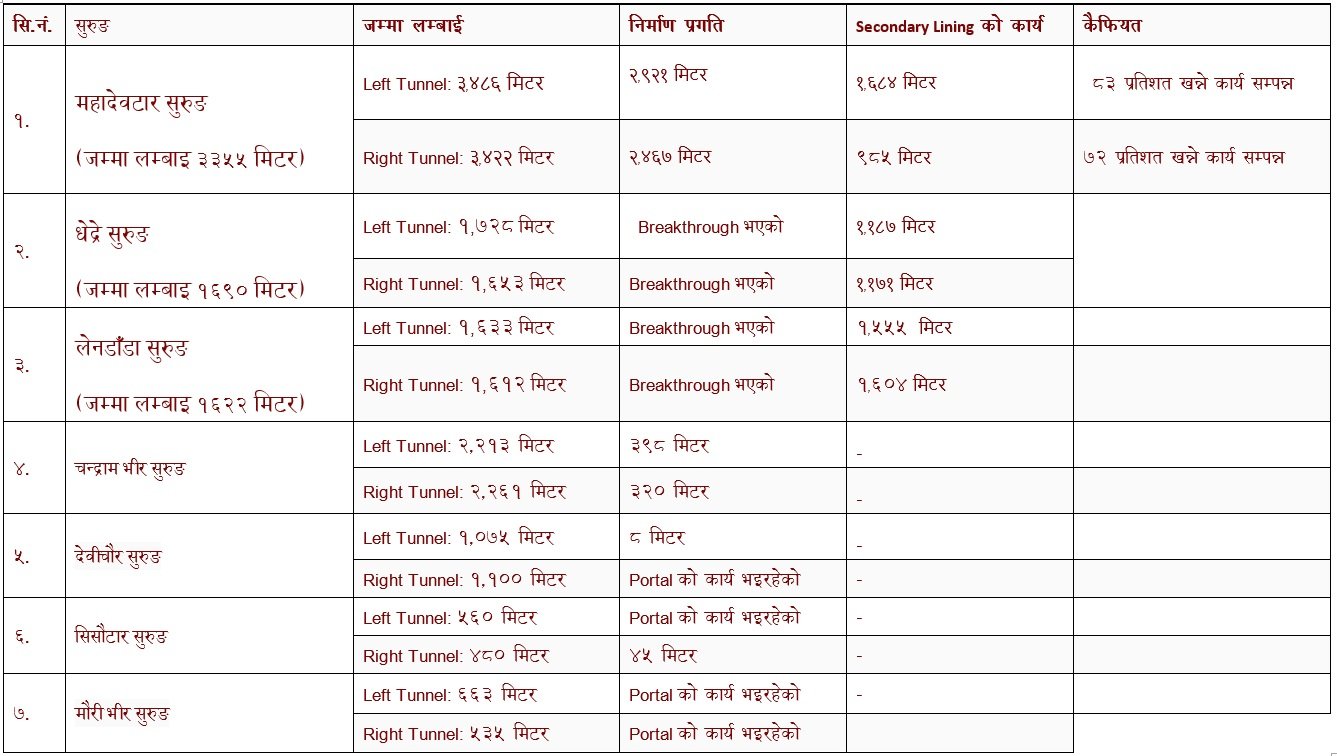
Despite the problems in Khokana, the army is working at a war footing on other sections of the expressway. Of the total 7 tunnels under the project, both tunnels of the Dedhure and Lendanda tunnels have been breakthrough. Excavation work on the Mahadevtar tunnel, the longest at 3.3 kilometers, is also in its final stages. Its left tunnel is 83 percent complete, and the right tunnel is 72 percent complete.
_QDFBIZfTJy.jpg)
Similarly, out of the total 89 bridges in the project, the contract management for 85 has been completed and they are in implementation. The remaining 4 bridges have not been able to go into the tendering process due to the dispute in the Khokana section. So far, the foundation work for 56 bridges has been completed, and the superstructure for 16 bridges has been prepared.
In terms of road construction, 11 kilometers of sub-base and 5 kilometers of service lane have been blacktopped. The army has reported that the work on the interchange and toll plaza in the Nijgadh area is also progressing rapidly.
Source: Nepali Army
Challenges in Land Acquisition
A large amount of land acquisition is still pending in the Khokana and Bungamati areas. According to the army, 135 ropanis of private land are yet to be acquired. Similarly, 14 ropanis of Guthi land and 165 ropanis of land whose value is yet to be determined are pending.
Furthermore, compensation distribution and valuation processes for an additional 128 ropanis of land in Kathmandu district and 54 ropanis in Lalitpur are ongoing, which has somewhat affected the project's pace. On the other hand, the number of trees cut has reached 54,151, and some packages have been delayed due to procedures related to forest land use rights.
How Much Has Been Spent?
The total expenditure of the project has reached 85.14 billion rupees so far. Out of the 24.49 billion rupees allocated for the current fiscal year 2024/25, approximately 4.59 billion rupees have been spent by the end of March. The army has clarified that it maintains transparency in expenditure details, with net expenditure being 77.97 billion rupees, and the remaining amount being for land purchase and advance payments to contractors.
According to the revised Detailed Project Report (DPR), the total cost of the expressway is estimated to be 211.93 billion rupees. Initially, it was estimated to be completed at 175.19 billion rupees. However, due to the failure to complete the project on time, the project cost has increased to over 200 billion rupees.
This specific news has been automatically translated by AI. As a result, there may be some inaccuracies or language errors.


_jxKX1kXOlf.jpg)