Milky Way May Have Engulfed 'Loki' Galaxy Billions of Years Ago, New Evidence Suggests

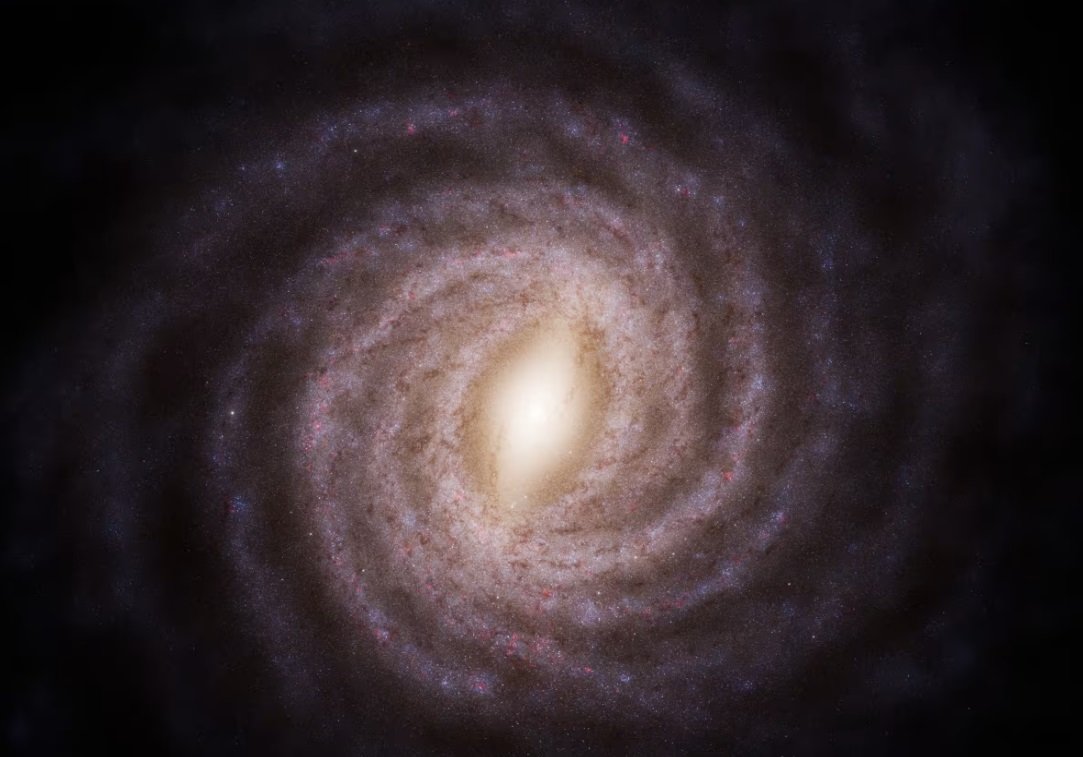
Washington DC. Scientists have found new evidence that our Milky Way galaxy may have swallowed another small galaxy about 10 billion years ago and still carries its remnants within it. Astronomers have named the ancient dwarf galaxy "Loki" after the trickster god of Norse mythology.
Scientists believe this discovery could change the current understanding of the Milky Way's early development. According to NASA, the Milky Way spans about 100,000 light-years in diameter and contains 100 billion to 400 billion stars. A light-year is the distance light travels in one year, equivalent to about 9.46 trillion kilometers.
Scientists say the massive Milky Way of today was not this large from the beginning. About 12 billion years ago, it expanded by continuously colliding with and absorbing smaller dwarf galaxies. However, the question of its initial size and mass remains unanswered. To understand this mystery, scientists are searching for remnants of the old galaxies it swallowed.
A recently published study has identified metal-poor stars in unusual groupings near the Milky Way's "galactic disk." This study was published in the Monthly Notices of the Royal Astronomical Society.
Why are metal-poor stars important?
The galactic disk is the large, rotating, disc-shaped part of the Milky Way where many stars are located. According to scientists, the earliest stars in the universe were primarily made of hydrogen and helium. Those stars created heavy elements in their cores, and after exploding, dispersed those elements into space. The new generation of stars that formed afterward contained more metals.
However, metal-poor stars are considered extremely old. Such stars are often associated with ancient dwarf galaxies. Scientists estimate that the Milky Way formed its current size by swallowing many such dwarf galaxies.
Dr. Kara Battersby, an associate professor of physics at the University of Connecticut, wrote in an email, "A large number of metal-poor or VMP stars have existed for billions of years, holding within them clues to the formation of the earliest stars in the universe." According to her, studying the composition and motion of such stars can help understand the conditions of the early universe.
Until now, scientists were primarily searching for such old stars in the outer region called the "stellar halo." But some astronomers had speculated that evidence of ancient mergers might be hidden in deeper regions, especially within the disk. However, due to the abundance of dust, gas, and newer metal-rich stars there, identifying old metal-poor stars was difficult.
The study's lead author, Federico Cestito, and his team identified 20 metal-poor stars near the galactic disk using data from the European Space Agency's Gaia telescope. Gaia has been measuring the motion and composition of about 2 billion stars in the Milky Way from 2014 to 2025. Subsequently, scientists used the high-resolution spectrograph of the Canada-France-Hawaii Telescope for a detailed study of these stars.
According to scientists, these stars could be more than 10 billion years old and are all located about 7,000 light-years away from our solar system. Their nearly identical chemical composition suggests they may have originated from the same ancient dwarf galaxy.
Why was it named 'Loki'?
Eleven of these stars were orbiting in the same direction as the Milky Way's rotation, while nine were orbiting in the opposite direction. This indicates that an external galaxy merged with the Milky Way at some point. Cestito said, "If the Loki scenario is correct, the system that merged with our galaxy could have accumulated its stars in both prograde and retrograde directions." He added, "This would only be possible if the merger occurred when our Milky Way was still very young and its gravitational pull was weaker than it is today."
Scientists have named the ancient dwarf galaxy "Loki." Regarding the reason, Cestito said, "Similarly, our accreted stars gave us some difficulty in understanding their origin." According to him, it was initially very difficult to understand how stars from the same system could orbit in two different directions.
Scientists say the Milky Way's evolution occurred through "galactic cannibalism." In this process, a larger galaxy pulls a smaller galaxy towards it with its gravitational force and absorbs it. Alexander G, an assistant professor in the Department of Astronomy and Astrophysics at the University of Chicago, said, "There are always many small mergers happening, but truly massive cannibalisms can change the evolutionary history of the Milky Way."
Previously, evidence has been found that the Milky Way merged with a large galaxy called "Gaia-Sausage-Enceladus" 8 to 10 billion years ago. Scientists say that event played a significant role in giving the Milky Way its current stable form. According to G, the new "Loki" discovery could be just as important. He said, "If this is real, it indicates that a major part of our Milky Way's formation history has been lost. But he added that further studies are needed to confirm this discovery." Scientists are now preparing to use even larger datasets to determine whether "Loki" was indeed an independent ancient galaxy.
This specific news has been automatically translated by AI. As a result, there may be some inaccuracies or language errors.