Richmond Bridge and Sohrah-Chhattis Kulo: Examples of Historical and Resource Management

During my visit to Australia, I had the opportunity to see many historical and cultural sites during my nearly two-month stay in Tasmania. Among them, the experience of 'Richmond Bridge' was special for me. I realized that it is not just an old bridge, but a confluence of history and tourism.
Tasmania's Richmond settlement itself feels like an open museum preserving colonial history. The main attraction there is this bridge, which is considered one of Australia's oldest living freestone bridges.
The construction of this bridge began around 1823 and was completed around 1825. The construction techniques, stone masonry, and small details of drainage bring to life the engineering thinking of that time.
The Richmond settlement has transformed over time from a small agricultural settlement into a cultural and tourist center. Heritage conservation has been given special attention here since the 1970s, and old buildings have been repurposed in a 'cottage style'. For this reason, this area was included in the national heritage list in 2005.
Today, this Richmond Bridge is considered one of the most photographed places in Tasmania. Today, Richmond Bridge is not just a historical structure, but also a major tourist attraction. According to locals, leaving without seeing this bridge after reaching here is like not seeing Richmond at all.
For me, this bridge became a living school, representing colonial history of early engineering and cultural transformation simultaneously.
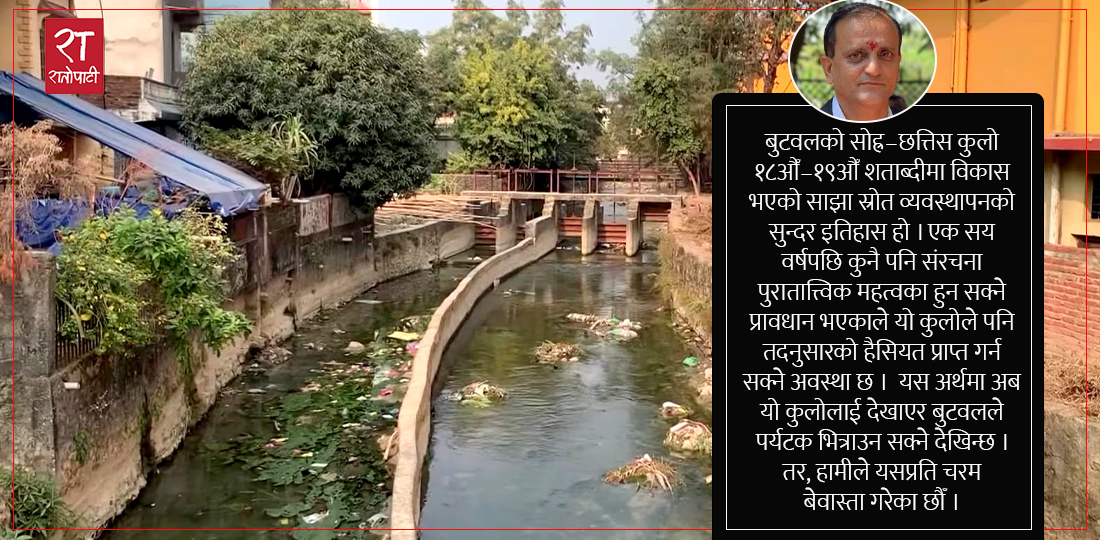
The Sohrah-Chhattis Kulo of Butwal is a beautiful history of common resource management developed in the 18th-19th centuries. Since any structure can have archaeological significance after a hundred years, this canal also has the potential to gain corresponding status. In this sense, Butwal can attract tourists by showcasing this canal. However, we have been extremely negligent towards it.
The Sohrah-Chhattis Kulo of Butwal is a beautiful history of common resource management developed in the 18th-19th centuries. Since any structure can have archaeological significance after a hundred years, this canal also has the potential to gain corresponding status.
Western scholars in the world developed the theory of common resource management based on this canal. The world recognized this management system after studying the management it showed. Whereas the farmers in this region had established this theory not by reading it, but by practicing it.
In this sense, by conserving and 'branding' this canal, foreign scholars can come here and stay for months by paying fees. The irony is that the local government has not paid attention to it at the level it should have.
Looking at its historical aspect, as local farmers managed water from natural springs, the canal gradually expanded. And this system is considered an example that not only increased agricultural production but also strengthened social organization and cooperation.
This Sohrah Chhattis Kulo, which irrigates the fields around Butwal, is not just a normal irrigation canal, but a model of community, discipline, and cooperation. This canal teaches us that when resources are shared, management must also be shared.
Nepal also taught the world a new lesson by establishing the concept of community forests since the 1990s for common resource management, which we are also forgetting.
In reality, both are original Nepali principles for resource management. Based on which Nepal can attract the world for study. But our representatives and policymakers are unaware of such issues. And they do not have the patience to listen to such matters.
The context is the silence seen in the encroachment of this traditional system in the Butwal area. This canal system has repeatedly faced encroachment. Whereas it has established the principle that local communities can distribute sensitive resources like water equitably even without state or privatization. This simple and effective practice has generated trust among farmers.
Punishments for breaking rules, social pressure for not working, have been and are more effective than formal laws. The world-renowned economist Elinor Ostrom, who presented the theory of common resource management based on such issues of irrigation and community forest conservation in Nepal, received the Nobel Prize in 1990.
In the conclusion of her research, she said – 'Communities can manage resources sustainably by making their own rules.' She established 8 principles by studying such systems.
First, clear demarcation: This includes the demarcation of the resource. Such as: boundaries of water, forest, and users. Under which it should be clear who can use and who cannot.
Second, rules according to local conditions: The rules for resource use should be according to local needs and conditions. For example, water distribution, time, and labor should all be based on local context.
Third, collective decision-making process: Participation of users in the rule-making process is mandatory. So that a sense of ownership can be generated by saying 'these are the rules we made'.
Fourth, monitoring: There should be monitoring of whether the resource is being used and rules are being followed. And the monitor should be accountable to the community.
Fifth, gradual sanctioning process: The punishment for violating rules should be gradually increased. For example, first a warning, then a fine, and finally strict action.
Sixth, conflict resolution mechanism: A system should be arranged for quick, cheap, and easy resolution of disputes at the local level.
Seventh, recognition of self-governance: The community's right to make rules should be recognized by external bodies (government agencies, etc.). So that no inconvenience arises. Or the community should be allowed to operate independently.
Eighth, multilevel structure: In large systems, small levels should work together (coordination at local, regional, national levels).
In this way, Ostrom's main message was – 'To make common resources sustainable, communities need rights, responsibilities, and rules.'
In this sense, the Sohrah-Chhattis Kulo is not just a local irrigation system, but a practical example of world-class common resource management. It shows that sustainable development is possible with the participation and self-governance of local communities.
The Sohrah-Chhattis Kulo is a world-class example for the following main reasons. First, operation without direct state control. Second, water distribution, rotation system, and punishment system. Third, maintenance and conservation work was done collectively. Fourth, it has been in continuous operation for generations.
The Sohrah-Chhattis Kulo is a world-class example for the following main reasons. First, operation without direct state control. Second, water distribution, rotation system, and punishment system. Third, maintenance and conservation work was done collectively. Fourth, it has been in continuous operation for generations.
All these characteristics match the eight principles stated by Ostrom. In this sense, the Sohrah-Chhattis Kulo is a living example of globally recognized common resource management.
This Sohrah-Chhattis Kulo is an example where farmers in the Butwal region have been practicing for decades what Elinor Ostrom's theory scientifically proved through research – a theory developed in the Western world.
It is another matter that there are many challenges today. Urbanization is reducing farmland, youth are going for foreign employment, and the culture of collective labor is weakening. Perhaps for this reason, the canal is also narrowing.
If this trend continues, not only the physical structure of the canal but also the community spirit associated with it will be lost. Many research studies based on Nepal's irrigation systems have been conducted on this canal at the international level. Among them, in 1994, American researcher/anthropologist Robert Yoder studied and documented irrigation systems operated by farmers in Nepal.
Yoder, who helped introduce Nepal as a community irrigation model to the world, is an important researcher who introduced Nepal's traditional irrigation systems to the world and strengthened the idea that communities can manage resources.
In his view, irrigation needs to be understood not just as a technical aspect but as a social institution. He became famous especially through his study of irrigation systems operated by farmers in Nepal.
Similarly, the International Water Management Institute (IWMI), headquartered in Sri Lanka, which scientifically explains the relationship between water, agriculture, and society, and guides the world towards sustainable development, has conducted research on water resources, irrigation, sustainability, and agricultural systems.
It bridges the social, economic, and environmental aspects to understand water management, influence water policy formulation worldwide, advise governments and international bodies, and implement research in practice. In this sense, the study by the individuals and institutions mentioned above is certain to have a long-term impact.
Therefore, what this canal teaches us is that the sustainability of common resources is possible not by government orders, but by community responsibility. As this is a subject of research worldwide today, its conservation can make it a center of tourism for researchers and students working in the field of resource management.
(The author Ghimire is a senior journalist active in Butwal.)
This specific news has been automatically translated by AI. As a result, there may be some inaccuracies or language errors.




_6FSvCrCShE.jpg)