Government Demolishes Informal Settlements Along Bishnumati River


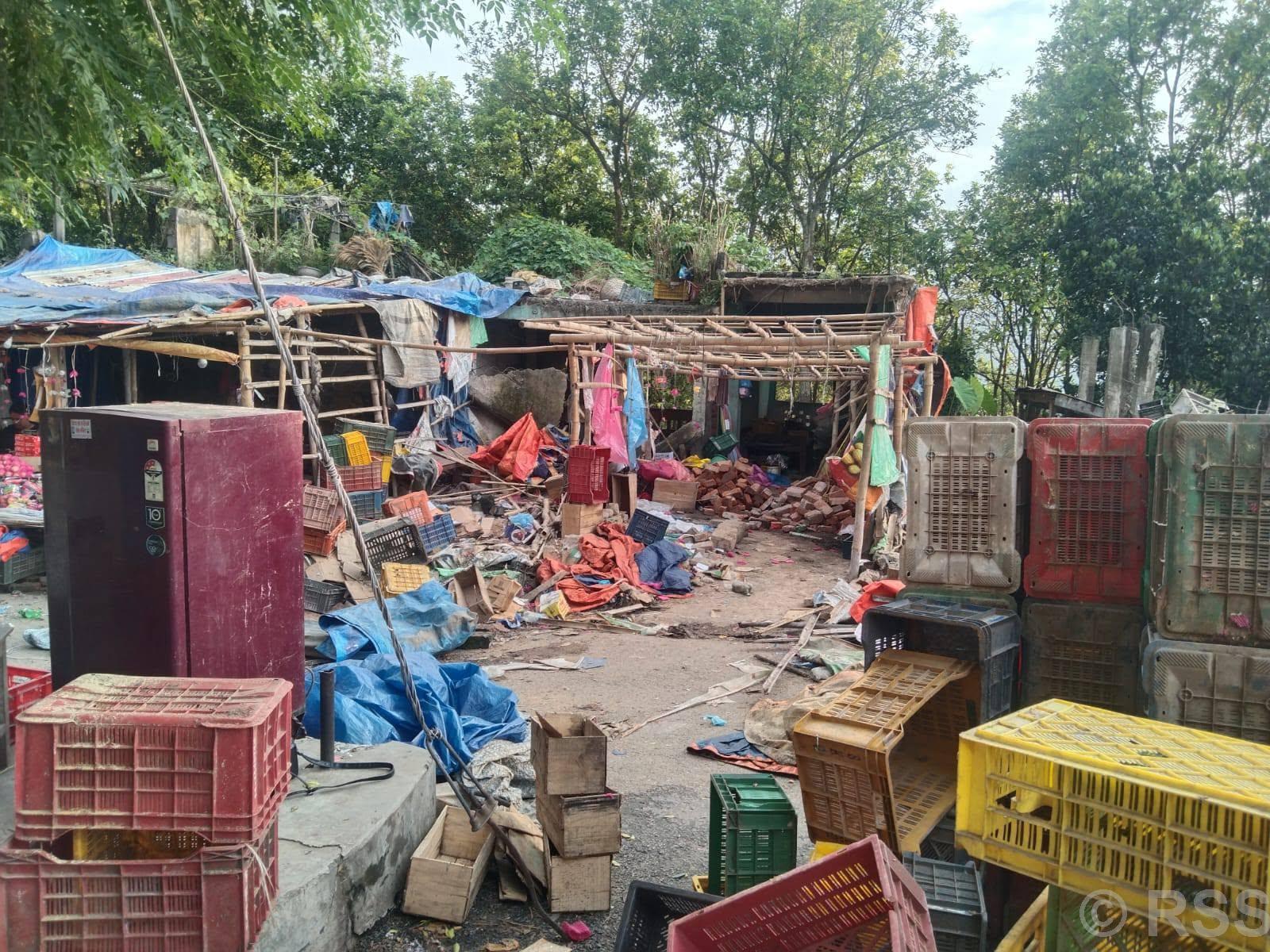
Kathmandu. Early on Saturday morning, bulldozers ran over the informal settlement on the banks of the Bishnumati River in Balaju. The government had informed on Wednesday that bulldozers would run yesterday (Friday). However, the settlement was cleared one day late. Chaos had already begun in this settlement from early Thursday morning, and the informal settlers were busy vacating their shacks day and night. By Friday, 90 percent of the shacks had been vacated, and the remaining ones were given time throughout that day. Although bulldozers did not run on Friday, four bulldozers ran in the settlement on Saturday with a heavy police presence. After the bulldozers entered the settlement on Saturday, it became desolate in moments. The bulldozers run by the government demolished the shacks of the informal settlers that had stood for years. In view of potential tension, the police had set up a tight security cordon from the bridge. No one from outside was allowed to enter. Even those with houses nearby were forced to stay outside. However, we entered the ruins of the demolished settlement as informal settlers. The scene inside would tear anyone's heart. Most of the informal settlers had already left their homes, but Sanumaya Syangtan, who had been living on the riverbank for 30 years, watched her settlement being demolished by bulldozers, shedding tears. We reached her and asked – is no one in the settlement, haven't you gone anywhere? She retorted, 'Who are you, why are you asking?' We told Sanumaya, 'We are journalists.' And she said, 'I have nowhere to go. I was alone. Where should I go? I have no place to go. The state bulldozed even the small shack I had. I slept on the street for two days. Now I have no option but to stay here.' Tears streamed down her eyes. Her home and small shack were her everything. Now she feels – she will collect the bricks and wood used to build the shack and sell them to sustain herself for a couple of days. Others who had nothing were also staring at the ruins. Standing on the debris of the houses and shacks demolished by the bulldozer, they were searching for the broken pieces of their lives. Shedding tears, they were collecting corrugated iron sheets, iron rods, bricks, wooden doors and windows, and other broken items used to build houses. Ramvir Sunar, another 40-year-old man met there, was also there. His complaint was, 'My shelter has been looted, now I have to earn a living for a few days by selling these scraps.' As he dug through the debris devastated by the bulldozer, he had both despair and anger. He had been living in this settlement for 40 years. After the government suddenly snatched his shelter, he is now worried about management. Another young man was sitting a little below the ruins. He was also thinking of collecting corrugated iron sheets, iron rods, bricks, wooden doors and windows, and other broken items from the settlement and not letting others have them. 'I will collect all these things myself. By selling all the collected items, I can sustain myself for a few days. If the state gives land elsewhere, it will be useful for building a shack,' he said. In a corner of the ruins, 50-year-old Ambika Shrestha was found. She had lived in this informal settlement in Balaju for 31 years, but her tears have not stopped since the government ran bulldozers on Saturday. 'I have no one, I am alone. I had a small hut made by washing dishes and selling tea, the government demolished that too,' said Ambika, crying. She hopes that the government will identify and manage the informal settlers. She is highly dissatisfied with the government's working style. 'I had hoped that the new government would do something, and clear the settlement only after properly managing the informal settlers,' she said, with tears in her eyes, 'but instead, it did not even show humane behavior. Without any alternative, the government suddenly pushed us onto the streets, we are in distress.' Nanu Shrestha, 45, from the same settlement, has a similar plight as Ambika. She feels that she was used as a vote bank during the elections. She is angry because the candidates who promised to remove the settlement only after management have now run bulldozers in the settlement without any alternative. Claiming to have grown up here for seven generations, she also accused the leaders of showing double standards. 'Leaders had promised to manage the informal settlers, but today they have made the public cry and pushed them onto the streets,' she said angrily, 'When I go to look for a room, no one believes me. Either the state should kill us, or give us a place to live. Mothers who have just given birth are on the streets with small babies in their stomachs. The state has shown inhumanity.' Maya Syangtan, who has been living in the same place for 40 years, raised her children here. After the state demolished the place where she had lived for 40 years, she was now collecting bricks. She said, 'Why did the government covet even a hut covered with plastic? The government says it will manage, but it doesn't. This government is sinful.' The government has intensified its campaign to run bulldozers over unauthorized settlements along the riverbanks in the name of making the Kathmandu Valley beautiful and organized. Today alone, bulldozers have been used in Swoyambhu, Anamnagar Dhobi Khola, Machhapokhari, and Tilganga in Kathmandu. Management of informal settlers is necessary. However, the future of hundreds of informal settlers who have been pushed onto the streets due to the removal of settlements without proper management has become dark. The education of children has also been affected. Their one-point demand is that they should be shown a place to live before being removed and that proper management should be done quickly.
This specific news has been automatically translated by AI. As a result, there may be some inaccuracies or language errors.