Nepal's Tunnel Era: Progress, Challenges, and the Road Ahead


Kathmandu. 'The tunnel era in Nepal will begin from the year 2080 BS' - said then-Prime Minister KP Sharma Oli on Chaitra 8, 2075 BS, while laying the foundation stone for the Butwal-Narayanghat road section.
A few months later, on Kartik 4, 2076 BS, while laying the foundation stone for the Nagdhunga tunnel, he reiterated, 'Nepal has entered a new era of tunnels.'
Reaching the year 2083 BS, that dream of Oli seems to have been realized to some extent.
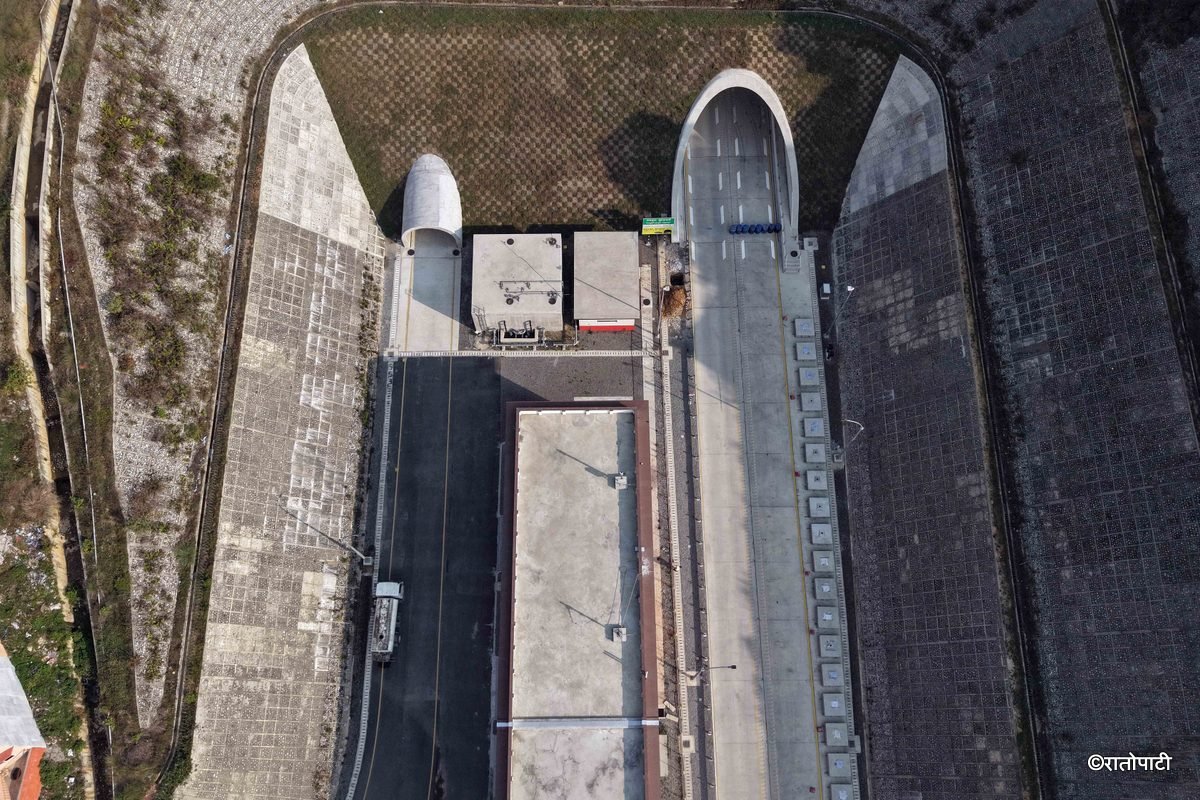
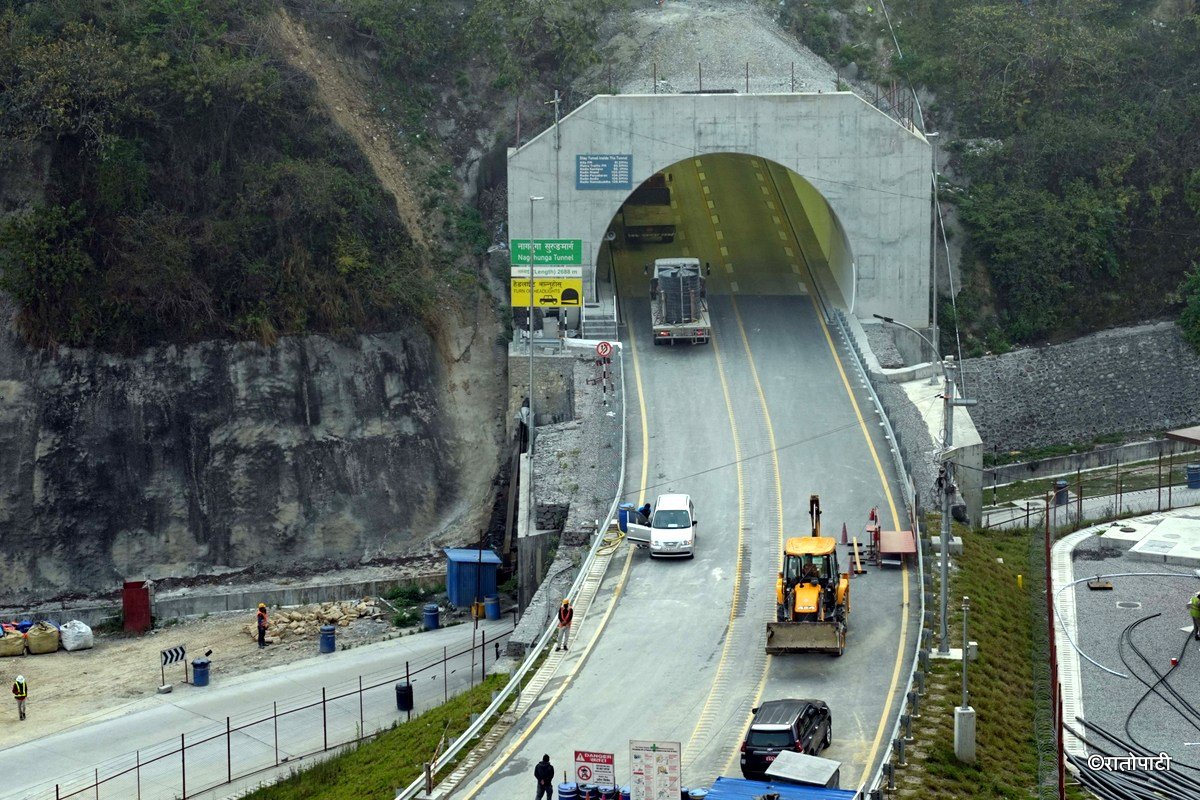
Currently, Nepal's first modern road tunnel, the Nagdhunga-Sisnekhola tunnel, has completed construction and is in the final stages of preparation for operation. Project Chief Saujanya Nepal states that preparations are underway to sign a contract for operation this week, with the goal of fully opening it from the upcoming new fiscal year (Shrawan).
Project Chief Nepal informed that legal documents and internal preparations are currently being finalized. He said, 'It will take about three months to fully open it to the public, but discussions are ongoing about conducting a trial run with a limited number of vehicles before that.' According to him, there is a possibility of including public transport during the trial, although a final decision is pending.
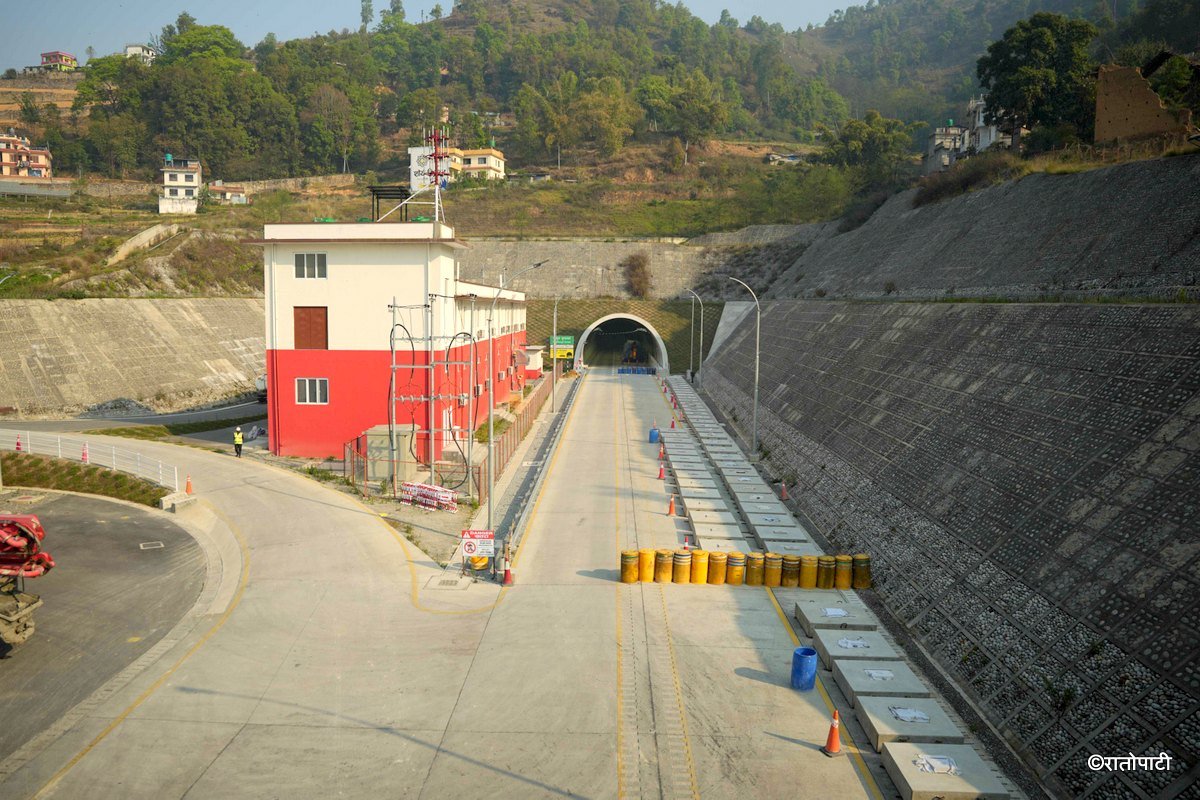
Although construction is complete, some technical preparations for management and operation remain. Project Chief Nepal argues that waiting for the new fiscal year is necessary to ensure staff training, integration with service provider systems, and robust security measures.
Work was briefly obstructed due to a landslide below the tunnel's western portal (Dhading side). The project chief informed that the landslide prevention and repair work is now in the final stages.
The project, featuring a 2,688-meter main tunnel and a 2,557-meter emergency tunnel, was constructed by the Japanese company Hazama Ando Corporation. Built with Japanese technology and concessional loans, this tunnel has reduced a grueling half-hour journey to just 5 minutes.
The government has already prepared the necessary procedures and toll structure for the operation of the Nagdhunga tunnel. The responsibility for operation and management has been awarded to the Chinese company 'Chongqing Yuxin Road and Bridge Development' and the Nepali company 'ART Construction' (Yuxin-ART JV) for 5 years. Preparations are underway to officially sign the contract for operation and management.
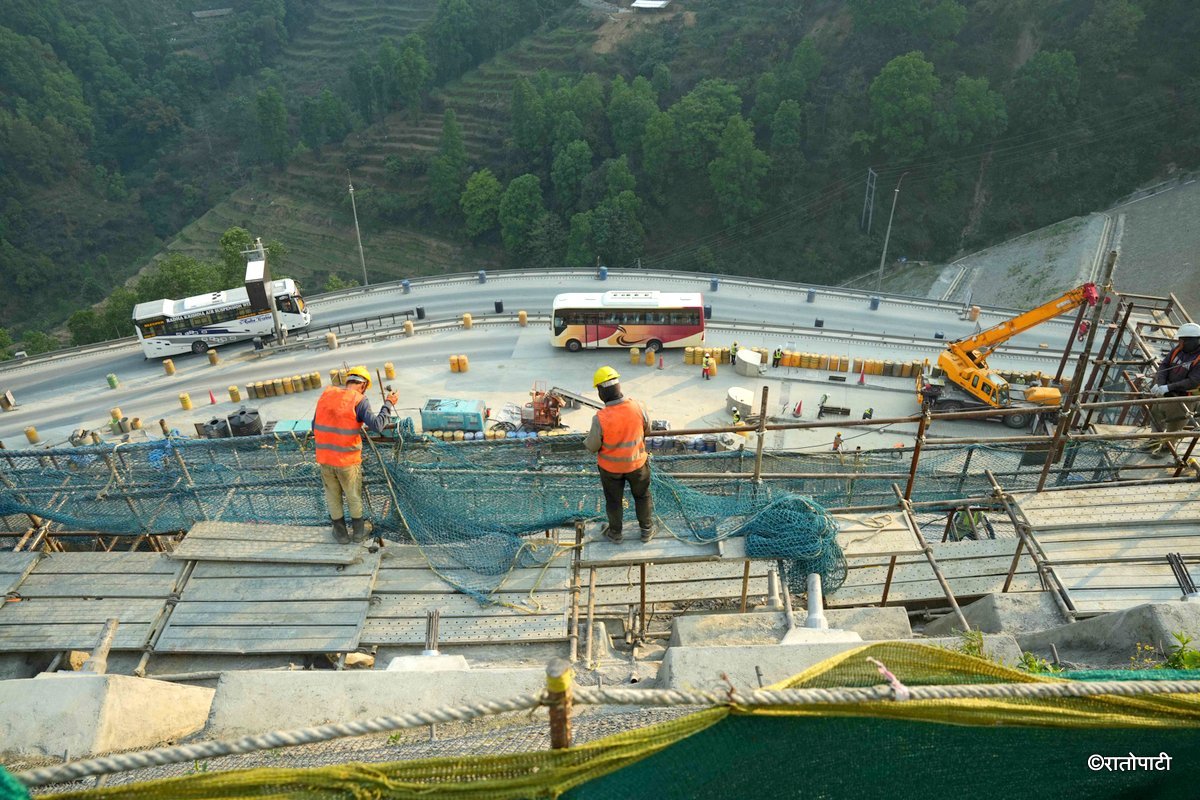
Traveling through this tunnel will shorten the distance by 8 kilometers, and a toll will be charged for its use. The project states that the collected toll will be deposited into the Road Board's account and spent on tunnel maintenance. An 'Electronic Toll Collection' system will be used, where chips installed in vehicles will automatically deduct the toll while the vehicle is in motion. The government has set a fee of 60 to 65 rupees for light vehicles and up to 600 rupees for heavy vehicles.
Construction began on Kartik 4, 2076 BS, and the contract stipulated completion by Baisakh 13, 2080 BS. However, due to delays caused by COVID-19 and local disputes, the deadline was extended to Baisakh 13, 2081 BS. Construction could not be completed by this deadline, leading to a second extension until Kartik 8, 2082 BS. During this period, the tunnel construction was finished, but due to the landslide on the Dhading side and other technical work, the final deadline was extended to Baisakh 12, 2083 BS. The project indicates that the landslide work will not be completed within this deadline. However, preparations are being made to bring the tunnel into operation for testing even if the landslide work is not immediately finished.
Similarly, the Siddhababa tunnel is under construction as the second road tunnel. The project reports that about 60 percent of the construction is complete. The Siddhababa area, located on the Butwal-Palpa section of the Siddhartha Highway, has long been known as a 'death road' due to the constant risk of landslides and falling rocks. The tunnel concept was advanced to solve this.
_n9bHJIkAKS.jpg)
The physical progress of the under-construction Siddhababa tunnel is now around 60 percent. The 'breakthrough' of the 1,126-meter main tunnel has been achieved, and work on the inner floor concreting and wall lining is proceeding at a rapid pace. The project, being built by the Chinese company CSCEC for 7.3421 billion rupees, aims to be ready for vehicles by Dashain next year. State-of-the-art 'control buildings' are being constructed at both entrances of the tunnel, from where security will be monitored directly.
The contract for this tunnel was signed on Falgun 25, 2078 BS, with a 5-year completion timeline. The Chinese company China State Construction Engineering Corporation was awarded the contract for 7.3421 billion rupees, including VAT. According to the contract terms, construction must be completed within 5 years of the start of the first phase, i.e., by Chaitra 8, 2083 BS.
Similarly, seven tunnels are being built on the Kathmandu-Tarai/Madhesh Expressway (Fast Track), with the 'breakthrough' of the Dhedre and Lende tunnels already achieved. Over 70 percent of the excavation work for the Mahadevtara tunnel is also complete. Tunnels like Chandram Bhir, Devichaur, Sisautar, and Mauri Bhir are currently in the portal construction and testing preparation phase. These tunnels will not only reduce the distance between the hills and the Tarai but will also save significant fuel and time for Nepal's economy.
- A pile of studies but uncertainty in construction
However, despite the wave of tunnel construction that had begun, government delays and budget shortages have left dozens of planned projects stalled.
While ongoing projects inspire hope, the state of projects that have been studied but shelved is quite disappointing. The process for 16 tunnels studied by the Quality Research and Development Center under the Department of Roads has been virtually stalled for a year. According to Center engineer Deepak Jha, even tunnels with completed detailed studies cannot move forward because the government has not provided resource approval (budget).
According to Engineer Jha, after the Ministry of Finance froze the budget under Section 21 of the Financial Procedures and Fiscal Responsibility Act, 2076 BS, the study and DPR work for new tunnels have been limited to files. Technical work has been affected by the provision that capital research expenditure can only be made after certification by the accounting officer.
Engineer Jha states that feasibility studies for 13 of the projects being studied through the center have been completed. Detailed studies are yet to be done. Among these is the Dharan-Leuti tunnel in Sunsari, which will be 3.87 kilometers long. Another is the Khutiya-BP Nagar-Dipayal tunnel in Kailali and Doti, which will be 7.01 kilometers long. Similarly, the feasibility study for the Godavarikunda-Kavre Manedovan tunnel in Lalitpur and Kavrepalanchok has been completed, with a length of 3.65 kilometers.
Another tunnel with a completed feasibility study is the Bihun-Narethanti tunnel in Baglung (7.44 km). There is also the Prabhas-Jorte road tunnel in Palpa (4 km). Feasibility studies have also been completed for the Kulekhani-Bhimfedi (3.156 km), Khurkot-Sindhuli (4.90 km), Tathali-Rabiopi (4.58 km), Babai-Chinchu (5 km), Sunmai-Rajduwali (12.30 km), and Majhimtar-Shaktikhor (10.60 km) tunnels.
These are the tunnels for which feasibility studies have been conducted:
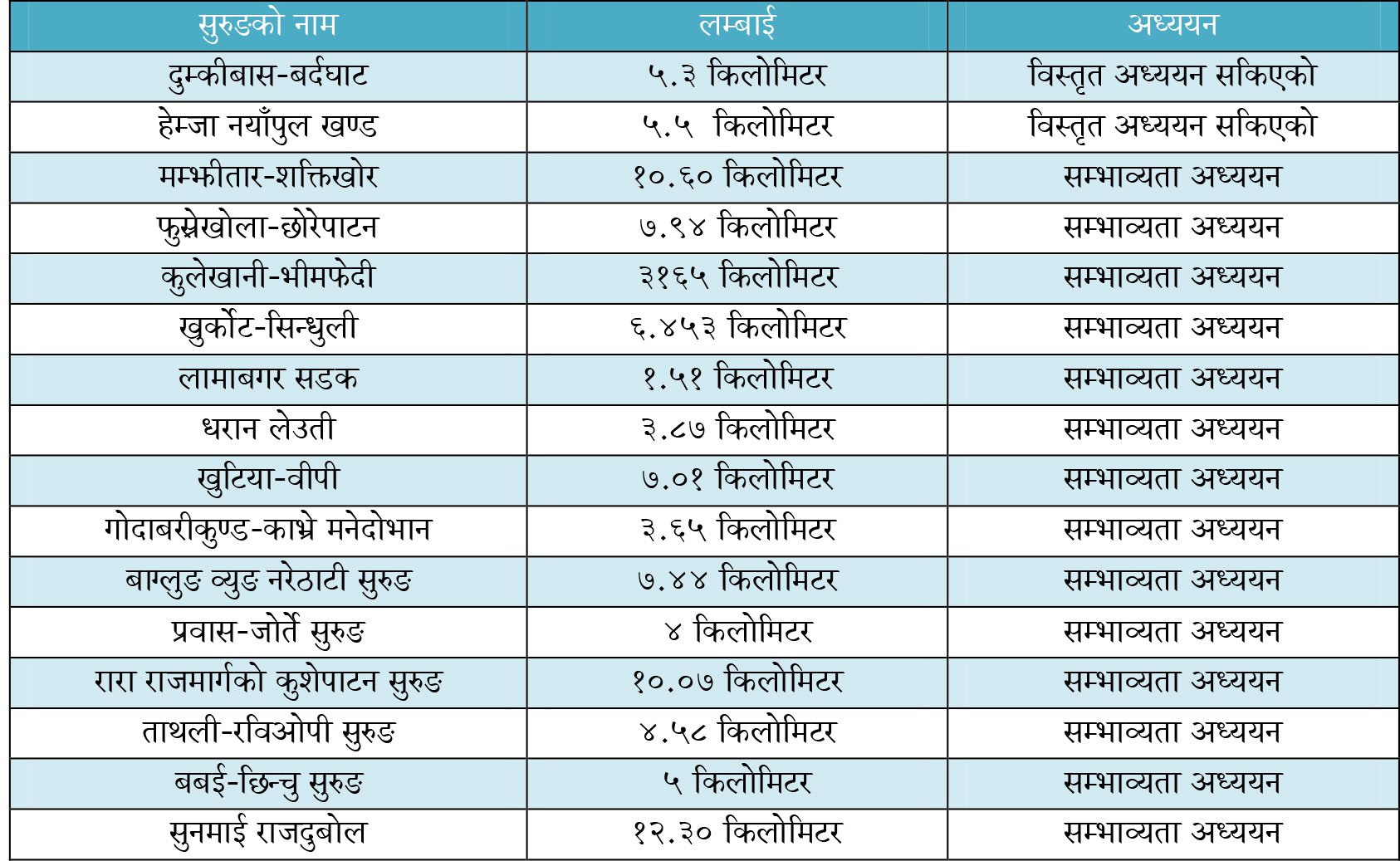
(Source: Quality Research and Development Center)
The feasibility study for the Jajarkot Byauli Dhunga and Jumla Imilchakhola tunnel (10.07 km) under the Rara Highway is also complete, and work on preparing the DPR is underway.
The situation for the Lamabagar tunnel (1.51 km), Majhimtar-Shaktikhor (10.60 km), and the Phusrekhola Chhorepatan (Pokhara) to Syangja Gudikhola tunnel (7.94 km) is similar. Engineer Jha says, 'Without resource approval, we cannot move forward with donor agencies even for projects where the DPR is finished.'
According to him, detailed feasibility studies for two tunnels have been completed, including the Hemja-Nayapul road section tunnel. The detailed feasibility study for the Dumkibas-Bardaghat tunnel has also been completed.
- Why are tunnels necessary?
Experts have their own arguments as to why tunnels are necessary despite the country's limited resources. Due to Nepal's winding and steep roads, transportation costs are very high. Tunnels save fuel, reduce vehicle depreciation, and save human labor. According to Rajesh Prasad Paudel, Director of the Quality, Research and Development Center under the Department of Roads, the main objective is to reduce transportation costs.

According to infrastructure expert Shriram Dhakal, tunnels not only reduce distance but also reduce the risk of landslides during the rainy season to zero and contribute significantly to road safety.
Former Secretary of the Ministry of Physical Infrastructure and Transport, Keshav Kumar Sharma, says that in a country with complex geography like Nepal, tunnels are not just a means to shorten the path but are multi-dimensionally beneficial in terms of road safety and economic savings.
According to former Secretary Sharma, tunnels save time and fuel. Not only that, but one can also be free from the obstacles of natural disasters like landslides and earthquakes. Sharma said, 'Technically, tunnels are considered earthquake-resistant. Compared to roads on the ground surface, tunnels dug in deeper parts are less affected by earthquakes. They are safer and more sustainable than roads.'

He also stated that in the long run, the maintenance cost of tunnels will be lower than that of roads. Although the operating cost seems high when there is only one tunnel (Nagdhunga tunnel), he believes that after many tunnels are built, all of them can be managed from a single central control center.
Without winding and steep roads, there is less load on the vehicle's brakes, tires, and engine, which reduces 'wear and tear,' lowers maintenance costs, and increases the vehicle's lifespan. Sharma said that while tunnel construction is an expensive technology, these multi-dimensional benefits will make the country's overall transport and logistics sector more organized and safer.
- Disadvantage: Tunnels are 15 to 20 times more expensive than roads
As attractive as tunnel construction sounds, its economic aspect is equally challenging. According to former Secretary Sharma, it costs about 100 million rupees per kilometer to build a two-lane paved road in Nepal's hilly terrain. However, building a tunnel in the same place costs up to 3 to 4 billion rupees per kilometer. This means tunnels are 15 to 20 times more expensive than normal roads.
- This is the history of tunnel construction
The history of tunnel construction in Nepal is about 400 years old. According to experts, the first use of tunnel technology was in Argali, Palpa. There, a 1.5-kilometer-long tunnel was dug by hand for irrigation. The approximately 2-kilometer tunnel of Chandibhanjyang, dug by Pratap Shamsher for irrigation in Tansen during the Rana period, is also a witness to old Nepali engineering.
_itzaivMLcR.jpg)
For Nepal's road transport, the first tunnel was built in 1917 at Churiya Mai on the Hetauda-Pathlaiya road section. The 239-meter-long Churiya Mai tunnel, designed by engineer Dilli Jung Thapa, is considered the first road tunnel in Asia. This tunnel, 5 meters high and 5 meters wide, is still safe today.
Before entering modern road infrastructure, Nepal had already gained extensive experience in tunnels in the field of hydropower. So far, more than 210 kilometers of tunnels have been dug for hydropower projects alone. Since the first hydro tunnel was dug for the Tinau Hydropower Project in Rupandehi in 1974, Nepali technicians have gained significant experience in digging mountains, culminating in the 27-kilometer-long Melamchi Water Supply tunnel.
This specific news has been automatically translated by AI. As a result, there may be some inaccuracies or language errors.