NCP Central Coordination Committee Meeting Postponed Amid Internal Deliberations


Kathmandu. It has been nearly a month since the Central Coordination Committee of the Nepal Communist Party (NCP) began its meetings, yet no decision has been reached.
Following the party's embarrassing results in the House of Representatives elections held on Falgun 21, Coordinator Pushpa Kamal Dahal 'Prachanda' called a meeting on Chaitra 19. During the meeting, Coordinator Prachanda presented a report regarding the election review.
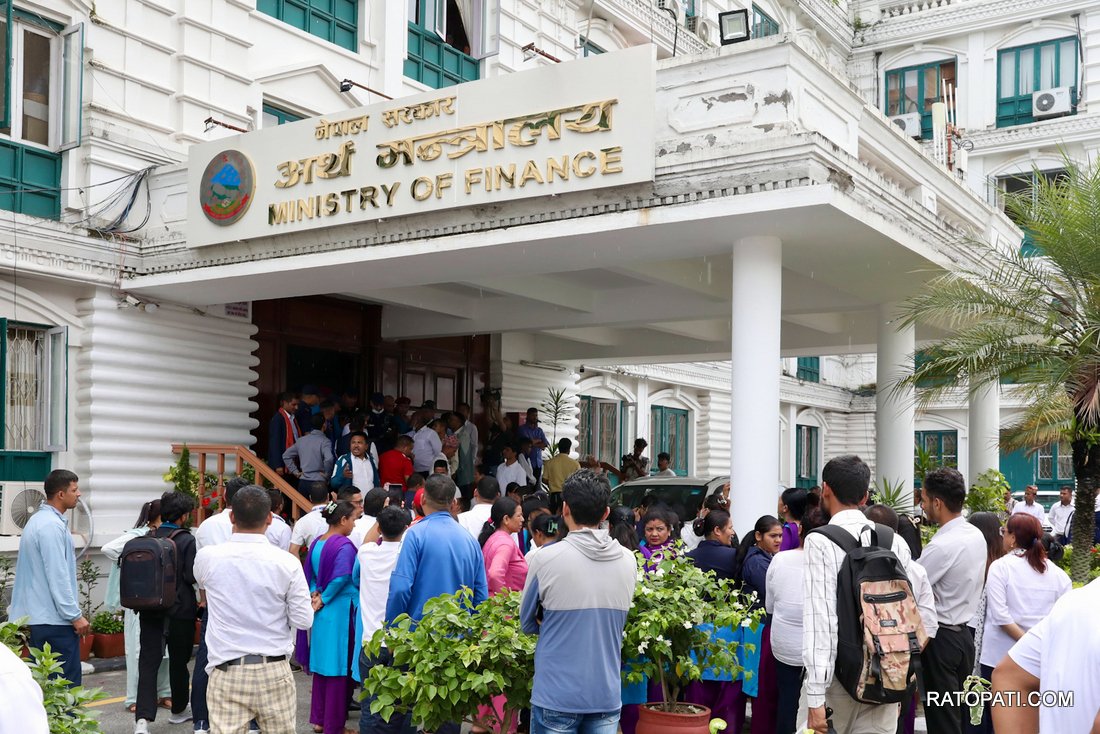
After 40 members provided their written and oral feedback on the report between Chaitra 23 and 28, the meeting was adjourned until Baishakh 3. Leaders had stated that the decision would be made public yesterday (Saturday) after Coordinator Prachanda and Co-coordinator Madhav Kumar Nepal responded to the questions raised. However, the meeting, which was scheduled to be held at the central office in Parisdanda at 11 AM, was postponed at the last minute, citing a lack of preparation. Chief Secretary of the Central Office, Ganeshman Pun, informed that the meeting was postponed due to insufficient preparation. He stated that the next meeting might be held around the 10th.
'The meeting was postponed because the preparations were not complete. Internal homework also needs to be done. Therefore, the meeting might be held around the 10th,' Pun told Ratopati.
Coordination Committee member Chakrapani Khanal 'Baldev' also informed that the meeting was postponed due to a lack of homework regarding the division of labor among leaders, the formation of the central secretariat, and future programs. He mentioned that there is a low possibility of completing the central working committee according to the statute.
'There is an opinion that there is no need to form a central working committee since we are going to announce the date of the General Convention. There is also an opinion that all committees should be completed according to the statute. It is likely that the secretariat will be formed and the work of the leaders in the coordination committee will be divided,' said Baldev.

While there is growing pressure to include at least 50 percent youth in the central secretariat, central coordination committee, and central committee, he believes there is little chance of their demands being addressed immediately. Baldev stated that only the responsibilities of the leaders in the coordination committee might be divided.
NCP youth are divided into two groups. Youth leaders like Yubaraj Dulal, Madhav Sapkota, and Saral Sahayatri are in favor of leading the party through rules, methods, and processes and transferring leadership. Another leader informed that youth leaders like Ramprasad Sapkota and Ranjit Tamang appear to be in favor of immediately giving space to youth at the leadership level.
'There are two types of views among the youth. One group says the party should first establish rules, methods, and standards to include everyone. Another group says there should be an immediate transfer. They argue that old leaders cannot lead the party and that an environment must be created for youth to come into leadership. Homework is being done to incorporate all these ideas,' the leader said.
Some student leaders of the party are staging a hunger strike at the central office, demanding that 60 percent of the positions from the center to the lower committees be given to youth, arguing that the coordination committee is like an advisory group.
However, Yubaraj Dulal, a member of parliament elected from Sindhupalchok-2 and a youth leader, said he is not in favor of the leadership leaving their positions immediately.
'The party should represent the youth by establishing a method, procedure, and standard. Homework was done to have one representative from each of the seven provinces in the central coordination committee, but it was not possible,' said Dulal. 'If we nominate leaders without establishing rules and procedures, we cannot do anything either. It is already late, so the coordination committee should bring a proposal for the General Convention. The General Convention will establish the rules, methods, and standards. Whoever is elected from that should be accepted by all.'
On the other hand, Ranjit Tamang, a former president of ANNFSU (Revolutionary) and a youth leader, says that it is the sentiment of the general youth that the party should be transformed along with a generational shift. He informed that he is in discussions with leftist parties inside and outside the party accordingly.
'We are not saying that leadership should be transferred immediately. But the coordination committee meeting has been held by changing names. It cannot provide a way out. The central committee meeting should be called immediately to create an environment to go to the General Convention,' said Tamang.
Coordination committee member Baldev, concluding that the Communist Party cannot move forward from the status quo, had presented four proposals in the meeting to improve the leftist movement.
The first proposal is to collaborate and form a front with parties from the 12-point agreement to the constitution-making process. His suggestion is to support the good work done by the current government and constructively criticize the bad work, without bargaining or non-cooperation while forming a front in opposition.
The second proposal is to completely reform the organization. For this, he suggests a major reshuffle of the responsibilities of party leaders at four levels.
'Madhav and Jhalnath ji should go to the advisory board. Prachanda and Narayan Kaji should remain as patrons. We will set this in the statute. It will work once we make arrangements so that they can take steps whenever necessary,' he said.
The third proposal concerns the third generation, who are very active. If their leadership is not acceptable to the youth, they should be given the responsibility of coordination. Baldev said, 'If it is not enough as the youth say, we will do the work of coordination. That means we will do coordination of fronts and 2/3 provinces. We will be in an external but important role.'
The fourth proposal is that if the youth cannot be given leadership responsibilities right now, they should be made provincial in-charges and presidents. He argues that if the Leninist organizational principle cannot be developed by doing this, it has no meaning.
'If we do this, there is no point if we cannot develop it further while basically relying on the Leninist principle. Its development means giving responsibility to the new ones. Instead of repeating the old ways according to the current time, the organization can be moved forward in a multi-dimensional way,' he said.
Baldev believes that if this much can be done now, all these processes will be completed by the time of the General Convention, and 50 percent of the youth will be given space up to the party leadership level.
Baldev said, 'By the time we reach the national conference to be held one year after the General Convention, we will move forward in a way that new leadership will also emerge. A person who is a deputy and commissar has an authority. One person runs it as a general secretary. If we can go this way, the party can be improved.'
He also has a proposal in favor of reorganizing the communist movement. Baldev believes that even if the UML, Maoist, and other leftist components cannot be brought together immediately in favor of reorganization, the recent public opinion can be increased.
'It is not that all communists will come to one place right now. If we reorganize the movement, we still have 2.2 million votes. We can increase that,' he said. 'The condition for reorganization can be the question of leadership, the question of ideology, and the question of organization. All these should be managed and made suitable for the time.'
His conclusion is that in this election, one side went for a digital war and they were defeated by a manual war. Baldev says that it is necessary for the communist movement to be reorganized to bridge this gap.
This specific news has been automatically translated by AI. As a result, there may be some inaccuracies or language errors.

_8xHho19k4P.jpg)