The Resilient Women of Sindhuli: A Story of Struggle and Survival on the Sidewalks

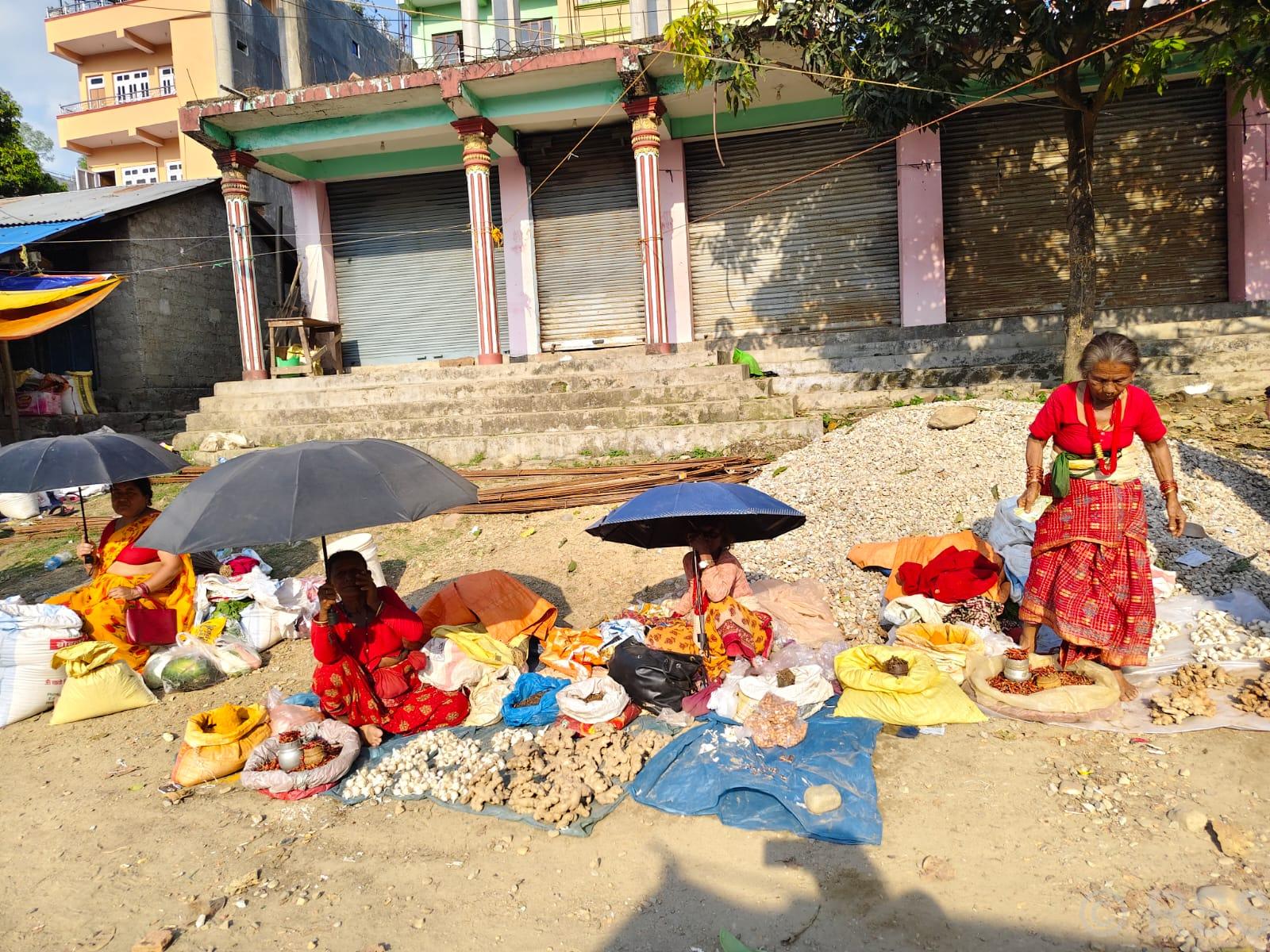
Sindhuli. The scorching sun of Baisakh has heated the ground. There is no shade to provide relief. Dhatimaya Darji, Sukumaya Thing, and Phulmaya Waiba are waiting for customers under their umbrellas. Although their heads are covered by umbrellas, the struggles of their lives remain exposed. Whether it is the storms of Phagun-Chait, the scorching sun of Baisakh-Jestha, or the downpours of Asar-Saun, they are found struggling in the daily markets and on the sidewalks.
It has been nearly three decades since 71-year-old Dhatimaya Darji began this journey. She started her business 27 years ago with an investment of 35 rupees. Dhatimaya's business journey began with buckwheat greens. "I used to buy 18 bunches of greens from farmers at two rupees per bunch for 36 rupees, and the farmer gave me a one-rupee discount. I sold those greens at five rupees per bunch, making a profit of three rupees. My investment of 35 rupees grew to 55 rupees," she recalled, reflecting on the past.
Dhatimaya, who used to travel to markets, fairs, and festivals in Sindhuli, Ramechhap, and Dolakha, continued to expand her business. The business that started with 35 rupees has now grown to nearly 35,000. She is a regular trader at the Saturday market held weekly in the district headquarters, Sindhuli-Madhi.
Even today, she sells seasonal produce grown in the village. She offers items like greens, ginger, turmeric, bananas, chili, hog plum, peanuts, guava, and gundruk. She said, "I am doing business according to my status. I have never had to beg from anyone to eat. I live by my own hard work. I am somehow managing my household expenses."
Today is Mother's Day. She hopes that her children might come to see her like other children visit their mothers, but no one cares. Dhatimaya had eight children—five daughters and three sons. All her daughters and her youngest son passed away prematurely. She does not have the support of her two surviving sons and daughters-in-law either. Dhatimaya, who works in the scorching sun, is troubled more by the grief of her lost children than by the heat of the sun. She has her husband with her, but she shared the bitter experience of having to fight through difficult struggles alone.
Dhatimaya's companion is Sukumaya. Over 80 years old, Sukumaya has been in business for 35 years. During this period, she has reached the Friday market in Bhiman, the Wednesday and Saturday markets in Sindhuli-Madhi, and even markets in Dolakha and Ramechhap. "If you are self-reliant, no one can look down on you. As long as my body supports me, I will work hard. I don't have any expectations from anyone," said Sukumaya. She says that one can make a living even by trading small quantities with a small investment.
Phulmaya, who was selling a handful of chilies, feels anxious seeing the skyrocketing prices of goods in the market. She has been trading in the Saturday market alone for 31 years. She has been selling organic vegetables, fruits, and other items produced in the village.
72-year-old Phulmaya does not want to burden anyone as long as her arms are functional. "My son is employed in the Nepal Army. But I have never burdened my son to this day. I am living on my own earnings. I hope to die while working and earning money like this," she said.
Dhatimaya, Sukumaya, and Phulmaya are each other's companions. They are often seen trading together in the markets. Even today, they are sitting in a row at the Saturday market. And it is not just in the markets! Many women are found trading with small investments on the sidewalks. It has been four years since Sabitri Thapa started trading on the sidewalk. She works on the sidewalk in the Sindhuli-Madhi area daily from 9 AM to 7 PM. There are many compulsions for this.
She is a mother of two children. Her daughter is married. She has two grandsons from her son, but after her son, who was the breadwinner, became ill and bedridden, she had to start trading on the sidewalk at the age of 60. Today, she has placed chili, chicken eggs, bananas, gundruk, wild perilla, timur, and turmeric for sale at Veterinary Chowk in Sindhuli-Madhi. She said that her daily earnings from the business range from 400 to 1,000 rupees.
Similarly, 80-year-old Devkumari Bhujel is also struggling on the sidewalk. She sells roasted and green corn, turmeric, chili, and hog plum. Since her social security allowance is not enough to cover her medicine, she is still forced to struggle on the streets. Unable to bear the neglect of her children, she has been living in a rented room separately. The struggle of spending old age alone for Devkumari is as difficult as it is for Anita Devi Ram to raise three children. Her struggle on the sidewalk began after her husband passed away.
Anita Devi's family from Gaushala, Mahottari, has been living in a rented room in Kamalamai Municipality-5, Chisapani, for 12 years. After Bijay Ram, the only support of the family, passed away due to illness, Anita Devi became destitute. She did not even get support from relatives or family.
When Bijay passed away, her eldest son was 10 years old. As the problem of hunger began to grow, she started continuing the work that Bijay used to do. Chandan, who was studying in class five at Gaumati Model Secondary School, had to drop out. After that, Anita Devi learned to mend shoes and slippers and apply polish herself. Once she learned the skill, she sent her son to school and she went to work.
The beginning of this journey was not easy. After her husband's death, life took a difficult turn. "Earlier, I used to be busy with household chores. I didn't know this work. My son had learned it by watching his father work, and I started learning and doing it from him," she shared.
Anita Devi, who was limited to household chores when her husband was with her, is now forced to manage outside work as well. Her daily routine is to finish morning household chores, send her children to school, and then go out to the sidewalk with the tools she needs to mend shoes and slippers. "My fingers get pricked while mending shoes and slippers all day, and my arms ache so much that I don't get a good night's sleep sometimes. The work is difficult. But there is a compulsion to do it," she said.
Anita Devi charges 100 rupees for mending shoes and slippers and 50 rupees for polishing shoes. She has kept polish, shoe cleaning brushes, soles, and shoelaces for sale. Her husband used to earn 1,500 to 1,800 rupees daily from the same shoe-mending profession. Anita Devi's earnings are lower. She said, "Sometimes there is no income at all. Sometimes it is between 500 to 1,000 rupees."
Because she is a woman, men do not give their shoes and slippers to Anita Devi for mending or polishing. She says that perhaps because they don't see her as a 'Lakshmi' (goddess of wealth), she only gets work from women, which results in lower income. While working on the sidewalk, she also faced many types of behavior. The view of society, her own hesitation, and shame broke her many times.
"Some people used to mock me. They said this work is only for men and that I should go look for work washing dishes," Anita Devi shared. This journey, which she started with difficulty and shyness, is about to cross three and a half years. But the difficult struggle of making a living by mending shoes and slippers on the sidewalk has not decreased.
Small traders on the sidewalk are occasionally removed by the municipal police. This causes problems for those who are making a living by doing small trade and business on the sidewalk. The local government has also not been able to manage this properly.
The people's representatives of the municipality say that efforts are being made to manage it. These hardworking women in this story, who are sweating on the sidewalks due to extreme scarcity and pressure, have a little regret about their fate, but they have no complaints against anyone. The hope that one day their fate will change through today's difficult struggle is alive in all of them.
This specific news has been automatically translated by AI. As a result, there may be some inaccuracies or language errors.