The Struggle for Connectivity: How Lack of Infrastructure Threatens Nepal's Remote Vyas Region


Dhangadhi. One does not need to look far to find an example of how a region slowly becomes alienated due to the lack of roads. Until 2018 BS, residents of Kuti, Napi, and Gunji villages in Vyas Rural Municipality-1 paid taxes to the Government of Nepal. They held official Nepali land ownership certificates. However, due to the absence of state presence and road networks, those villages gradually fell under Indian control.
Today, the people of those villages have become Indian citizens. They hold Indian citizenship, work for the Indian government, and speak Hindi. Although Nepal has included those villages in its updated map, the country's capital has become very distant for the people living there. Locals in the other two settlements of Vyas-1, Changru and Tinkar, are now living in fear.
'The people of Kuti, Napi, and Gunji share the same language, culture, and blood ties as us. But without a road, they became neighbors. If the Tinkar road is not built, it cannot be said that the future of the remaining Changru and Tinkar will not follow the same path,' said local Bir Budhathoki.
Among the six wards of Vyas Rural Municipality, Ward Number 1 (Changru and Tinkar) is the most remote. According to the 2078 BS census, the population here is about 10,000. As the area is covered in snow during winter, they descend to the district headquarters, Khalanga, for six months and head back up once Baisakh arrives. This is known as 'Kuncha Sarne' in the local language. In winter, only the Armed Police Force's Border Out Post (BOP) remains deployed in the village. The rest of the village becomes deserted.
Ward Number 2 includes villages like Dumling, Kalju, Mal, and Ratla. Ward Number 3 includes Sinah, Pusarpani, and Salyani, while Ward Number 4 is slightly larger, containing Sunsera, Dokato, and Madgaun. Ward Number 5 includes Dhaulakot, Syaku, Maji, and Tigram, while Ward Number 6 includes Huti, Pachhyar, Khati Gaun, Tamtoli, and Panikhal. While wards 6, 5, 4, and 3 have been electrified, the condition of Ward Number 1 is pathetic. Although there is a micro-hydro project in Tinkar, locals in Changru are forced to spend their nights relying on solar power after their project was swept away by floods.
To reach Ward Number 1 of their own country, Nepali citizens must use Indian territory. Nepalis are not allowed to go there without an Indian permit. The Government of Nepal spent 55 million rupees to build a trekking trail to reach there, but it is so dangerous that people are afraid to walk on it. Only traders and shepherds take that risk. Ordinary citizens must obtain a permit to use the Indian route. What greater national shame can there be than needing permission from another country to visit a village in one's own?
According to locals Basu Kunwar, Basanti Dhami, Janak Dhami, and Krishna Budhathoki, India has extended well-facilitated roads and infrastructure up to the border on their side. However, on the Nepali side, even though locals use the forests and land, everything is at a standstill due to the lack of roads.
The Mahakali Corridor (Brahmadev-Jhulaghat-Darchula-Tinkar road project), which carries the dream of transforming Vyas, started in the 2065-66 BS fiscal year. According to Engineer Dinesh Raikhola, Information Officer at the project office, this 413-kilometer-long road aims to connect four districts of Sudurpashchim—Kanchanpur, Dadeldhura, Baitadi, and Darchula—up to the Tinkar border with China.
Looking at the progress so far, 334 kilometers are under the responsibility of the Department of Roads, while the remaining 79 kilometers of the extremely difficult rocky section from Tusarpani to Tinkar have been handed over to the Nepal Army. With an estimated total cost of 18.16 billion rupees, 8.59 billion rupees have been spent so far. Out of the 334 kilometers under the Department of Roads, the track has been opened for 287 kilometers. However, 17.8 kilometers of track remain to be opened in the Darchula section.
The main problem is the budget. The Army brought machines to Changru by helicopter to break through the hard rock and started work. The Army has been requesting an annual budget of 250 to 300 million rupees, but the government barely allocates 80 to 90 million. If work continues at this pace, no one knows when this road will be completed. Out of 35 concrete bridges that need to be built, only one is currently under construction.
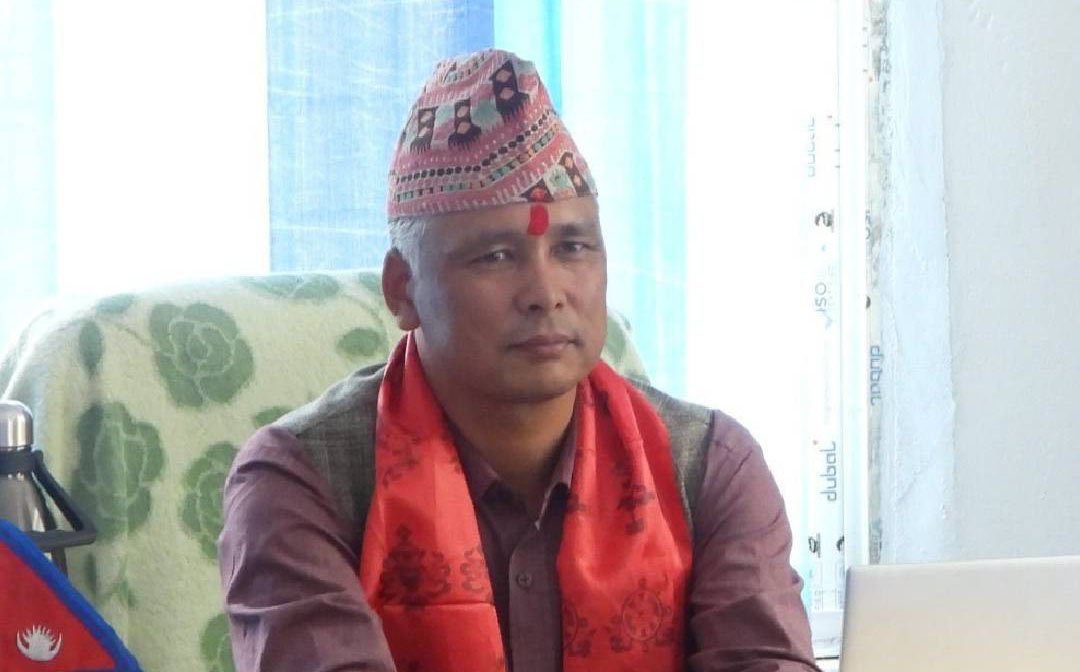
Vyas Rural Municipality Vice-Chairman Binod Singh Kunwar grew up using tuins (cable crossings). 'Until the Tinkar road is built, it is very difficult to replace the tuins,' he says.
According to Kunwar, the suspension bridges that have been built are not accessible to everyone due to the difficult terrain. Even now, a 70-meter-long tuin is in operation in Dumling, Vyas-2, with one end in Nepal and the other in Uttarakhand, India. While Member of Parliament Harka Sampang had promised to remove this only remaining tuin in Darchula by raising funds, he could not build a bridge there due to bilateral issues. Under his leadership, a bridge is currently being built over Ghatte Khola to connect two villages in Dumling.
Vyas is attractive in terms of tourism. From here, one can reach the base of Api Himal in a single day. This could be the shortest and safest route for the Kailash Mansarovar pilgrimage. It is a treasure trove of medicinal herbs and natural resources. But there is no hospital on its own land. Even though there is a health post, for critical patients, one must either wait for a helicopter or rely on the Indian road.
According to Vice-Chairman Kunwar, the representatives of Vyas have knocked on the doors of Singha Durbar many times and pleaded. Internal roads have been dug with the municipality's own budget. Among the 6 wards of the municipality, roads have been dug in all wards except 2 and 1. But those roads do not connect all the villages and settlements to the district headquarters.
'Since we were elected, we have visited Singha Durbar many times; there is a lack of budget to build the road. Things are said one way outside, but our internal reality is like this. The future of Vyas is the Tinkar road; how much more suffering must the people here endure?' says Vice-Chairman Kunwar.
He states that since the Tinkar road project will work to secure a bright future for Vyas and save the remaining Nepali settlements, the government must now prioritize the construction of that road.
This specific news has been automatically translated by AI. As a result, there may be some inaccuracies or language errors.