Bagmati Province Government Faces Budget Execution Challenges with Low Spending in First Nine Months

Hetauda. The Bagmati Province government has spent only about one-fourth of its total allocated budget by the end of the third quarter of the current fiscal year. As of the end of Chaitra, the provincial government has spent only 28 percent of its total budget.
With only three months remaining in the fiscal year, there has been no significant progress in government spending. Based on the current situation, the provincial government is required to spend 72 percent of its budget in the next three months.
The financial progress report for the period ending in Chaitra, published by the Ministry of Economic Affairs and Planning, shows that the provincial government's performance has been extremely sluggish. The government faces pressure to exhaust 72 percent of the budget in the upcoming three months (Baisakh, Jestha, and Asar).
The government had introduced a total budget of 67.47 billion 33 million 70 thousand rupees for the current fiscal year. By the end of Chaitra, only 19.37 billion 17 million 81 thousand rupees (28.71 percent) has been spent. It appears the government must spend 48.10 billion 15 million 89 thousand rupees (71.29 percent) in the remaining three months.
Spending such a large amount in a short period is certain to compromise the quality of work and encourage the trend of year-end spending.
The state of capital (development) expenditure, which is directly linked to the province's development, also appears weak. Out of the total capital budget of 40.83 billion 53 million 56 thousand rupees allocated for the current fiscal year, government agencies have spent only 9.42 billion 32 million 6 thousand (a total of 23.09 percent) in the nine-month period. The government faces the task of spending 31.41 billion 21 million 50 thousand (76.91 percent) of the development budget.
- Ministry-wise Sluggishness: What is the status of each ministry?
The spending capacity of the development-focused ministries, which hold the largest budgets, appears weak. The Ministry of Physical Infrastructure Development, which received about 40 percent of the provincial government's total allocated budget, has shown only 30 percent expenditure in nine months. With a capital budget of 21.14 billion, the ministry has spent 6.37 billion (30.15 percent) so far. The ministry is in a position where it must spend over 14 billion in development budget in the next three months.
The second largest ministry in terms of budget share, the Ministry of Water Supply, Energy and Irrigation, has spent only 25.13 percent of its budget so far. Having received a capital budget of 9.72 billion, the ministry has spent only 2.44 billion to date.
The Ministry of Agriculture and Livestock Development has spent only 410 million (19.63 percent) out of a capital budget of 2.13 billion, while the Ministry of Health has spent only 870 million (25.55 percent) out of a capital budget of 3.41 billion. The Ministry of Forests and Environment has spent only 440 million (21.05 percent) out of a capital budget of 2.12 billion.
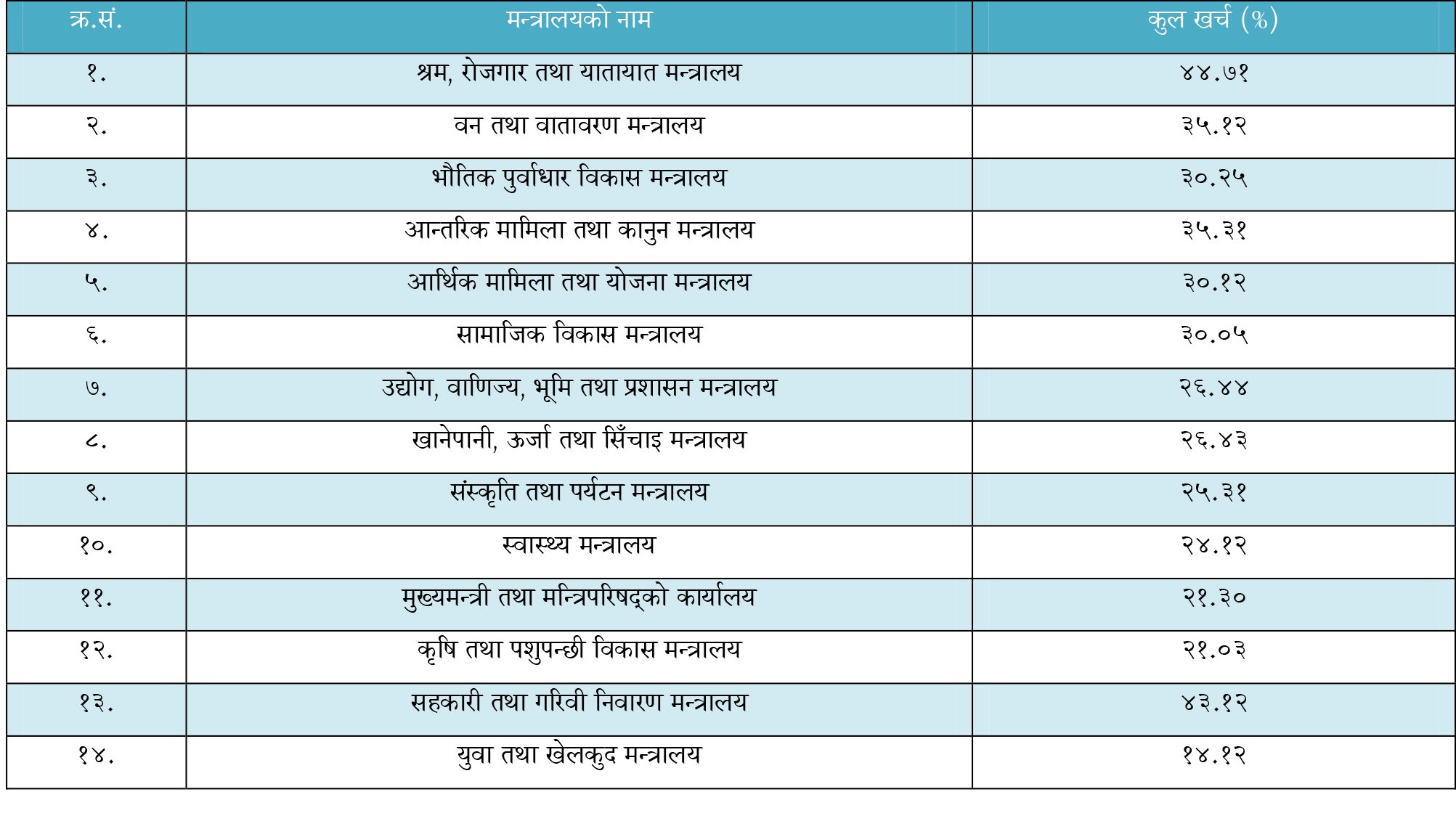
According to data from the Ministry of Economic Affairs and Planning, provincial ministries have spent an average of only 28.71 percent of their budget by the end of Chaitra. Among the 14 ministries of the province, the Ministry of Labour, Employment and Transport has spent a relatively higher amount of budget. That ministry is at the top of the list of ministry-wise expenditure, having spent 44.71 percent of its budget.
While the Ministry of Economic Affairs and Planning spent 30.12 percent, the Ministry of Social Development 30.05 percent, and the Ministry of Forests and Environment 35.12 percent, the Ministry of Industry, Commerce, Land and Administration spent 26.44 percent.
The Ministry of Physical Infrastructure Development has spent only 30.25 percent of its budget, while the budget expenditure of the Office of the Chief Minister and Council of Ministers appears limited to 21.30 percent. The performance of the Ministry of Youth and Sports is the weakest, having spent only 14.12 percent of its budget by the end of Chaitra.
The Ministry of Water Supply, Energy and Irrigation has implemented 26.43 percent, the Ministry of Health 24.12 percent, the Ministry of Culture, Tourism and Cooperatives 25.31 percent, and the Ministry of Agriculture and Livestock Development 21.03 percent of their budgets.
- Average Revenue Collection
The revenue collection status of the Bagmati Province government for the nine months (ending Chaitra) of the current fiscal year (2082/083) appears average. With revenue collection under the provincial government's headings not being satisfactory, it looks very challenging for the government to meet its revenue collection target in the next three months.
According to the financial statement of the Ministry of Economic Affairs and Planning, the provincial government has collected 41.40 percent of the total target. While the government set a target to collect a total of 67.47 billion 33 million 70 thousand rupees in revenue for the current year, 27.93 billion 2 million 4 thousand rupees have been collected by the end of Chaitra. Among the various revenue headings, Value Added Tax and Vehicle Tax have become the main sources of the province's income.
Under Value Added Tax, 5.63 billion (64.86 percent) has been collected against a target of 8.67 billion, while 3.06 billion (61.40 percent) has been collected under Vehicle Tax against a target of 5.25 billion. 3.42 billion (45.80 percent) for house and land registration fees and 2.29 billion (49.32 percent) for excise duty have been deposited into the government treasury. Revenue received under these headings is obtained through revenue sharing.
In terms of the province's internal sources, entertainment tax collection appears to have increased slightly. For internal income, the provincial government had set a target of 6.6 million, and 92.04 percent (6.055 million rupees) has already been collected. The government has collected 63.02 percent in tourism fees and 1.99 million rupees from the sale of forest products (wood and firewood). 1.86 billion (75.40 percent) in revenue has been raised from driver's license and renewal (blue book) fees.
Regarding the fiscal equalization grant received from the federal government, 5.83 billion (70.45 percent) has been received so far against a target of 8.35 billion, but the receipt of conditional grants, special grants, and matching grants is low compared to the target. In particular, it appears that only about 15 percent of conditional and matching grants for capital expenditure had been received by the end of Chaitra.
Although the government estimated that 16.98 billion rupees would be received from last year's cash balance and recovery of arrears, only 1.21 billion (0.71 percent) progress has been seen under that heading by the end of Chaitra.
This specific news has been automatically translated by AI. As a result, there may be some inaccuracies or language errors.
_xNfaHPeaw1.jpg)
_bYdCl5n4QS.jpg)