The Chaos of Nepal's Agricultural Subsidy System

Kathmandu. In the government's language, there is one issue that farmers are always complaining about in the agricultural sector: 'subsidies'. The government is investing billions in subsidies under the guise of modernization, increased investment, and promotion in agriculture. Federal, provincial, and local governments are all active in this, but due to a flawed subsidy system, it has become the main subject of farmers' grievances. Critics argue that the subsidies provided by the government to increase agricultural production do not reach actual farmers, while 'paper farmers' siphon off the funds.
In the policy, program, and budget for the fiscal year 2081/082, the government even declared a 'Decade of Agricultural Investment'. Accordingly, the government claimed it would organize the subsidy system to increase investment in the agricultural sector. In the current fiscal year (2082/083), under the National Agricultural Modernization Program—which replaced the Prime Minister Agriculture Modernization Project—the budget announced the provision of capital subsidies and concessions for irrigation, fertilizer, seeds, and technology for 21 super zones and 206 zones in agriculture and livestock.
A budget of 3.5 billion rupees has been allocated for this in the current fiscal year, but due to a lack of coordination between the federal, provincial, and local governments regarding the budget allocated for agricultural subsidies, the system appears chaotic.
The then K.P. Sharma Oli government, which introduced the budget, was ousted following the Gen-Z movement, leading to the formation of an interim government, and subsequently, a new government was formed after elections. The new government led by Prime Minister Balen Shah has not prioritized the issue of agricultural subsidies.
Although the 100-point agenda made public by the government includes modernization of the agricultural sector, market guarantees, and concessional loans, it barely touches upon the issue of subsidies. According to the 100-point agenda, policy reforms will be made through the Nepal Rastra Bank to facilitate easy access to agricultural loans for investors and farmers.
According to point number 57, the current 'risk weight' in agricultural loan disbursement will be reduced within 30 days to make arrangements for interest rate concessions. This will open the path for those making commercial investments in agriculture to obtain loans at lower interest rates. Beyond that, no other matters regarding subsidies are mentioned.
- Subsidy details not made public regularly, difficult to find
On Poush 28, 2081, the Ministry of Agriculture and Livestock Development published the names and details of farmers receiving agricultural subsidies for the first time. Since taking charge of the ministry, the then Agriculture Minister Ramnath Adhikari had repeatedly promised to publish the names and details of subsidy recipients, and six months into his tenure, he released the details including names for the past five years.
_eJpHGoBXLv.jpg)
The government has been providing subsidy support to farmers through crop and livestock insurance, incentive subsidies for sugarcane farmers, special agricultural production programs, support through minimum support prices for various crops, the Prime Minister Agriculture Modernization Project, various projects operated with foreign aid, vaccine production programs for animal disease control, semen production and distribution programs for breed improvement, and conditional grant programs at provincial and local levels.
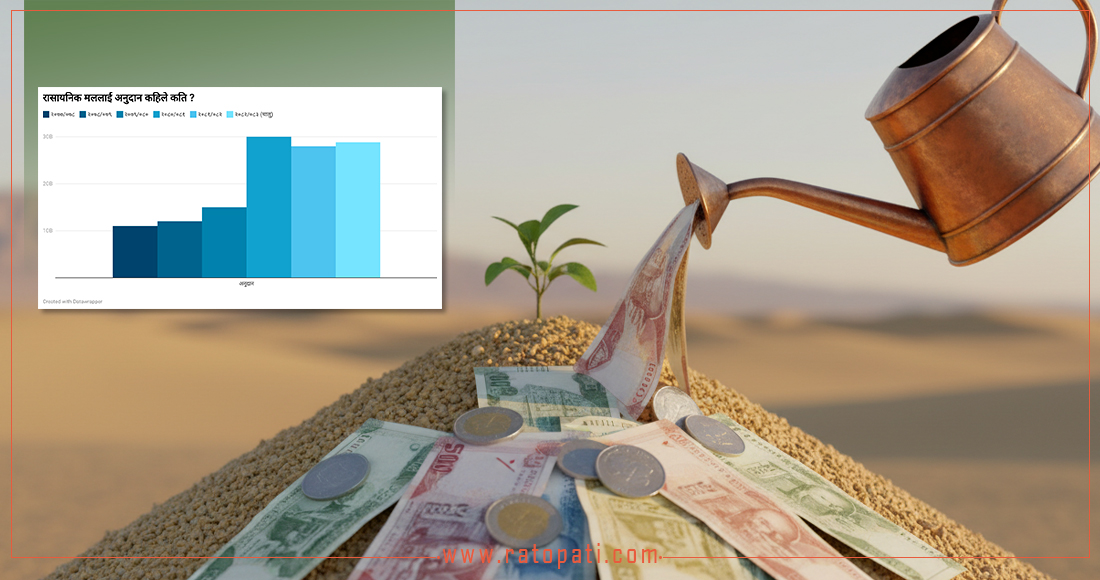
According to the subsidy details released by the then Minister Adhikari, approximately 19.6 million farmers have benefited from the distribution of subsidies worth a total of 107.66 billion 27 million 89 thousand rupees from the Ministry of Agriculture and Livestock Development over the past five years, from fiscal year 2076/077 to 2080/081.
The subsidy amount increased annually from 2076/077 to 2079/080, but it appears that the subsidy amount in 2080/081 was lower than in 2079/080. While the subsidy amount was 19.34 billion rupees in 2078/079, it reached a total of 36.02 billion rupees in 2079/080, primarily due to a two-fold increase in subsidies for chemical fertilizers, whereas it decreased to about 29.0034 billion rupees in 2080/081. According to the details, the majority of the subsidies distributed by the ministry were for chemical fertilizers.
According to public data, the ministry states that 107.66 billion 27 million 89 thousand rupees were distributed in subsidies over the five years from 2076/077 to 2080/081. The ministry claims that about 19.6 million farmers benefited from this, but since then, the ministry has not been able to provide information on how much subsidy has been distributed other than for chemical fertilizers. It is also not easy for farmers to find subsidy details.
Subsidy details booklet can be viewed here
The ministry states that the said amount was distributed in subsidies, both directly and indirectly, from 2076/077 to 2080/081. According to the ministry, 20.30 billion 30 million 14 thousand rupees were distributed in direct subsidies during those five years. In the period from 2076/077 to 2080/081, according to the ministry, a total of 6.61 billion 95 million 31 thousand rupees was distributed through 141,670 agricultural cooperatives, agricultural groups, and agricultural firms under this project.
Besides that, startup subsidies were distributed by the ministry under the Rani Jamara Kulariya Irrigation Project Agriculture Program Implementation Unit, Food and Nutrition Security Improvement Project, and RIDP project. Similarly, the federal government provided subsidies for sugarcane farmers, livestock and fisheries insurance premiums, and the PACT project.
- Lack of coordination
The Constitution of Nepal has entrusted the authority over the agricultural sector to all three tiers of government, but the lack of coordination between these governments has made agricultural subsidies chaotic. Even years after the implementation of federalism in Nepal, the 'subsidy system', considered the backbone of the agricultural sector, remains in a state of confusion and chaos. Farmers have been saying that due to the lack of coordination between the federal government, provincial governments, and local levels, agricultural subsidies are like pouring water into sand.
As local and provincial governments have not developed an integrated data system, monitoring of subsidies has become almost impossible. 'None of the three governments are clear about who gives the subsidy, how to take it, and whether it reaches the actual farmers,' says indigenous agriculture activist Badri Kandel. 'Due to the lack of a "one-door" system in Nepal's agricultural subsidy system, not only has the state treasury been misused, but actual farmers are becoming even more frustrated.'
According to Dr. Ramkrishna Shrestha, Joint Secretary at the Ministry of Agriculture and Head of the Agriculture Development Division, the means of subsidy distribution have changed with the implementation of federalism, but those means have not been integrated. While the federal government is working by focusing on large policy plans, chemical fertilizers, and insurance, provincial governments are emphasizing value chain development and large storage centers. Local levels are distributing small incentive amounts based on production and small agricultural tools by creating their own procedures.
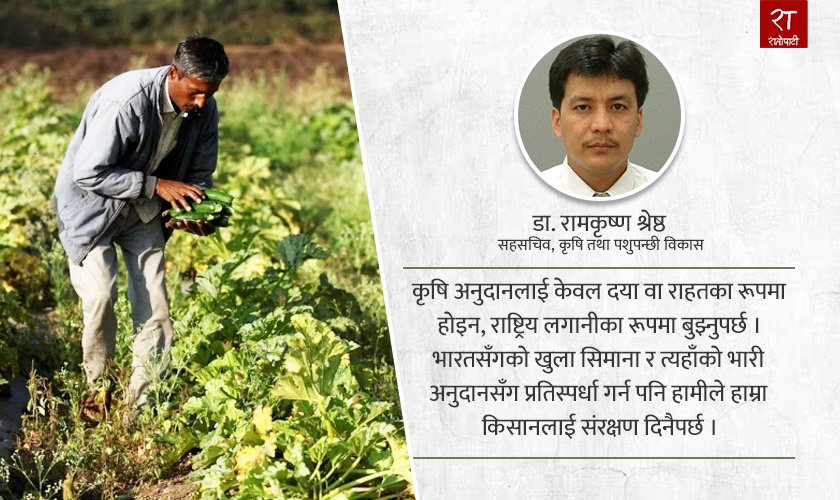
Shrestha admits that problems have arisen because all three tiers have created their own procedures for subsidy distribution. He said, 'The constitution has placed the agricultural sector in the list of shared rights of all three tiers, but the scope of work regarding which tier provides what nature of subsidy is still blurred.'
According to Shrestha, the federal government provides subsidies for chemical fertilizers and large projects, while the province emphasizes machinery and small irrigation. Then, local levels are also distributing small tools and seeds in their own way. 'The same person might be receiving subsidies from all three tiers, but we do not have any integrated software or database to track that,' he said.
According to Dr. Shrestha, subsidies need to be viewed by dividing them into two parts: input subsidy (based on cost) and output subsidy (based on production). In Nepal, about 60 to 90 percent of the total agricultural budget is spent on cost subsidies like fertilizers and insurance.
_P39mIdHh6R.jpg)
A Joint Secretary at the Ministry of Agriculture, who has also worked as an Agriculture Secretary in the province, says, 'Due to the own ways of the three tiers of government, a large amount of money is being spent in unproductive sectors in the name of agricultural subsidies.'
He argues that the federal government is busy distributing small pieces of subsidies when it should be making policies and standards. 'Provincial governments are copying federal programs to show their existence, while at the local level, the selection of plans is happening more on the basis of pleasing political cadres than technical necessity. For this, an integrated subsidy system is needed,' he said.
- Subsidy system is not farmer-friendly
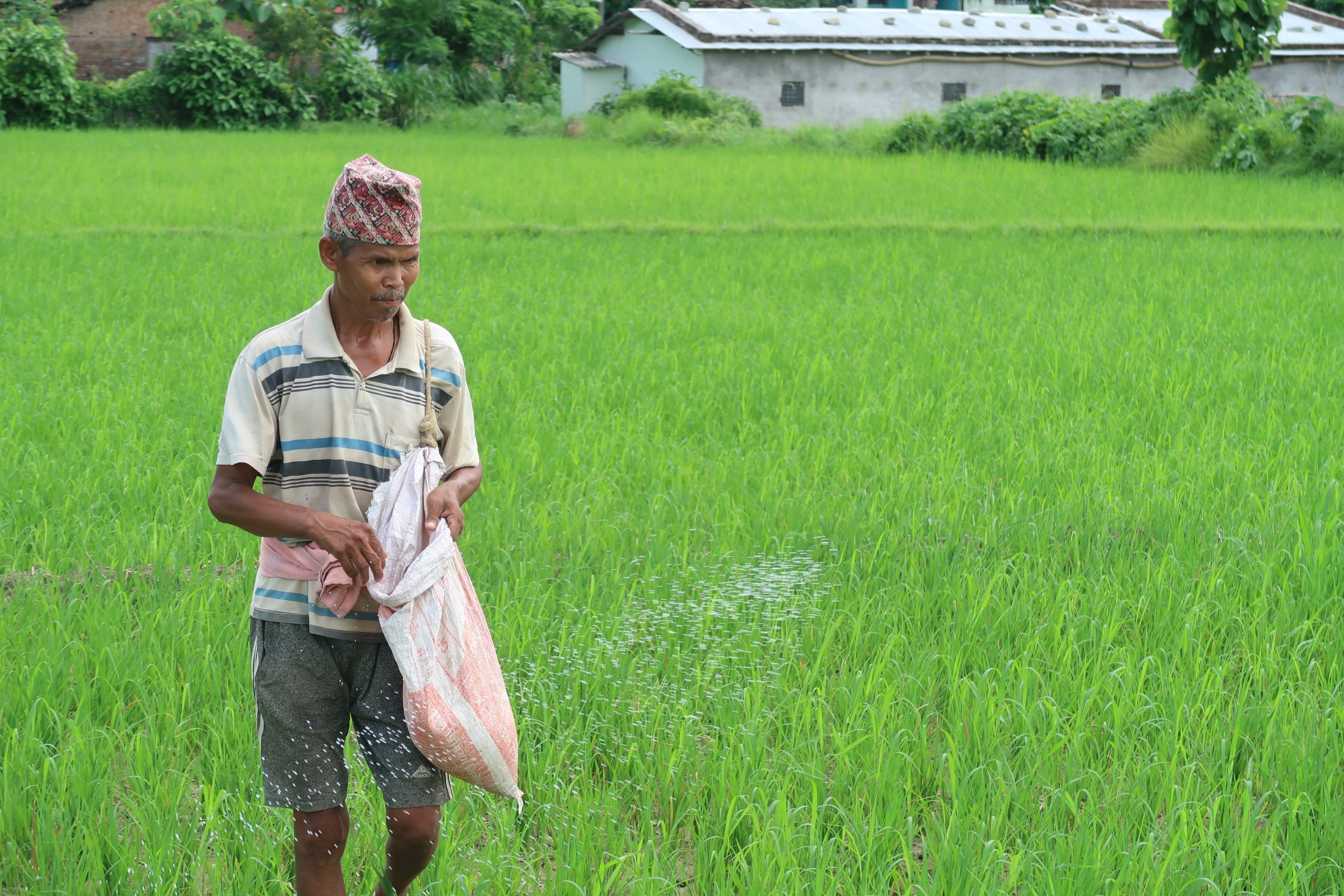
Farmers say that even though agricultural subsidies are for their benefit, they have always been complicated for small farmers. They argue that due to the paper-based and impractical system, only those who can manage the paperwork, rather than those who produce, are able to get the subsidies. Farmer leaders have been accusing some local levels of creating subsidy plans only to feed their 'own' people.
According to Kandel, farmers are not encouraged to farm because the share of subsidies given after production increases is minimal. 'Due to procedural complexities and paperwork hassles, applying for subsidies for small farmers in remote areas is like a Mahabharata,' he said.
According to Panchakaji Shrestha, President of the National Farmers Group Federation, Nepal's agricultural subsidy system has not been able to be truly farmer-friendly. He claims that the state has invested, but it is like pouring water into sand.
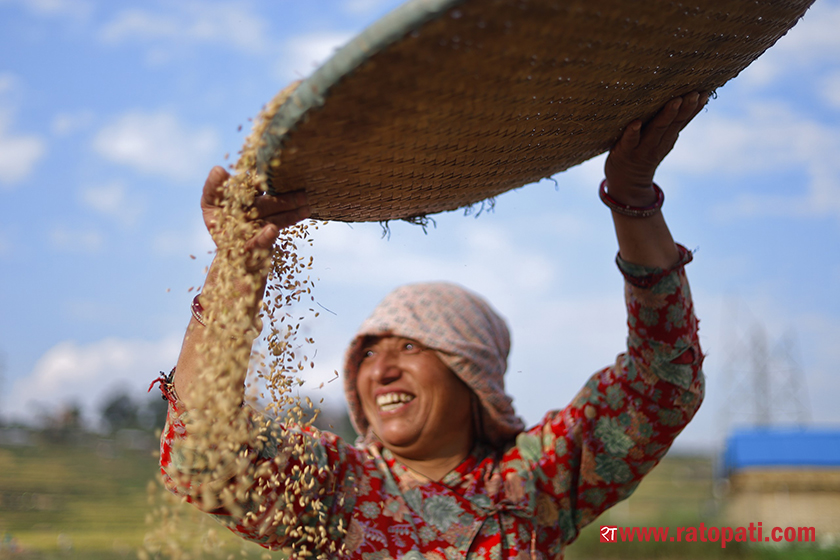
'Especially in the area of concessional loans and interest subsidies, the recent apathy of banks has pushed farmers to the brink of displacement. Banks have stopped giving concessional loans since last Falgun, and the government has shown no interest in finding a solution to this,' said Shrestha. He said that while influential people and large firms are exploiting state resources, small farmers are suffering from the high interest rates and cumbersome processes of banks.
President Shrestha emphasized that 'farmer identification' should be made the main basis for subsidies. Without clear listing and identity cards for farmers, no subsidy provided can reach the actual target group. He argues that the current style of 'giving to whoever comes to ask' has always sidelined marginalized and landless farmers. 'Until the subsidy policy is revised to respect the labor and production of farmers working in the field, talk of self-reliance in agriculture will remain limited to paper slogans,' Shrestha told Ratopati.
It is necessary for the subsidies provided by the state to become a strategic tool to improve the living standards of actual producers, rather than a means to fill the pockets of a few limited individuals. He alleges that even now, the subsidy system is 'access-oriented' rather than farmer-oriented. 'The current subsidy distribution is arbitrary. Because there is no farmer listing, whoever knows how to file an application or has political access is grabbing the subsidy.'
According to Shrestha, small farmers without access do not even know which subsidy is available from where. 'Talk of subsidies is heard in the market, but the actual farmer in the village knows neither the process nor the doors of government offices. It is as if government subsidies are only for farm owners and industrialists,' he expressed his anger.
According to agricultural activist Dipesh Nepal, the current subsidy system is completely demand-based, which is its biggest weakness. The system where only those who can complete the paperwork and those who can run around government offices get subsidies has frustrated actual producers. Activist Nepal argued that subsidies should be classified into two parts: universal and competitive.

'There should be an arrangement where everyone gets equal access to basic needs like fertilizer and seeds, while machinery and large subsidies should be competed for based on certain criteria. The current "hundred versus ten" (out of 100 people who apply, only 10 get it) situation is creating hatred towards the state in the remaining 90 people,' he said.
According to Nepal, the local level makes one rule, the provincial 'Agriculture Knowledge Center' has different conditions, and federal projects have their own cumbersome processes. He said, 'A farmer has to run to three offices to buy one machine. The proposal made to get a subsidy is so complex that the farmer cannot make it himself. This increases the manipulation of middlemen.'
He argued that focusing agricultural subsidies only on machinery and physical infrastructure instead of making them production-based has not led to an increase in actual production.
- What is the problem and solution?
According to agricultural experts, the lack of an integrated database is the main problem of the current subsidy system. 'There is no coordination between government agencies regarding which farmer received what support from which tier. This has encouraged double dipping,' said agricultural market economist Abinash Silwal.
Similarly, according to the National Farmers Group Federation, the subsidy system has not been able to be good because the work of farmer classification is neglected. 'It is not fair to put rich and commercial farmers and small farmers who farm for subsistence in the same basket and distribute subsidies,' said Federation President Shrestha.
Agricultural activist Nepal says that a 'roster system' could be an effective alternative for its solution. According to him, the state should ensure that all farmers who meet the criteria are listed, and those not covered by the budget this year are automatically prioritized next year. This keeps the hope alive in farmers that 'I will also get it in the future'. 'For small and marginalized farmers, there is a need to develop a system where a one-page application is arranged and technicians themselves reach the fields to recommend subsidies,' he said.
Agricultural economist Silwal argues that concessional loans for startups and production-based subsidies for established businesses would be fair. 'To compete with cheap products from Indian and international markets, there is no alternative to making the subsidies given to Nepali farmers production-oriented,' he said.
Agricultural economist Abinash Silwal says that until all three tiers of government make farmer listing mandatory through a one-door system, agricultural subsidies will not be able to increase productivity. According to Silwal, subsidies should not be limited to cash or machinery but should be linked to 'farm demonstration' and market assurance.
- The entire agricultural sector is at low priority
The government has been giving very low priority to the agricultural sector while preparing the budget. Half of the budget allocated for the Ministry of Agriculture goes to chemical fertilizer subsidies every year. 'Firstly, the budget for the agricultural sector is low, and even then, 50/60 percent of the budget goes to chemical fertilizers. The government should at least give more than 5 percent of the budget to the agricultural sector annually, but the government has not been able to give more than 2/3 percent,' says farmer activist Badri Kandel.
The government has allocated only 2.93 percent of the budget to the Ministry of Agriculture and Livestock Development in the current fiscal year's budget. Data from the past 12 years shows that as the government's total budget increases, the budget for the agricultural sector also increases.
Here is the agricultural budget for the last 12 years
- 2070/071: 21.40 billion
- 2071/072: 23.28 billion
- 2072/073: 21.51 billion
- 2073/074: 27.43 billion
- 2074/075: 24.26 billion
- 2075/076: 29.94 billion
- 2076/077: 34.83 billion
- 2077/078: 37.40 billion
- 2078/079: 45.05 billion
- 2079/080: 55.89 billion
- 2080/081: 58.98 billion
- 2081/082: 57.29 billion
- 2082/083: 57.48 (current)
This specific news has been automatically translated by AI. As a result, there may be some inaccuracies or language errors.