Former Foreign Minister Gyawali Criticizes Government's Use of 'Buffer State' Terminology

_agHMR5oB6V.jpg)
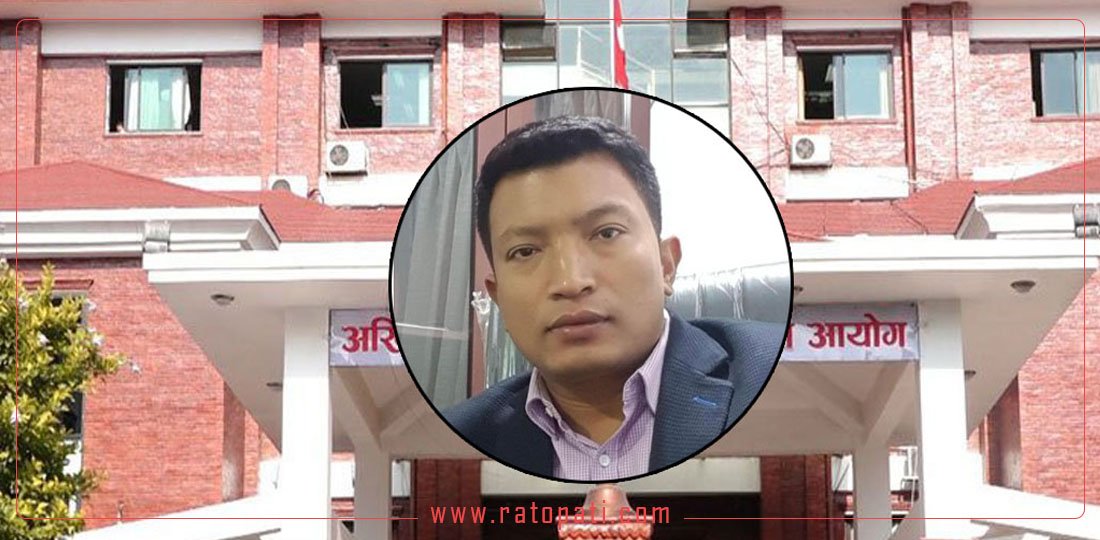
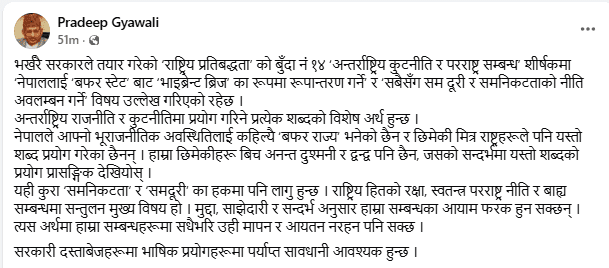
Kathmandu. Former Foreign Minister and CPN-UML leader Pradeep Gyawali has expressed strong objection to the government's description of Nepal's geopolitical position as a 'buffer state.' Leader Gyawali took to social media to criticize the new government's choice of words, asserting that Nepal's geopolitical status has never been defined as a 'buffer state'.
The Balendra (Balen) Shah government released a draft of its national commitment on Tuesday, which incorporated elements from the manifestos of national political parties. 'In point number 14 of the government's newly prepared 'National Commitment' under the heading 'International Diplomacy and Foreign Relations,' it is mentioned that Nepal will be transformed from a 'buffer state' into a 'vibrant bridge' and that a policy of 'equidistance and equiclose' will be adopted,' Gyawali wrote. 'Every word used in international politics and diplomacy carries a specific meaning. Nepal has never referred to its geopolitical position as a buffer state, nor have our friendly neighboring nations used such terminology.'
Reminding that there is no perpetual enmity or conflict between our neighbors, Gyawali clarified that the use of such terms appears irrelevant. He further stated that the same logic applies to the concepts of equiclose and equidistance.
Emphasizing that the protection of national interest, an independent foreign policy, and balance in external relations are paramount, leader Gyawali noted that the dimensions of our relationships may vary depending on issues, partnerships, and contexts.
'In that sense, our relationships may not always maintain the same measurement and volume,' Gyawali said, adding, 'Sufficient caution is required in the linguistic usage within government documents.'
This specific news has been automatically translated by AI. As a result, there may be some inaccuracies or language errors.