
Bureaucratic Hurdles Leave Community Forest Timber Rotting in Kailali


Kailali. Bimala Budhathoki, a resident of Ghodaghodi Municipality-1, Sukkhad, lives right next to a community forest and is a member herself. She initially thought obtaining timber for her new house would be easy, but the reality proved otherwise.
Complaining about the difficulty of obtaining wood for windows and doors despite living near the forest, Budhathoki says, "I thought being a member would make it easy, but the process is incredibly cumbersome. I ended up having to buy expensive timber from a sawmill."
Budhathoki is not alone; most residents in the district, including those in Ghodaghodi, face similar issues. Kailali and Kanchanpur are among the districts with the highest forest cover in the country, rich in valuable species like Sal, Sissoo, and Khair. These forests contribute significantly to local employment, community income, and state revenue.
However, in recent years, many trees have fallen or dried up due to natural disasters, but they are not collected in time. Consequently, the timber rots in the forest, is stolen, or is destroyed by wildfires.
Jograj Chaudhary, chairman of the Singhpur Community Forest in Kanchanpur, confirms this problem. He notes that while large quantities of timber are piled up in the forest, they cannot be utilized. "The wood is rotting in the forest, but we cannot collect it until the procedures are completed. As a result, local consumers cannot get wood even in times of urgent need," Chaudhary said.
'Better to let it rot in the forest'
Community Forest User Groups play a vital role in forest conservation, yet they are unable to utilize fallen or dead trees within their own forests. For sustainable management, only a limited number of trees can be felled according to the annual forest work plan, but fallen trees cannot be used without further authorization.
Collecting such trees requires a decision from the District Disaster Management Committee, followed by recommendations from the Provincial Forest Directorate and consent from the Provincial Ministry of Forests. Nar Bahadur Sodari, chairman of the Budho Betal Community Forest User Group in Kailali, says this process takes weeks or months, leading to the wood rotting. "Even if trees fall, we are not allowed to collect more than the number specified in the annual work plan. By the time the process is complete, the wood has already deteriorated. We need to find a suitable solution for this problem," he said.
Suresh Chaudhary, chairman of the Jan Jyoti Sonia Community Forest in Bhajani Municipality-9, adds that delays in receiving cutting orders from the Sub-Division Forest Office after field inspections further complicate timber management. "Orders arrive late, and sometimes exports are blocked, causing the wood to rot and its value to decrease. This has been a problem for years," he said.
Shishir Chand, chairman of the Laligurans Community Forest in Gauriganga-4, notes that cutting permits often do not arrive even three months after filing. He suggests ending this situation to allow for the easy and scientific utilization of forest products.
Increasing risk of wildfires
The failure to collect fallen and dead trees in time is also increasing the risk of forest fires. Pushkal Bam, chairman of the Basanta Forest Conservation Area Council, states that the accumulation of dry wood is a major challenge for fire prevention. He explained that if a fire breaks out in a forest with a lot of dry wood, it requires significant resources to control and causes extensive damage.
Bal Bahadur Mahata, chairman of the Gauriganga Partnership Forest User Group, said that partnership forests face similar problems. He believes that limited consumer rights and long waiting periods for timber create the same issues as in community forests.
Yadav Prasad Bhandari, secretary of the Partnership Forest User Federation, also points to the current structure and legal processes as the root cause. "One has to visit three levels of offices to collect a single fallen tree. Therefore, the consumer remains a silent spectator rather than an owner," he says.
Om Prakash Sapkota, chairman of the Community Forest Coordination Committee in Masuriya, emphasizes that the current process strips consumers of their rights and needs to be made practical. "Rights exist on paper, but in practice, consumers are left out of the decision-making process. It needs to be made practical," he said.
Lal Bahadur Shahi, a member of the Environmental Conservation and Forest Products Entrepreneurs Association of Kailali, suggests ending the practice of starting cutting work only after the fiscal year ends. Ranger Navraj Upadhyay, working at the Sub-Division Forest Office in Chaumala, stated that even after all technical processes are completed in the field, the final decision rests with higher levels, causing delays. "We inspect the field and send reports, but it takes time for decisions to come. This process needs to be simplified to solve the problems in the forest sector," he said.
Hemraj Bista, Director of Forests for Sudurpashchim Province, says that internal disputes within partnership and community forests often affect the collection and removal process. Therefore, he believes that along with improvements in government delays and procedures, community forest user groups must also advance their own decisions and processes in a timely manner.
"The process adopted for timber collection and sales is not intended to be cumbersome, but to maintain transparency and prevent irregularities. However, the problems and weaknesses of both sides must be identified and resolved," says Bista.
Dandi Raj Subedi, Central General Secretary of the Federation of Community Forestry Users, Nepal (FECOFUN), stated that the Ministry of Industry, Tourism, Forests, and Environment has been drawn to issues such as facilitating the collection and distribution of firewood. He believes that delays in implementing the Forest Act and Regulations have harmed user groups and prevented the proper utilization of forest resources.
"It is ironic that our forests have wood rotting while we have to import timber from abroad for essential materials. We have repeatedly drawn the attention of the concerned bodies to this, but the problem has not been solved. Therefore, the utilization of forest products and double or triple taxation have negatively affected forest management. We have drawn the attention of the provincial government to this matter," said Subedi.
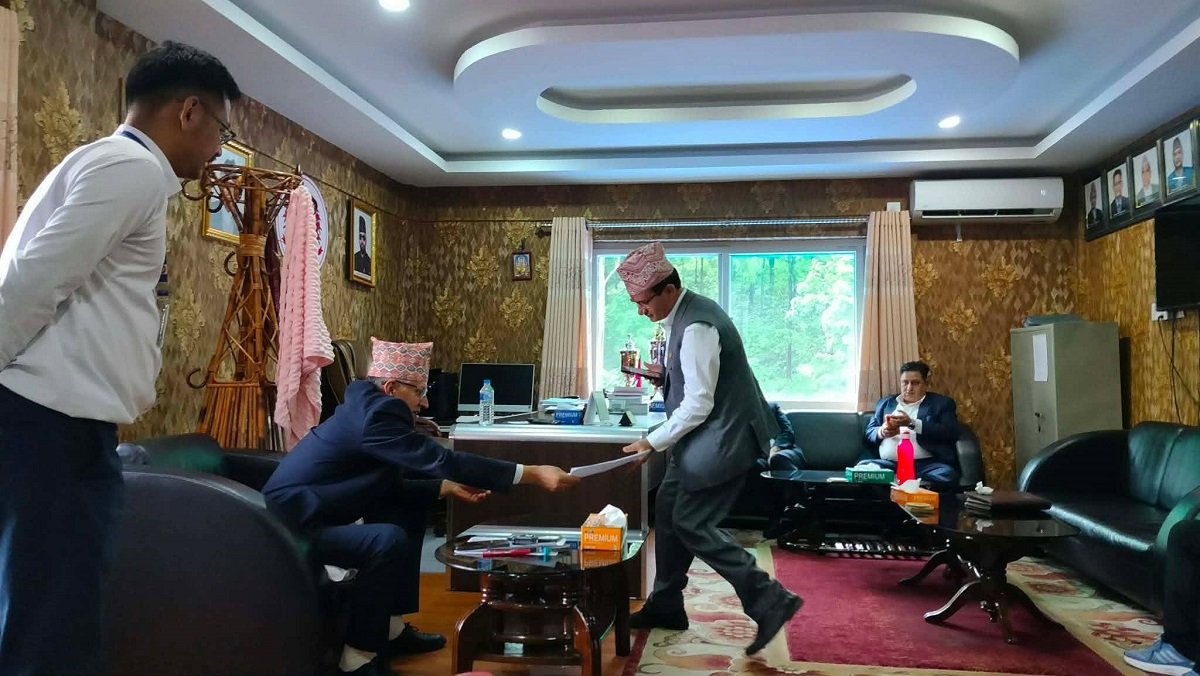
According to him, a memorandum was submitted to the relevant provincial ministry on Tuesday, demanding solutions to these problems.
This specific news has been automatically translated by AI. As a result, there may be some inaccuracies or language errors.



_cvUCBlwFTZ.jpg)