Nepali Farmer Pioneers Sustainable Mixed-Crop Farming in Jhapa

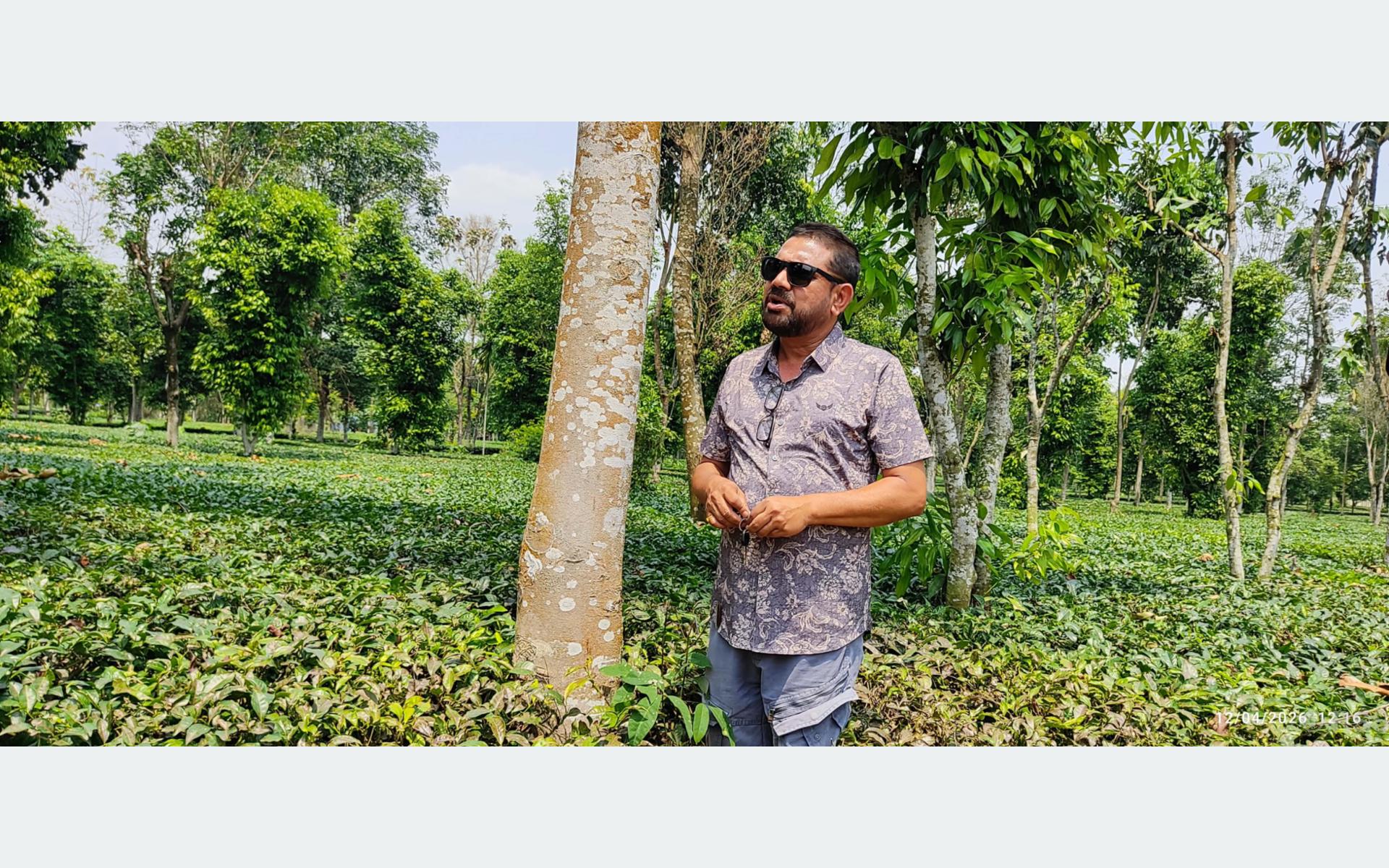
JHAPA: Rabi Nepal, a farmer from Bahundangi in Mechinagar Municipality-4, has become a model for modern mixed farming by cultivating 27 varieties of cash crops on a single plot of land. Having dedicated himself to commercial agriculture for the past 13 years, he has utilized every corner of his 12-bigha farm for integrated cultivation.
Starting his agricultural journey with tea farming, Nepal now simultaneously grows tea, rubber, agarwood, amla, jackfruit, and bay leaves, among dozens of other cash crops. He explained that he initially planted tea and subsequently integrated other cash crops within the tea gardens.
Nepal noted that tea begins producing after three years, amla after five, jackfruit after four, rubber after five, and bay leaves after three. "Initial investment and labor are high, requiring time for tilling, weeding, and nurturing the plants," he said. "Returns begin after three years, and by the seventh year, all crops start generating income." According to him, there are currently 27 species of cash crops in his garden.
Nepal shared that he is also harvesting medicinal plants like Arjuna, Moringa, and Rudraksha, alongside kitchen staples like cinnamon and lemons. His farming style is innovative and impressive; for instance, pepper vines are thriving by climbing the trunks of trees within his large areca nut orchard.
Recently, he has begun experimenting with coconut cultivation within his tea gardens. Following the advice of agricultural experts, he has started replacing every two tea bushes with coconut saplings. "This is the first experiment of coconut farming as an intercrop within a tea garden. I believe it will add a new dimension to Jhapa's agricultural tourism and production," he said.
Farmers in the Bahundangi region are often affected by wild animals like elephants, leopards, and monkeys. Nepal suggests that since elephants and monkeys do not cause significant damage to tea and coconut crops, farmers are increasingly adopting them as alternative crops.
Soil testing has also indicated that the Bahundangi, Shanischare, and Budhabare areas along the East-West Highway are suitable for coconut farming. He estimates that a single coconut tree can generate an annual income of Rs 17,000 to 18,000.
He began planting coconuts within his areca nut orchards last year. "I have a plan to plant 1,000 trees; I planted 300 last year and will plant 700 this year," Nepal said. He believes there is no shortage of market demand, as coconuts are sold while still green for their water, which is seeing increasing demand.
In his 13 years of experience with mixed farming, he has found no issues with the market for cash crops. Areca nuts and bay leaves are sold directly from the farm, and there are numerous processing industries for tea and rubber in Jhapa. "One must take an interest in finding and identifying markets; you cannot just produce in the field and sit idle at home," Nepal said. "If you manage mixed farming systematically on one bigha of land, you can easily earn Rs 800,000 to 900,000 annually."
His successful agricultural venture serves as an example that one does not need to travel to Europe or America to earn money if they are willing to work hard on their own soil. He urged the state to introduce incentive policies and programs to attract the younger generation to mixed farming.
"Vegetables are suitable for those looking to earn in three months, grains for those looking at six months, and herbs for those willing to wait a year," he said regarding the income from farming. "However, if one is patient for three to four years and engages in mixed farming, it will provide continuous income for up to 50 years."
This specific news has been automatically translated by AI. As a result, there may be some inaccuracies or language errors.