Nepal's Construction Sector Faces Shutdown Amid Soaring Costs and Supply Crisis


Kathmandu. The ongoing conflict in West Asia has severely impacted Nepal's construction sector. Due to the sharp rise in global petroleum prices and the extreme cost of construction materials caused by the US-Israel/Iran conflict, Nepal's construction industry is on the verge of a complete standstill.
Due to disruptions in the supply chain caused by the conflict in West Asia, fuel and construction material prices have become uncontrollable, leading construction entrepreneurs across the country to demand that the government declare a 'Construction Holiday'.
Currently, the Federation of Contractors' Associations of Nepal (FCAN), its seven provincial and district chapters, and the Confederation of Nepalese Construction Industries have issued a joint statement demanding a construction holiday.
Through the statement, they have raised serious questions about government policy. They complain that while market prices for construction materials have skyrocketed, the central bank's price index shows a decrease, an impractical practice that prevents contractors from receiving price adjustments. They have urged the immediate issuance of 'Price Adjustment Guideline-2' for construction sector price adjustments. They also demanded price adjustment provisions for all contract periods. Contractors complain that it is a huge financial burden that while rebar has risen from 70-72 rupees to 95 rupees and bitumen from 85 rupees to 145 rupees, the government index fails to reflect market reality.
Break in Strategic Road Construction
Meanwhile, government infrastructure projects are beginning to be affected. Due to the price increase and shortage of construction materials, blacktopping and other construction works on the Nagdhunga-Mugling road, a key lifeline connecting the capital, and the Dhulikhel-Khawa road section under the Araniko Highway have started to halt.
Similarly, national pride projects like the East-West Highway and Hulaki Highway are also seeing their construction work affected. Due to fuel shortages, the exorbitant rise in bitumen prices, and increased transportation costs, contractors are unable to proceed with work at sites. Especially during the peak blacktopping season, the massive increase in bitumen prices and its unavailability in the market have left the construction of these strategic roads in limbo.
Rising Fuel Prices and Transportation Costs Increase Project Expenses
The impact of the conflict has led to a massive increase in fuel prices in Nepal. Since the beginning of Chaitra, prices have risen four times. The Nepal Oil Corporation has increased prices three times. The new government formed after Falgun 21 decided through the Council of Ministers to provide relief on petroleum products by granting a 50 percent exemption on customs duty and infrastructure tax. However, instead of a positive impact, this decision led to the opposite result. Immediately after the tax exemption announcement, the government increased petrol by 17 rupees per liter and diesel/kerosene by 25 rupees. Since this government came to power, the price of petrol has increased by 47 rupees and diesel by 55 rupees.
The direct impact of this is seen in transportation. With the rise in fuel prices, transport entrepreneurs demanded adjustments to public transport (passenger and freight) fares. Consequently, the Department of Transport Management has adjusted fares, increasing freight vehicle fares by 21.68 percent in the hills and 15.75 percent in the Terai. Similarly, in Bagmati Province, the provincial government has increased freight vehicle fares by 26.79 percent. Now, the rate per kilometer-ton is set at 18.76 rupees, up from 14.80 rupees.
According to construction entrepreneurs, this increase in transportation and fuel costs has pushed project costs far above estimates.
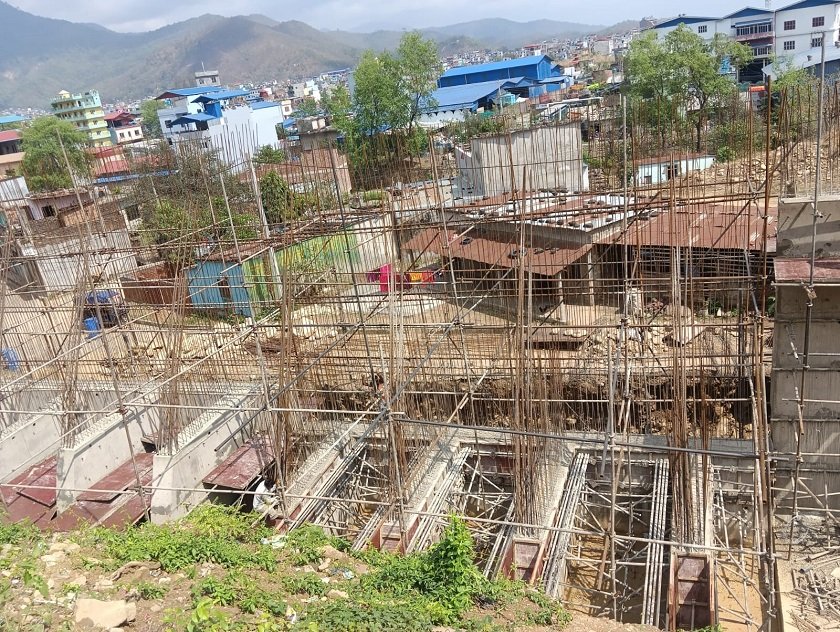
How Much Have Construction Material Prices Increased?
Immediate past president of the Federation of Contractors' Associations of Nepal, Rabi Singh, stated that it is impossible to continue work in the construction sector under the current circumstances. 'Prices are rising every day; cement has increased by 80 rupees per sack and rebar by up to 30 rupees per kg,' Singh said, 'The high cost of goods is one thing, but even if you are willing to pay, the goods are not available in the market. They demand cash instead of credit and LC, which contractors do not have.'
According to Rabi Singh, not only have prices increased, but materials are no longer available in the market. 'Rebar has increased by up to 30 rupees per kg and cement by 80 rupees per sack,' Singh says, 'Goods that were previously available on credit are now scarce in the market even if you offer cash.'
Singh stated that the price of construction materials is rising every day and there is an extreme shortage in the market. According to him, in the last few weeks alone, the price of cement has increased by up to 80 rupees per sack, and the price of rebar has increased by 25 to 30 rupees per kg.
According to Singh, the price of rebar, which was available for 70-72 rupees per kg some time ago, has now crossed 95 rupees. Similarly, the price of bitumen, which cost 85 rupees, has reached 140 to 145 rupees. Along with price hikes, there is also a problem with the availability of construction materials in the market. 'Construction materials are not available regularly, all sizes of rebar are not available, and there is an even bigger problem with bitumen and oil,' he said.
According to Singh, the market has stopped providing goods on credit, and a situation has arisen where mandatory cash payment is required. Since most projects are paid after construction (payment delays), there is a compulsion to bring goods on credit, but in the current situation, even when offering cash, materials are not available, so traders are reluctant to provide goods on credit. This is why he complains that they are unable to continue construction work.
Payment Issues and Labor Shortage
Additionally, there is a growing shortage of skilled workers in the construction sector. Singh informed that especially workers coming from India did not come this time due to insecurity and mental trauma caused by war and fuel shortages.
According to the immediate past president Singh, along with price hikes, the shortage of workers is another major challenge. Skilled workers from India have returned due to fuel shortages and mental trauma.
On the other hand, the government has still withheld about 40 billion rupees that should be paid to contractors. Contractors are in an extreme financial crisis because the government has made them work on projects that were not in the budget or lacked guaranteed funding and has not paid them.
Statements issued by various construction entrepreneurs
_XO8MhKp79X.png)
_u5avMiKLOJ.png)
_yYhdhS5Yki.png)
_jV8cGd3zuq.png)

This specific news has been automatically translated by AI. As a result, there may be some inaccuracies or language errors.