Fewa Lake Conservation: Tensions Rise Over Land Rights and Demolitions in Pokhara

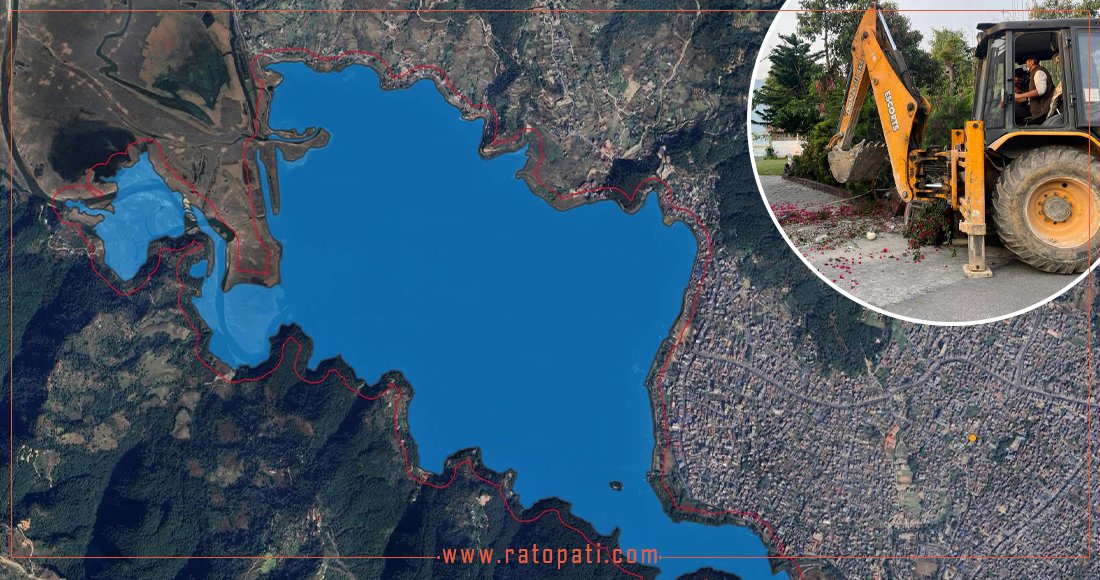
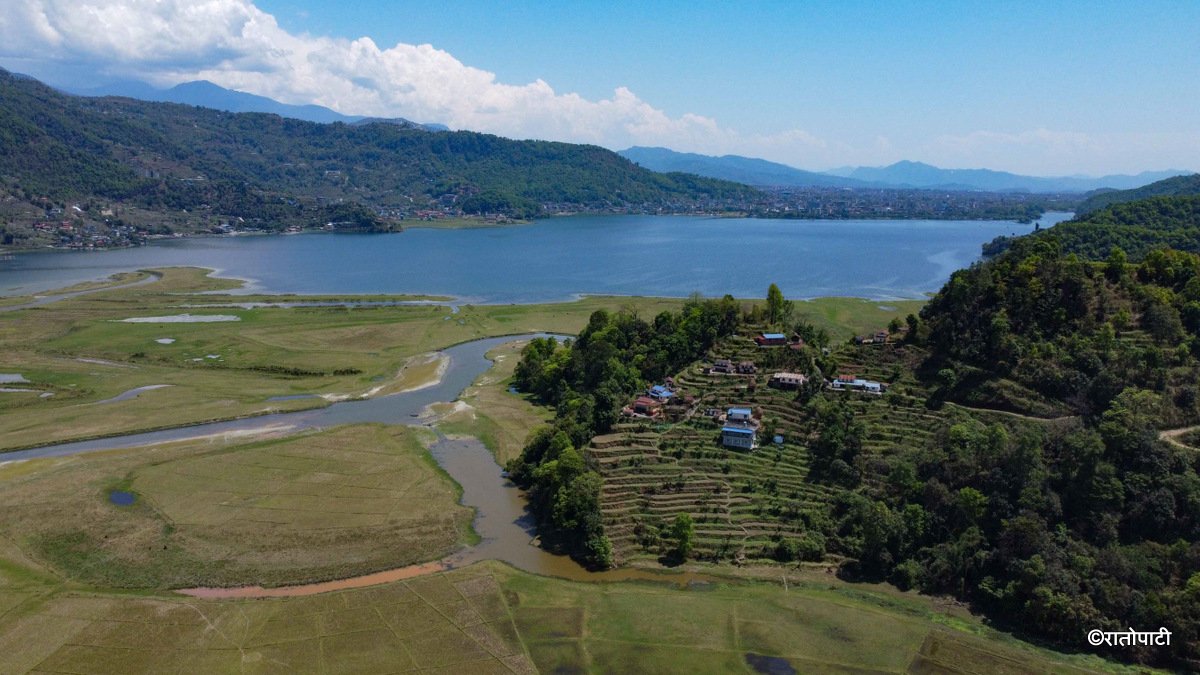
Pokhara. As the size of Fewa Lake, a central attraction of Pokhara, continues to shrink, concerns regarding its conservation have intensified. However, the activities surrounding this process are sparking controversy.
Landowners along the shores of Fewa Lake have two primary demands: either the government should provide compensation to acquire the land and proceed with conservation, or it should release the land and allow citizens to exercise their property rights.
Since 2030 BS, landowners here have been suffering due to the freezing of their land. They no longer wish to endure further hardship. They are warning against spreading terror by unauthorized use of bulldozers on private property.
Locals are outraged after bulldozers were used at dawn last Saturday on houses where they were sleeping. They even approached the administration to demand the protection of their lives and property. The lakeshore is currently quiet. Structures demolished by bulldozers have been cleared, and businesses have resumed as before.
Locals say, 'The state cannot act forcibly. It is our legal and human right to conduct business on our own land.'
In the words of the landowners, the state spread terror without notice last Saturday morning, leaving citizens terrified. 'If terror is spread against the law, it is like running a bulldozer over the hearts of the people. We cannot even imagine the situation at that time,' warned Nabin Baral, coordinator of the Fewa Lake Victims Struggle Committee.
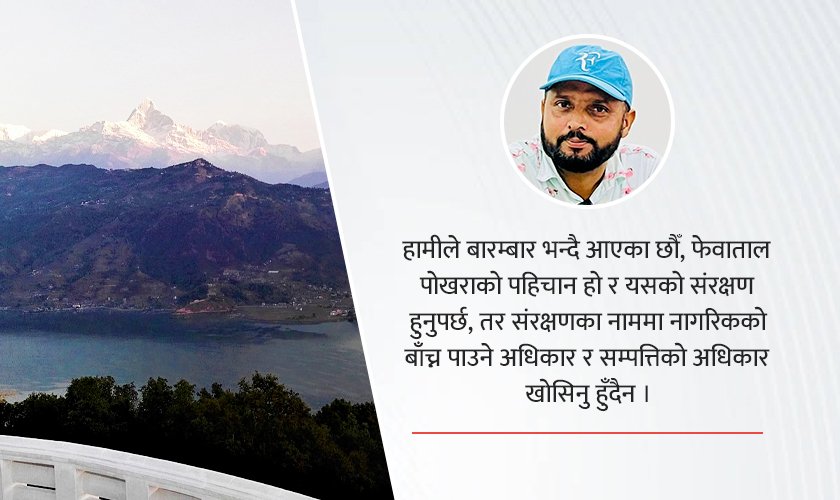
He stated that if they are forced to be displaced, the situation will take a different turn. He made it clear that the state would be responsible for that.
Currently, a narrative has been established that all land around Fewa Lake has been encroached upon. 'We are being treated like terrorists. They are treating the property we have been using since our ancestors as if it were looted overnight,' said Baral. 'We are neither terrorists nor land mafias. We are the real owners of this land.'
The Supreme Court has delivered historic verdicts regarding the lake twice, in 2075 BS and 2080 BS. Following the verdict of 16 Baisakh 2075 BS, the federal government formed the Fewa Lake Demarcation and Mapping Committee in Kartik 2077 BS under the coordination of Punya Prasad Paudel, former chairman of the Kaski District Development Committee. The committee submitted a report to the government in Falgun of the same year.
In 2078 BS, the government made a formal decision to publish the report. Dozens of reports have been prepared over the last 60 years to preserve the beauty and existence of Fewa Lake, but they have all been gathering dust. From the first development plan made with the help of the Indian government in 1959 to the demarcation announcement by the Government of Nepal in 2021, the conservation of Fewa Lake has not been practically achieved.
_8xd3HYH8yy.jpg)
Government documents point to three main reasons for the failure to implement Fewa Lake standards: a crisis of leadership, the heavy financial burden of compensation, and a lack of coordination.
According to data published in the Nepal Gazette, the actual area of Fewa Lake is 11,255 ropanis, 11 annas, 1 paisa, or 5.726 square kilometers. In 2069 BS, an investigation committee led by Bishwa Prakash Lamichhane showed that more than 1,692 ropanis of land were illegally registered in the names of individuals.
JICA and IUCN have prepared impartial reports on the conservation and environmental impact of Fewa Lake. Both reports mention that the depth and area of the lake are decreasing rapidly due to sediment brought by the Harpan Khola and other tributaries. The report warns that if silt trap dams are not built immediately and encroachment within 65 meters is not removed, Fewa Lake will turn into paddy fields or a riverbed within a few decades.
A high-ranking official who provided technical support during the latest mapping of the lake says, 'Land is also a matter of individual property rights. Therefore, the government should act based on legal and factual grounds rather than arbitrarily or by spreading terror.'
He suggested that the legality of all land falling within the lake's boundaries should be tested. 'Based on the report published in the gazette, it is necessary to test the legitimacy of the lands falling within the lake's boundaries,' he said. 'There is a problem with the court's order regarding high flood levels. There is no such thing as a high flood in a lake.'
- Different sizes in every study
So far, 13 reports have been prepared regarding Fewa Lake. The report led by Punya Prasad Paudel, published in 2077 BS, is the latest, following the first study in 2081 BS. That report maintained the lake's size at 5.726 square kilometers.
However, the facilitation committee formed to implement the Supreme Court's verdict published a larger area for the lake in Jestha 2082 BS. The committee, led by Gandaki Chief Minister Surendra Raj Pandey, set the actual area of the lake at 6.34 square kilometers. That report has not yet received official status.
_Nrq3o2Ywq1.jpg)
The British Survey of India first measured the area of Fewa Lake in 1925. At that time, the lake was 3.46 square kilometers, and its size has appeared different at various times.
Looking at all the reports produced in the 100 years of study, Fewa Lake appears to be within 5 to 6 square kilometers. A study conducted in 2018 BS showed the lake's size exceeding 10 square kilometers, but experts say it is impossible for a lake of that size to exist. The different areas found at different times are raising questions about the validity of the studies.
Pokhara Metropolitan City Mayor Dhanraj Acharya says the latest facilitation committee report should be considered official. He is a member of the committee. It has completely rejected the size determined by the Paudel committee in 2077 BS. The size has now increased by about 1,200 ropanis compared to that time.
- Neighbors do not agree with the standards
The neighbors of Fewa Lake do not agree with the standards set by the government. They believe that setting the lake's boundary during high-flow periods is unconventional.
On the other hand, they argue that the 65-meter standard is ineffective because it is linked to the livelihoods and lives of many people. Furthermore, the neighbors are angry that they were ignored in the process of demarcating the lake and setting the standards.
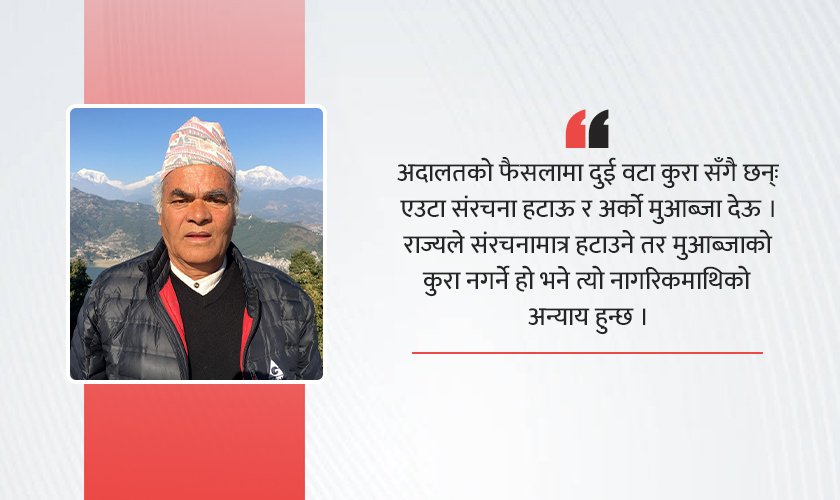
'It is a universally accepted principle that neighbors should be consulted during demarcation. It is illegal to set boundaries unilaterally without involving locals and stakeholders,' said neighbor Hari Bhujel. 'Boundary pillars were planted arbitrarily in the name of high flood levels. This is wrong.'
He accused the government of violating human rights and infringing on individual property rights by calling land titles (lalpurja) obtained from state agencies illegal. 'The land title was given by the state itself. Before displacing any citizen from their place of residence, proper compensation and arrangements for resettlement elsewhere must be made,' he said.
Bhujel claims that using bulldozers without providing compensation is wrong both humanely and legally. He said, 'The state does not have the right to forcibly seize an individual's legal property.' He suggested that re-demarcation should be done in the presence of local landowners and neighbors.
Examining the evidence, it appears that the first standard for Fewa Lake was implemented in 2030 BS. At that time, a prohibited area was designated where no construction work could be done within 200 feet (about 61 meters) from the lakeshore.
According to the 2029 BS Town Construction Plan Implementation Act, the cabinet meeting held on 15 Mangsir 2030 BS made a rule that there would be a complete prohibition within 200 feet, and even outside that, buildings could only be built up to one story according to the set standards. The 65-meter standard was only established in 2064 BS.
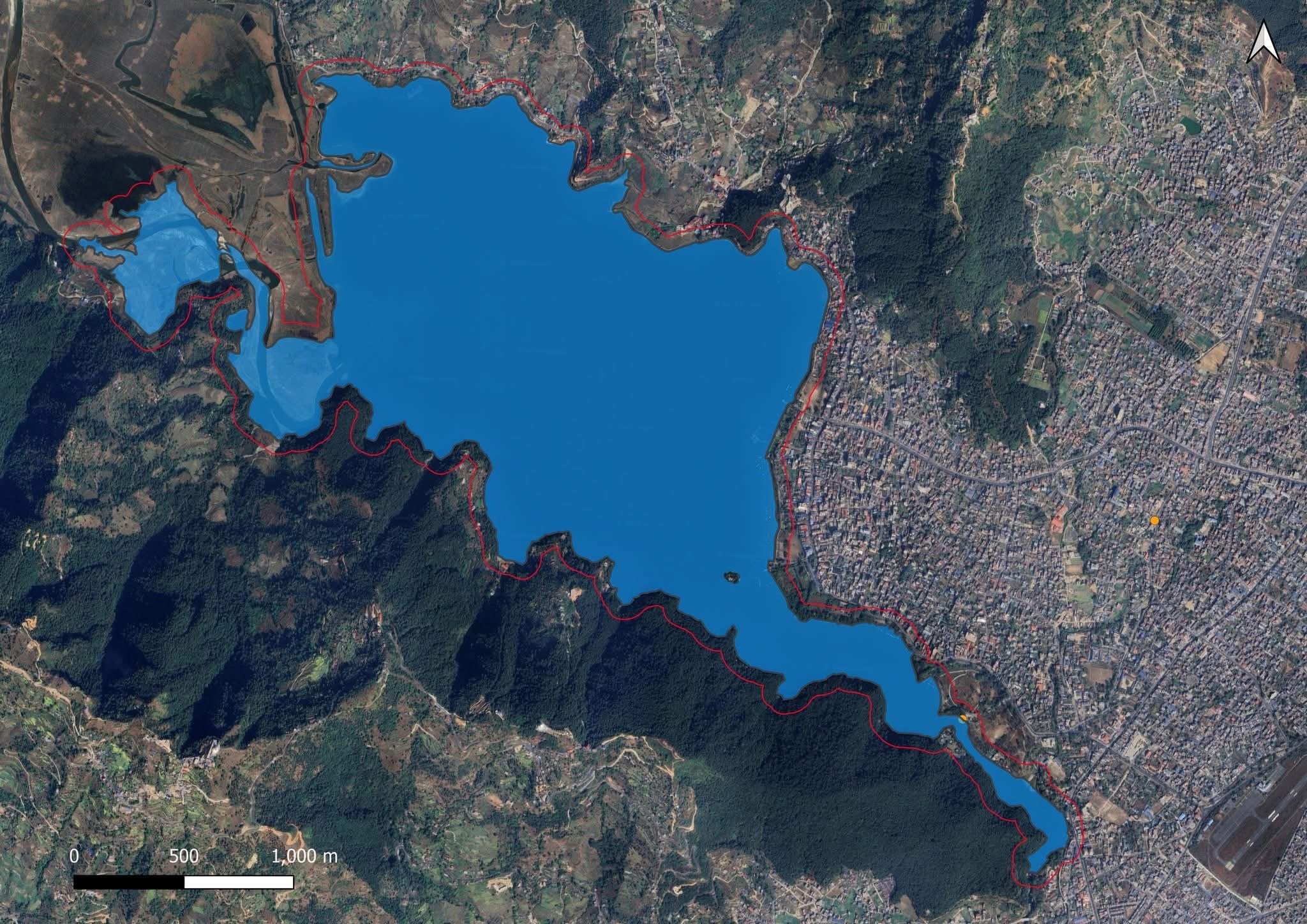
The Kaski District Council meeting held on 15 Ashar 2064 BS and the Pokhara Valley Town Development Committee meeting held on 28 Shrawan 2064 BS passed a rule that the land up to 65 meters from the high flood level of Fewa Lake would be considered a buffer zone and no physical structures could be built there.
The standards for the lake appear to be regularized by the gazette published on 17 Mangsir 2030 BS and the decision made in 2064 BS. On 28 Shrawan 2075 BS, the Supreme Court issued its first detailed mandamus to the government to remove all structures within 65 meters within 6 months and stop new construction. Since then, the government has been working on demarcation, mapping, and further studies with interest.
- What is within 65 meters? How much compensation must be paid?
When asked by Ratopati how much compensation is needed to fully implement the standards, Pokhara Metropolitan City Mayor Dhanraj Acharya said it would cost at least 40 billion rupees.
In 2077 BS, the Pokhara Metropolitan City, with the help of the Survey Office, conducted a survey and reported that about 500 structures fall within the 65-meter standard. Mayor Man Bahadur GC had submitted a report to the Prime Minister at that time stating that 493 permanent and temporary structures fall within this area. According to that report, 1,200 ropanis of land within 65 meters belong to individuals. It was concluded that at the prices of that time, at least 10 billion rupees would be needed as compensation to remove the 1,200 ropanis of land and structures.
It is said that the land area will increase further if the high-flow area is considered the lake's boundary, but the exact details of how much land is in individual names have not yet been determined. Setting the high-flow area as the boundary also pushes the 65-meter standard limit much further, which will certainly increase the compensation amount.
Seeing the difficulty in removing structures and acquiring land within 65 meters, the Pokhara Metropolitan City reduced the Fewa Lake standard to 30 meters in the 2078 BS executive meeting. According to the court's initial order, the metropolis has the authority to make this decision. However, a writ was filed in the Supreme Court against the metropolis's decision. In the order issued in 2080 BS, the verdict was that the lake's standard would remain 65 meters.
According to the metropolis's report, not only private but also government structures fall within the standard. These include the Police Training Center at Damside, the building housing the Education Division of Pokhara Metropolitan City, the Nepal Tourism Board office, the Ratna Mandir and Himagriha palaces built by the royal family, Kedareswor Temple, Fishtail Lodge, Waterfront Resort in Sedi, and various hotels, restaurants, and shacks on both sides of the lake. Some of these structures are multi-story, while others are single-story. The government must pay compensation when removing structures on private land.
The same report shows that 3,302 ropanis of land fall within 65 meters, including the water edge of the lake. Of that, 1,306 ropanis is public land, and 1,996 ropanis is private land. Excluding the water edge, 2,064 ropanis of land fall within 65 meters. Of that, 1,280 ropanis is private land. This means that 716 ropanis of private land are also underwater in Fewa Lake.
_nkar8LbuVm.jpg)
- Compensation is the final condition
Everyone agrees that actual landowners should be given proper compensation. Ram Bahadur Paudel, a leader of the Civil Society Kaski, suggests that when implementing the 65-meter standard, proper compensation and land pooling arrangements should be made so that local residents are not treated unfairly.
He argues that when demolishing structures, it should start with government structures. 'It must first be clarified which land is tainted and which is legitimate land with a title,' he said. 'The state should not be stingy in making arrangements for proper compensation and land pooling without making landowners homeless while implementing the 65-meter standard.'
Paudel demanded a serious investigation into structures built by encroachment under the influence of power centers and tainted land. He has urged the local government and stakeholders not to terrorize the Jalari, Bhujel, and other communities living on the shores of Fewa Lake and to proceed only after giving them proper compensation.
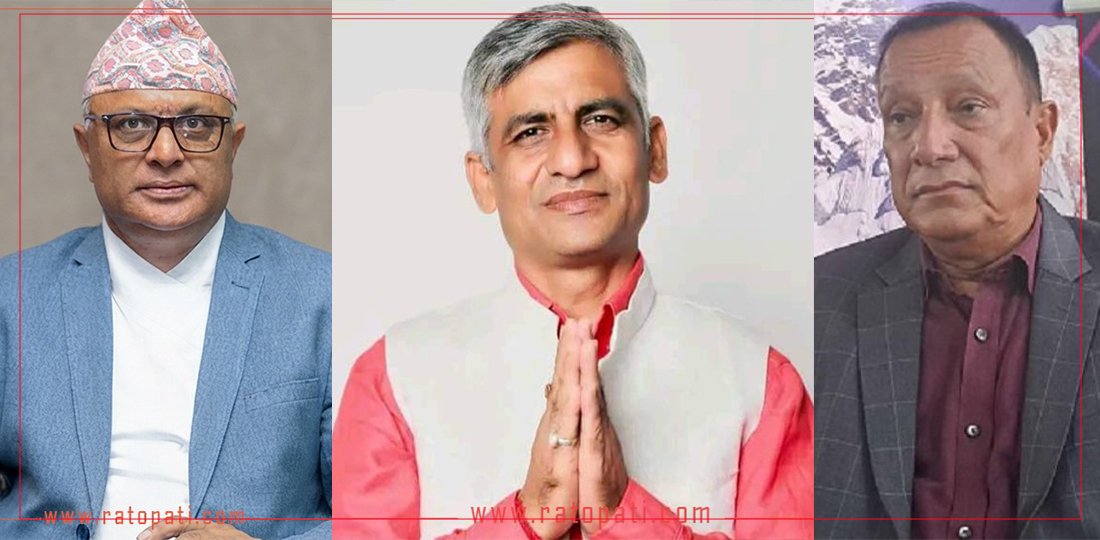
Chief Minister Surendra Raj Pandey also argues that bulldozers should not be used on private land in an undemocratic manner. 'A facilitation committee has been formed under my coordination to maintain the beauty of the lake. We are working,' he said. 'Illegal structures must be removed, but it is wrong to run bulldozers on private land overnight in a bandit-like style. It is an act against democratic methods.'
Chief Minister Pandey emphasized that structures should be removed by taking the public into confidence and giving prior notice, and for that, the state must first guarantee compensation. 'Land should be taken by convincing the people. The state cannot threaten anyone,' he said. 'Before taking the land, it must be decided how much compensation will be given.'
Metropolitan Mayor Dhanraj Acharya also agrees that compensation cannot be ignored. 'The land where structures have been demolished now is also private. Some of it is land that should receive compensation,' he said. 'That land should receive compensation. The metropolis has made that demand to the federal government.'
_MlbXGSTlo5.jpg)
- Neglect of sediment entering from the headwaters
Studies conclude that 175,000 to 225,000 cubic meters of sediment are deposited in the lake annually from the streams around Fewa Lake. This old data has now increased. No study is being done now. To stop this sediment, the Pokhara Metropolitan City and the provincial government have built siltation dams at the head of the lake, but the quality is not good. Dozens of studies have been done for the conservation of Fewa Lake besides the boundaries.
The Pokhara development plan made with the help of the Indian government in 2016 BS was the first. After that, the first physical development plan of Pokhara was implemented in 2031 BS. In the same year, the lake's dam burst, and the lake's water level dropped by more than 50 percent. The physical development plan of Pokhara Town Panchayat was prepared in 2044 BS. A separate study on the environmental protection of Fewa Lake was done in 2050 BS. The 2058 BS JICA study report suggested maintaining a protected area of 65 meters in urban areas and 30 meters in rural areas.
The Fewa Lake Standard Report was prepared in 2066 BS under the leadership of Shankar Prasad Pandey. Immediately after, the report prepared in 2067 BS under the leadership of Girja Prasad Gorkhali recommended a standard of 10 meters from the center of the road and 65 meters from the lakeshore. The investigation committee formed in 2069 BS under the chairmanship of Bishwa Prakash Lamichhane continued the 65-meter standard.
In 2070 BS, a task force led by Krishna Prasad Dhungana of the Commission for the Investigation of Abuse of Authority submitted a detailed action plan regarding lake conservation. Since then, the Supreme Court itself has declared the 65-meter standard for the lake as valid.
The committee formed on 10 Magh 2078 BS under the coordination of Ward Chairman of Pokhara-17, Tirtha Adhikari, has given integrated suggestions for the conservation and development of the lake. That committee suggested forming a single separate body with all authority for lake conservation and, if compensation cannot be given to landowners, to consolidate the land and maintain the standards while securing their rights.

The report by Bishwa Prakash Lamichhane, formed in 2069 BS, recommended canceling the land titles of 950 people. The report mentions that 700 of them have land falling within the conservation area.
A total of 1,692 plots of land are tainted. Committee coordinator Lamichhane says this land was surveyed when the lake water had dried up. According to him, 778 plots, or 1,100 ropanis of land, which are in individual names within the conservation area, should be given proper compensation. The Supreme Court's order in 2075 BS was based on that same report.
Lamichhane argues that mixing urban pollution into the lake is another problem. He concluded that the lake is shrinking due to human encroachment along with natural factors. Even until 2055 BS, the process of registering land formed by the drying up of the lake in individual names was ongoing. The practice of dumping sewage from hotels and houses in the Pokhara area directly into the lake, washing clothes, and throwing garbage continues.
- Study committee again
The Government of Nepal has formed a five-member committee again to ascertain the current status of the land falling within the four boundaries of the lake with the aim of making the conservation and management of Fewa Lake more effective.
Last Monday, the Ministry of Land Management, Cooperatives and Poverty Alleviation formed a committee under the coordination of Shiva Prasad Regmi, Director General of the Department of Land Management and Archive. The committee will study the current status of the land within the four boundaries of Fewa Lake, the structures built there, and other details.
Additionally, it will also perform the task of collecting and documenting the actual details of all plots of land falling within the lake area. This is expected to make a significant contribution to the long-term conservation of Fewa Lake.
This specific news has been automatically translated by AI. As a result, there may be some inaccuracies or language errors.

_cvUCBlwFTZ.jpg)