
Reflecting on the Legacy of Nepal's Democratic Movements


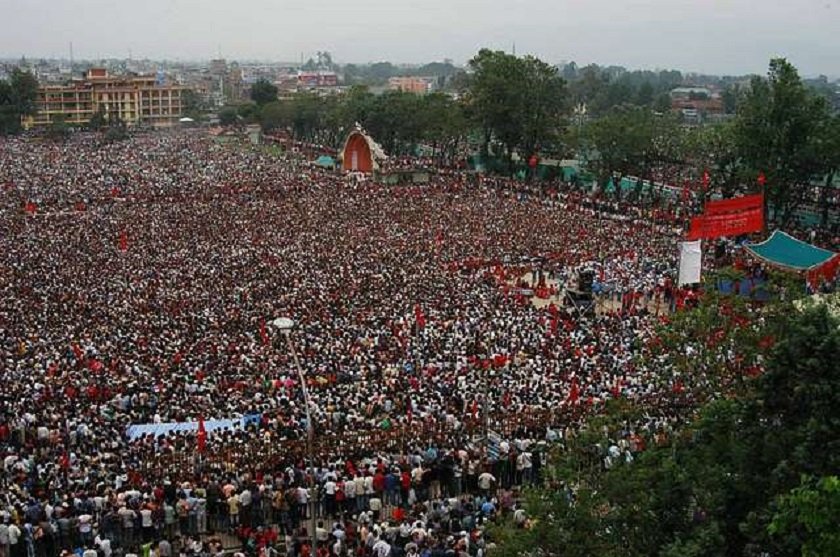
The image above is an 'iconic photo' capturing the jubilation at the peak of the People's Movement that successfully ended the non-party Panchayat system and restored a multi-party system in 2046 BS.
This photo was taken by renowned photojournalist Min Ratna Bajracharya. It features Durga Thapa, who stood up and chanted slogans at a rally held at Tundikhel Khulamanch to celebrate the arrival of the multi-party system.
King Mahendra had abolished the multi-party parliamentary system by force on Poush 1, 2017 BS, and initiated the non-party Panchayat system. The Nepali people had to endure a 30-year-long struggle of various forms to end the Panchayat system and restore multi-party democracy.
Led by the Nepali Congress and supported by the United Left Front formed under the leadership of Sahana Pradhan, which included various factions of the Nepal Communist Party, the People's Movement began on Falgun 7, 2046 BS, and ultimately led to the end of Panchayat rule.
The People's Movement was commanded by the supreme leader of the Nepali Congress, Ganesh Man Singh.
Leftist factions not included in the United Left Front also joined the struggle by forming the United People's Movement Front under the leadership of Baburam Bhattarai.
The participation of people fed up with autocracy made the movement stronger day by day. Unable to suppress the movement, then-King Birendra removed Prime Minister Marich Man Singh Shrestha from office on Chaitra 24 and appointed Lokendra Bahadur Chand as Prime Minister. On that same day, the National Left Front led by Baburam Bhattarai had announced a Nepal Bandh and protest march. After the demonstration that day turned violent, a curfew was imposed, and on the night of Chaitra 26, King Birendra reached an agreement with the Congress and the Left Front to announce the restoration of the multi-party system.
This photo was taken at a public meeting held at Tundikhel the very next day.
It has been 36 years since the announcement of the restoration of the multi-party system in Nepal. However, it feels as though the historic People's Movement Day has been overshadowed. It seems to be fading from the memory of political parties and civil society, and the media no longer appears to give it serious attention.
During the practice of democracy and the ups and downs of the multi-party system, Gyanendra Shah, who became King after the massacre at Narayanhiti Palace on Jestha 19, 2058 BS, which wiped out King Birendra's lineage, tried to act more like a leader than a King; he could not tolerate democracy. Against Gyanendra's autocracy, the then-seven parties and the armed rebel Maoists joined forces to start the second People's Movement from Chaitra 24, 2062 BS. The 19-day movement brought Gyanendra Shah's royal regime to its knees and established democracy in Nepal.
I was just crawling during the 2046 BS People's Movement. However, I participated directly when the second People's Movement began on Chaitra 24, 2062 BS.
I had just finished my IA second-year exams at Ratna Rajya Laxmi Campus in Bhrikutimandap, the center of the student movement. At that time, the People's Movement was intensifying. On one hand, the armed Maoist conflict was at its peak, and on the other, Gyanendra's royal regime was acting arbitrarily. People were caught in a double bind. Every alley and intersection of the city became a site of protest. The movement grew stronger day by day.
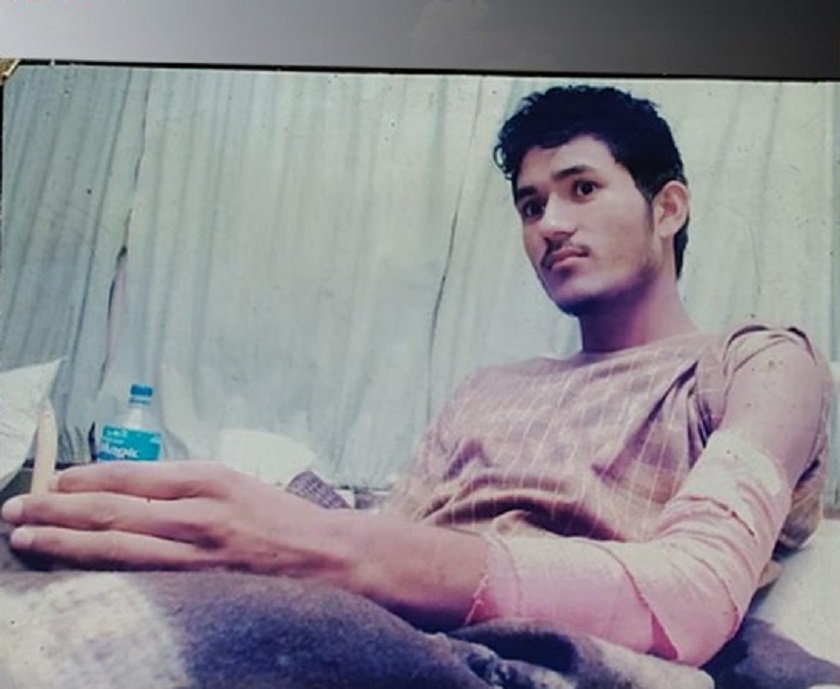
People wanted to breathe a sigh of relief. They wanted freedom from Gyanendra's autocratic rule and the armed Maoist conflict. Every government campus was considered a stronghold of politics. Students, filled with the spirit of rebellion and ideas, did not want to bow down to autocracy. The atmosphere became increasingly suffocating day by day. The then-government added fuel to the fire. There was no way the people's rebellion could be suppressed. The then-seven political parties and the Maoists engaged in armed warfare had started an undeclared People's Movement. While participating in the 19-day movement, I was shot in Tripureshwor, Kathmandu. Mohammad Jahangir Khan, who was shot in the head right next to me, became a martyr.
I was a student stepping into my 17th year. I had no one of my own in Kathmandu. Fortunately, I did not have to pay for my treatment. I was treated at Kathmandu Model Hospital for 10 days. Blood was flowing for a few days after being shot. I still remember, a doctor working at Kathmandu Model Hospital tried to discharge me on the very first day, saying, '100 percent discharge today. This is not a shelter for people from Kathmandu.' I was more hurt by that doctor's words than by the bullet wound from the movement.
I remember, my friends from Ratna Rajya Laxmi Campus who were staying with me at the Kathmandu Model Hospital in Bagbazar told the senior artist Hari Bansha Acharya about the doctor's sharp words. Coincidentally, Hari Bansha Dai, who was there, came to me after a while and apologized, saying, 'Sorry brother, on my behalf.' The Maha Jodi had spontaneously set up a fund for the treatment of those injured in the People's Movement.
The financial aid sent by Nepalis from home and abroad was deposited into this fund. This fund covered the treatment of the injured across the country.
In the blink of an eye, 20 years have passed since the start of the second People's Movement. Two decades have passed in the hope of change. In the meantime, we have seen many political ups and downs. The dreams for which we fought in the movement have not been translated into the lives of the people even today. The standard of living for the people has become increasingly difficult. No matter how big the changes were, only certain individuals and groups benefited. Ironically, the fate of ordinary Nepalis has remained the same. Our sentiments have been betrayed time and again. The sacrifice of the martyrs and the blood of the injured have not been respected.
I remember, when I was discharged from Kathmandu Model Hospital, the clothes I was wearing were soaked in blood. Durga Thapa, from that 'iconic' photo of 2046 BS taken by renowned photojournalist Min Ratna Bajracharya, came to rescue me. Durga Thapa, a warrior of 2046 BS, bought me a pair of clothes when I was being discharged. It has been 19 years today, and I have never met her since. Where might Durga Didi and other warriors like her from 2046 BS and 2062/063 BS be?
Durga Didi, are you reading this article I wrote? I want to meet you and express my gratitude.
This specific news has been automatically translated by AI. As a result, there may be some inaccuracies or language errors.


_bHthPq6v9e.jpg)
_6BsDewPY2j.jpg)