Gurung Community Celebrates Traditional 'Tote' Festival with Fervor

Gandaki. The Gurung community in the Gandak region is celebrating their ancestral festival, Tote, with great enthusiasm today. The festival, which typically falls on the last Tuesday of Chaitra and Shrawan, brings vibrant energy to Gurung-majority settlements. It is believed to have originated in ancient times to commemorate the act of driving enemies across the border to protect the Tamu kingdom.
According to Krishna Kumar Gurung, a central member of Tamu Dhee Nepal and head of the Language and Culture Department, the festival is deeply rooted in Gurung civilization, culture, and identity, with a history spanning 1,500 years. He noted that the tradition began as the Gurung people transitioned from living in caves and shelters to developing organized settlements.
He further explained that the festival gained prominence during the establishment of the Tamu kingdom, as ancestors used rituals and incantations to ward off enemies who threatened their communities. Srijang Gurung, another central member of Tamu Dhee Nepal, added that while the festival originally aimed to drive away evil spirits and enemies, it is now observed with prayers for the end of societal ills and for the welfare of humanity.
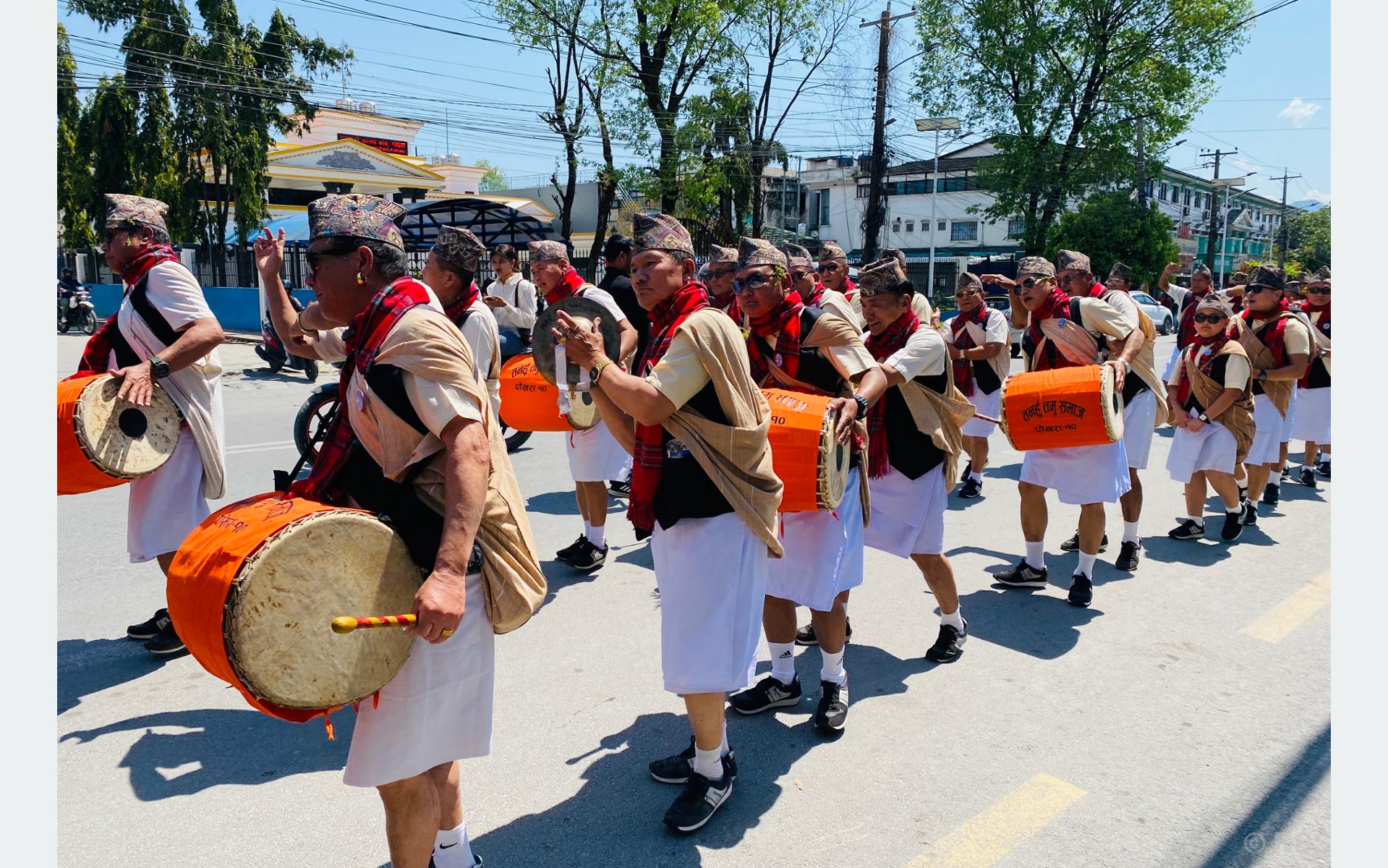
On Tuesday, the Gurung community in Pokhara celebrated the festival with cultural processions showcasing their unique identity. Tamu Dhee Nepal President Hum Gurung explained that in the Gurung language, 'Tho' refers to a state or village, and 'Te' signifies the act of driving out enemies to secure the territory.
“The Gurung community believes that since the tribal era, when Tamu (Gurung) people lived in small states, our ancestors established the Tote festival to drive away invaders,” he said. Under the leadership of Tamu Dhee Nepal, the festival has been organized systematically since V.S. 2052. Nature worship is a central practice during Tote.
During the festival, Gurungs participate in processions dressed in traditional attire and accompanied by traditional musical instruments. Cultural performances such as Ghatu, Sorathi, Chutka, and Krishna Charitra are showcased. Items such as ancient weapons, traditional clothing, and instruments like the jhyali, chopdi, sulachi, and chimta are also displayed. Participants range from youth to elders.
Legend has it that playing musical instruments in groups while roaming the village at night during the festival drives away demons and evil spirits. President Gurung stated that the festival is also a time to honor ancestors and worship nature, ensuring that no harm or invasion befalls the Gurung settlements.
There is a popular belief that celebrating this festival brings prosperity to the village, improves harvests, wards off diseases, and prevents natural disasters. The festival was observed in 148 Gurung villages and community centers across the region, including Pokhara. Gurungs who have migrated to Pokhara from various districts of Gandaki Province have been instrumental in preserving the festival.
The festival is celebrated as Ubhauli in Chaitra and Udhauli in Shrawan. Gurung leaders emphasize that Tote conveys a message of social unity and brotherhood, while also reminding the Tamu community of their history. Since the formation of Tamu Dhee Nepal in V.S. 2042, the community has become increasingly active in preserving Gurung culture and traditions.
On the occasion of Tote, local levels including Annapurna and Madi Rural Municipalities in Kaski, and Phedikhola Rural Municipality in Syangja, declared a public holiday. As a significant cultural festival, Tote is celebrated with joy by Gurung communities across the country, including in Kaski, Parbat, Tanahun, and Syangja.
This specific news has been automatically translated by AI. As a result, there may be some inaccuracies or language errors.