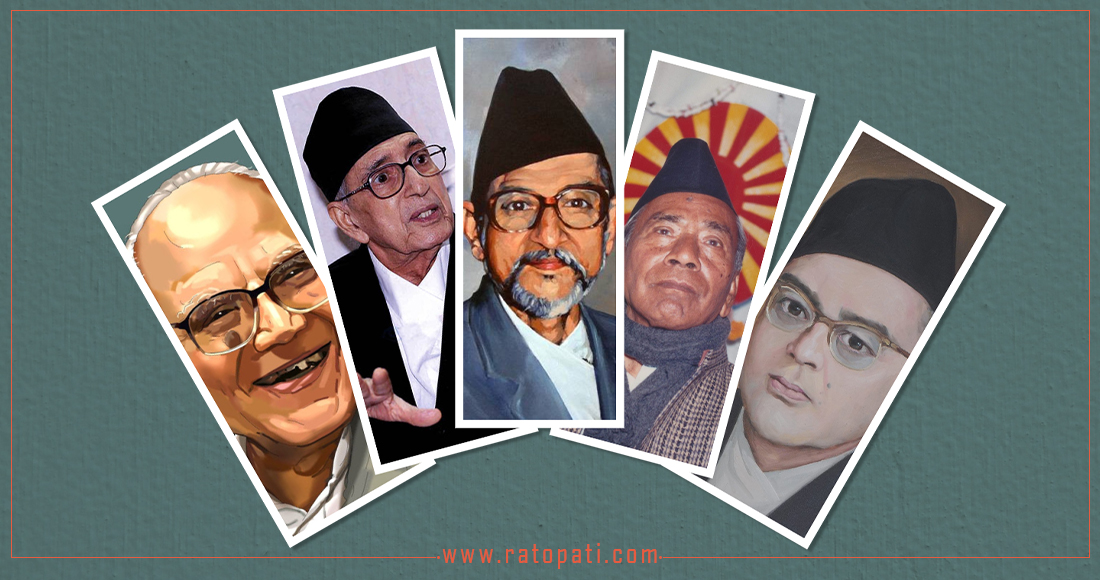
Nepal's Political Evolution: From Historical Instability to the Rise of a New Era
_C9jFahJlBs.jpg)
A deep analysis of Nepal's political history and power structure reveals an undeniable fact. Governments and systems change, but the underlying system and mindset of governance remain largely unchanged.
Examining the political fluctuations from the first elected government in 015 BS to the 080s, it is clear how political ego, foreign geopolitical influence, and bureaucratic settings have led to the hijacking and humiliation of public mandates.
Historically, while political movements succeeded in changing systems, they failed to change the character of the permanent government—the bureaucracy. Trained in the autocratic style of the Rana era and nurtured under the Panchayat structure, this mechanism transformed into an agent for politicians and middlemen by the time multi-party democracy and republicanism arrived.
Former bureaucrats, who understand the loopholes in policy-making, have become the main architects of policy corruption after retirement. The chaos and institutional decay seen in the recent governments led by Prachanda and KP Sharma Oli were the culmination of this.
In this context, the Rastriya Swatantra Party (RSP), which emerged with an unprecedented mandate in the 082 BS general election, and its leader Balen Shah, face the historic challenge of reforming over 71 old acts and policies across 22 ministries.
This article attempts to cover historical facts, the working style of the bureaucracy, the impact of the 082 BS Gen-Z movement, and the necessary policy and legal reforms for the upcoming government.
- The Foundation of Administrative Structure
To understand the psychology and working style of Nepal's current bureaucracy, it is essential to study the background of the 1952 (2009 BS) N.M. Buch Commission. After the end of the 104-year Rana regime, King Tribhuvan and the government of Matrika Prasad Koirala requested an expert team from the Government of India to modernize Nepal's administrative mechanism.
The team, led by senior Indian Civil Service officer N.M. Buch, studied Nepal's administrative mechanism and presented 143 recommendations. The Buch Commission outlined structural reforms such as reducing the number of ministries from 17 to 11, creating the post of Chief Secretary, abolishing old offices like 'Hajiri Goshwara', and making the Public Service Commission effective.
However, because this structure was a blend of British colonial mentality and Rana-era autocratic style, the tendency to rule rather than serve the people and to exercise power by stalling files became dominant. The lack of a vision for an inclusive and representative bureaucracy meant that only a certain class and elite had access to state power. This centralized and control-oriented administrative foundation eventually became the main obstacle to Nepal's development and delivery mechanism.
- The 015 Mandate and the 017 'Coup'
The 015 BS general election was a landmark event in Nepal's parliamentary history. Breaking through a long transition, the Nepali Congress won 74 out of 109 seats in the House of Representatives, securing a two-thirds majority. The government formed under B.P. Koirala put forward ambitious plans to lead Nepal on the path of modernization.
However, within a short span of 18 months, on Poush 1, 017 BS, then-King Mahendra dismissed the elected government and took power into his own hands. The fall of the B.P. Koirala-led government was largely due to internal interest groups. The Birta abolition and land reform programs introduced by Koirala's government dealt a severe blow to the economic interests of the landlords and elite class (Bhardars) who held sway in the army, palace, and administration.
The old elites and aristocrats in the army leadership conspired with King Mahendra to make the elected government fail to protect their waning privileges. They fueled the power struggle between the King and the Prime Minister, forcibly trampling on the democratic process.
The second major reason was the power balance and ego clash between King Mahendra and B.P. Koirala. King Mahendra wanted to establish himself as an active and powerful head of state, while B.P. Koirala firmly believed in parliamentary supremacy and constitutional monarchy. King Mahendra perceived Koirala's growing international popularity, intellectual stature, and the party's two-thirds majority as a threat to his existence and royal power.
While this was happening, the geopolitical situation of the time was also extremely complex. There were 18 Indian military checkpoints on our northern border. Although the government wanted to remove these checkpoints in 015 BS, it was not immediately possible because the 1950 Treaty of Peace and Friendship and subsequent correspondence gave India a special status in Nepal's security affairs. India viewed Nepal's northern border as the first checkpoint of its security umbrella.
In this context, a serious incident occurred near Kore Pass in Mustang on June 28, 1960. The Chinese People's Liberation Army shot and killed unarmed Nepali police Subedar Bam Prasad, who was patrolling within Nepali territory, and captured about 15 others. This incident caused a major stir within Nepal's sovereignty and state mechanism. B.P. Koirala strongly opposed this and demanded an explanation, apology, and compensation from Chinese Premier Zhou Enlai. After diplomatic dialogue and pressure, China admitted that the shooting was a mistake, thinking the Nepali police were Tibetan rebels, apologized, and provided 50,000 rupees in compensation.
However, using this geopolitical instability and national security sensitivity as a weapon, King Mahendra accused the elected government of being incompetent and unable to protect nationality, and took power. This event confirms how dangerous the intermingling of foreign policy and internal politics within the state mechanism can be.
- Mahendra, Birendra, and the 036 Referendum
After 017 BS, King Mahendra started direct rule in the name of the Panchayat system. He adopted a strategy of using the 'China card' to challenge India's unilateral influence. By building the Kodari Highway and taking relations with China to a new height, he startled India. A continuous conflict persisted between Mahendra's attempt to make Nepal a completely independent and neutral power and India's attempt to keep Nepal within its security perimeter.
In 028 BS, King Mahendra passed away at the age of 51 in Bharatpur, Chitwan. Officially, his death was attributed to a heart attack. With his passing, the strategic balance in Nepal's foreign policy gradually began to crumble. King Birendra, who succeeded King Mahendra, proposed to the world community in Falgun 031 BS that Nepal be declared a Zone of Peace on the occasion of his coronation.
The essence of this was to make Nepal a neutral nation like Switzerland and keep it free from any regional or global military alliances. Although more than 116 nations supported it, India did not accept it. This was because New Delhi analyzed that it would abolish the security provisions of the 1950 treaty and weaken India's influence.
In 036 BS, the student movement that started in protest against the hanging of Zulfikar Ali Bhutto in Pakistan took an aggressive anti-monarchy and anti-Panchayat form in Nepal. The movement became so intense that King Birendra was unexpectedly forced to announce a referendum. Although the reformed Panchayat won the referendum with 54 percent of the vote, it had already laid the foundation for the end of the partyless system and the advent of multi-party democracy.
- The 046 People's Movement and Political Instability
The 046 BS People's Movement ended the 30-year Panchayat system and restored multi-party democracy. The 047 BS Constitution vested sovereignty in the Nepali people for the first time and institutionalized the multi-party parliamentary system. However, this constitution did not explicitly remove the King's privileges and his control over the Nepal Army. For this reason, conflict between the palace and political parties was inevitable.
After the Nepali Congress won a majority in the 048 BS general election, Girija Prasad Koirala became Prime Minister. However, the government was headed toward failure not because of the opposition, but because of internal strife within the party. The power struggle between the 74 MPs of Prime Minister Koirala's faction and the 36 MPs of the dissatisfied group within the Congress reached an extreme.
After 36 MPs from his own party refused to cooperate with the government's policies and programs and refused to vote in Parliament, Girija Prasad Koirala dissolved Parliament in 051 BS and announced mid-term elections. This decision proved to be a short-sighted step in Nepal's democratic history. It pushed the country into long-term political instability, a hung parliament, and the distorted game of coalitions. This is where the middleman class was created in Nepali politics.
The Maoist People's War, which started in 052 BS with a 40-point demand, dismantled the country's entire old social and political power balance over the next 10 years. There were three main reasons for this. First, political corruption and instability. Second, existing social discrimination. Third, administrative failure.
Then came the unexpected Jestha 19, 058 BS. King Birendra and his family were killed in the palace massacre. This broke the backbone of Nepal's internal political balance. King Gyanendra, who came to power after that, started direct rule in 061 BS, planting the seeds of a politics that dismantled party infrastructure and humiliated leaders. Although his direct rule did not last long.
During Gyanendra's direct rule, the country entered the 062/063 People's Movement through the 12-point agreement between parliamentary political parties and the rebel Maoists in Delhi, India.
- Establishment of the Republic and Bureaucracy
After the Maoists became the largest party in the first Constituent Assembly election in 064 BS, Pushpa Kamal Dahal 'Prachanda' became Prime Minister. But his government fell within nine months. The main reason for this was the attempt to remove the then Chief of Army Staff, Rookmangud Katawal. Although Prachanda raised the issue of civilian supremacy, his move to establish control over the army was overturned by the then President Ram Baran Yadav, forcing Prachanda to resign; this was also political and strategic immaturity.
Behind this fall were Prachanda's unstable political nature, his inability to balance diplomatic relations between India and China, and internal ideological strife within the Maoist party. After the new constitution was issued in 072 BS, the Left Alliance of UML and Maoist Center won nearly a two-thirds majority in the 074 general election. This government led by KP Sharma Oli was considered the most powerful government in history.
However, this government also fell before completing its term. Due to the personal ambitions of leaders and disputes over power-sharing, the cycle of parliamentary dissolution continued. The failure of the governments led by Oli and Prachanda was as much due to personal ego as it was to the setting between institutional interest groups, middlemen, and former bureaucrats. Nepal's bureaucracy is accustomed to exploiting state resources through policy corruption in collusion with political leadership rather than strictly following the law.
The corruption scandals that have surfaced in the last few years prove what a terrifying nexus exists between the bureaucracy and political leadership in the state structure. The Lalita Niwas land case, the Bhutanese refugee case, and the Sudan scam are some representative examples.
- Gen-Z Rebellion and the Rise of New Politics
The syndicate of old parties that ruled for 33 years, complete failure in delivery, and corruption scandals had already created extreme frustration and anger among ordinary Nepali citizens, especially the new generation. Due to the lack of employment, millions of youths were forced to migrate to the Gulf, Europe, and America. The economy was dependent only on remittances, and the country's youth unemployment rate had reached over 20 percent.
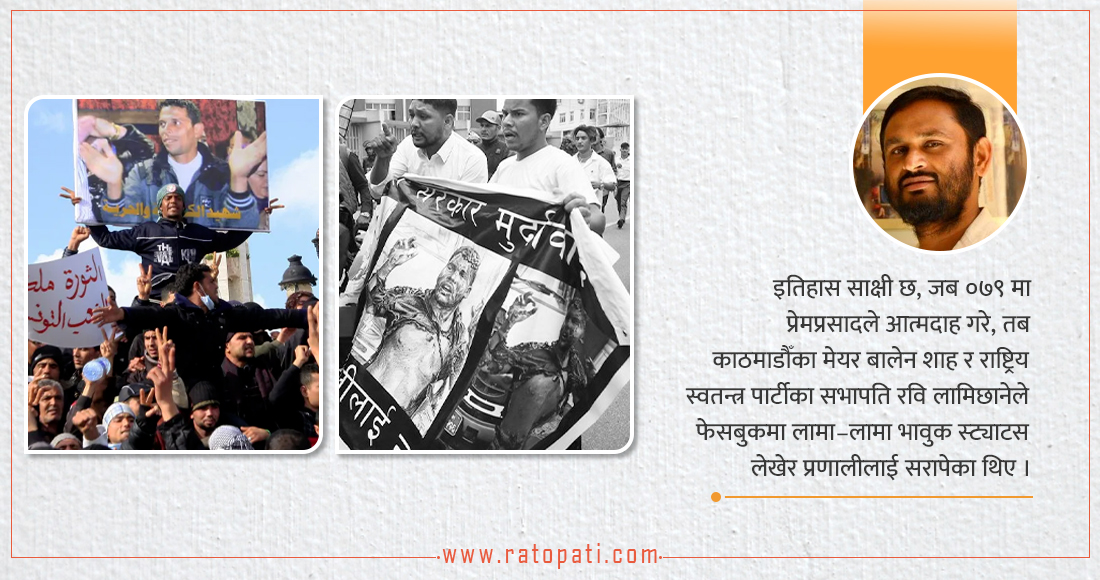
Feeling that the previous government's actions were a direct attack on democratic rights and freedom of expression, thousands of youths took to Maitighar Mandala on Bhadra 22. The government used excessive and indiscriminate force against the peacefully started Gen-Z movement. 19 people lost their lives to police gunfire.
To control the political vacuum and street chaos, a dialogue was held with the protesting youths through the mediation of the Nepal Army. The youths, who showed complete distrust of the traditional party mechanism, proposed former Chief Justice Sushila Karki as the interim Prime Minister. On Bhadra 26, President Ram Chandra Paudel dissolved Parliament, formed an interim government under the leadership of Sushila Karki, and announced elections across the country on Falgun 21.
The general election held on Falgun 21 completely changed Nepal's political landscape. Defeating the traditional parties badly, Balen was appointed Prime Minister. Due to his personality, which led the election from the RSP, the RSP won 182 out of 275 seats in the House of Representatives (125 under the first-past-the-post and 57 under proportional representation), achieving a historic success near a two-thirds majority.
- Balen's Future Path
Previous governments that reached or received a near-majority failed due to internal strife, bureaucratic non-cooperation, and foreign influence. But the government led by Balen does not have that luxury. Citizens want results rather than theoretical talk. Therefore, there are some important steps this government must take immediately.
First, amend the Public Procurement Act 2063. Second, amend the Civil Service Act and ban active party trade unions in ministries. Third, restructure the Prevention of Corruption Act and the Authority. Fourth, it seems necessary to consider the Local Government Operation Act, 2074.
The hard truth that history has repeatedly proven is that it is not enough to get a two-thirds mandate in an election or lead a new government. It requires the indomitable courage to change the system of state governance, the willpower to break the bureaucratic setting, and the diplomatic tact to keep foreign influence in balance. If the army's non-cooperation and geopolitical sensitivity were responsible for B.P. Koirala's fall, then if the current government does not learn from the past, its fate could be the same as the past.
This specific news has been automatically translated by AI. As a result, there may be some inaccuracies or language errors.




_6FSvCrCShE.jpg)