Nepal Oil Corporation Adjusts Fuel Prices Amid Rising Global Costs

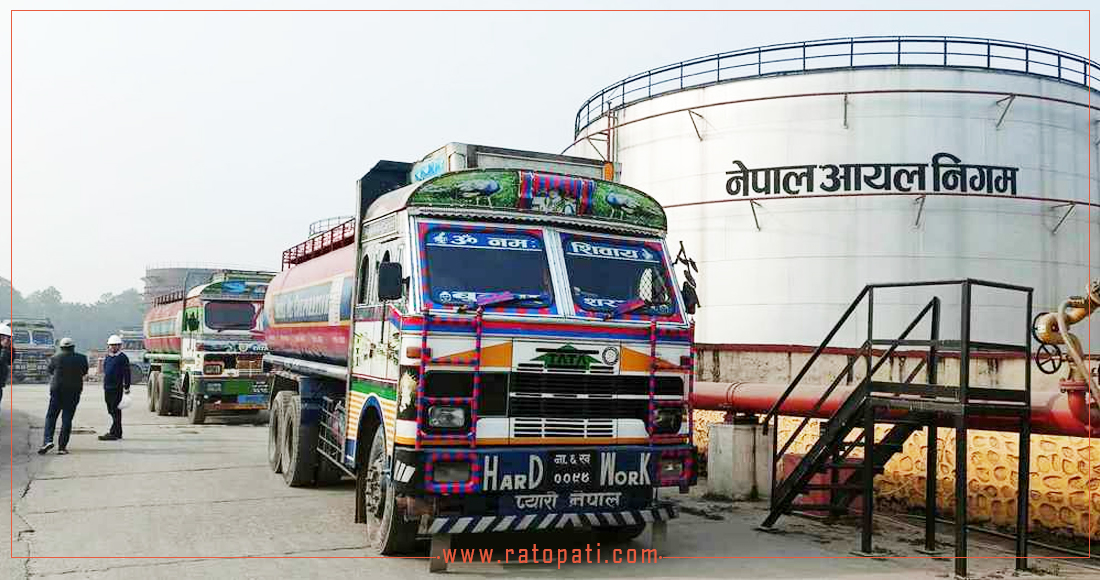
Kathmandu. On Thursday, the Nepal Oil Corporation (NOC) adjusted the prices of petroleum products. The adjustment was based on the price list received from the Indian Oil Corporation (IOC), reflecting the rising costs in the international market.
The new prices are set at 202 rupees per liter for petrol, 182 rupees for diesel and kerosene, and 251 rupees for aviation fuel. The price of cooking gas remains unchanged at 1910 rupees per cylinder.
However, the prices received from the Indian Oil Corporation are significantly higher. According to the NOC, the new price list indicates a loss of 34.36 rupees per liter for petrol, 120.54 rupees for diesel, and 416.37 rupees per cylinder for cooking gas. This means that to reach a 'break-even' point, the prices would need to be 236.36 rupees for petrol, 302.54 rupees for diesel, and 2326.37 rupees for LPG. The corporation reports a loss of 11.71 billion rupees every 15 days.
NOC spokesperson Manoj Thakur states that the daily demand in the Nepali market is 2 to 2.5 million liters of petrol, 4.5 to 5 million liters of diesel, and an average of 15 metric tons of LPG. Given this consumption and the current losses, the corporation is facing a monthly deficit of 23 to 24 billion rupees.
- How was the decision for price adjustment made?
According to the new price list sent by the IOC on the 31st, the cost of petrol increased by 41.60 rupees, diesel by 94.93 rupees, and LPG by 190.36 rupees. Since prices had also risen 15 days ago and were not fully adjusted, the per-unit loss remains substantial.
Despite this, why did the government decide to increase petrol and diesel prices by only 15 rupees each? Spokesperson Thakur says the decision was made by the Board of Directors, and they are merely implementing it. 'The decision to increase by 15 rupees was made by the Board of Directors. The Secretary of the Government of Nepal is also the Chairman of our Board,' Thakur said. 'This decision must have been made after discussions with the government.'
The line ministry for the corporation is the Ministry of Industry, Commerce and Supplies. This ministry is currently under the leadership of Prime Minister Balendra Shah (Balen). Balen has not yet provided a concrete decision on how to adjust prices, leaving the ministry's bureaucracy unable to act.
A ministry official mentioned that the absence of a minister is making it difficult to make decisions regarding price adjustments. 'Deciding whether to control inflation by keeping prices low or to facilitate supply by maintaining automatic price adjustments is only possible at the political level,' the official said. 'The ministry is currently under the Prime Minister's purview. We have not been able to explain the current situation to him clearly. The price adjustment was made based on the decisions possible at the staff level.'
- Supply remains continuous, but payment issues pose a risk of shortage
As prices rise, there are reports of petroleum shortages in the Indian market, raising concerns about potential shortages in Nepal.
However, NOC spokesperson Thakur says there is no possibility of a shortage based on the current supply status. 'We are receiving as much petrol and diesel as needed, and gas is also being imported according to the quota. There is no shortage due to imports at the moment,' Thakur said. 'Our challenge is to make payments on time.'
The corporation pays the IOC every 15 days for the previous supply, typically on the 8th and 15th of each month. So far, the NOC has made all payments to the IOC, utilizing funds from the Price Stabilization Fund despite the losses.
The next payment is due this coming Tuesday, but the corporation does not have sufficient funds. There is concern that if the full amount is not sent, the IOC might reduce supply, potentially leading to shortages.
- Why has diesel become more expensive than petrol?
Typically, petrol is slightly more expensive than diesel in the international market. Currently, however, diesel has become more expensive than petrol. According to the new price list from the IOC, petrol is 66.18 rupees cheaper than diesel.
Why is this happening? Petroleum expert Sushil Bhattarai says the demand side is the main reason for the price difference between products. He argues that while the demand for diesel does not decrease immediately, the demand for petrol can be adjusted, making diesel more expensive.
'Petrol is a product consumed for personal use at the international level. It is mainly used for small vehicles, whereas diesel is used for industrial production and freight vehicles,' Bhattarai said. 'Now that prices have risen, individuals are reducing consumption, but industries have to buy fuel even if it is expensive. This is why diesel has become more expensive.'
He added that the recent increase in the use of electric vehicles is also helping to control petrol consumption.
Bhattarai also noted that refinery and storage capacities in various countries influence prices, although he believes this has less impact on the price hikes in Nepal and India.
- How many days of storage capacity does Nepal have?
While storage and supply systems affect shortages, storage has little contribution in Nepal. Expert Bhattarai says the only reason there has been no shortage of petroleum products in the market so far is the continuous supply.
He states that Nepal's storage capacity can only cover about a week's demand for petroleum products. Since demand increases when a shortage begins, this stock is insufficient to control shortages.
'The capacity of the Oil Corporation is about 7 to 8 days. It is slightly above average in Kathmandu, Pokhara, and Amlekhgunj, but below average in Bhairahawa, Nepalgunj, and other places,' Bhattarai said. 'However, unless there is a capacity to store for two to three months, it will not contribute significantly to supply management.'
After the 2072 blockade by India, it was decided to build infrastructure to sustain three months of imports. However, even after a decade, the storage capacity has not reached even 10 days. In the last decade, the corporation has increased storage capacity in places like Amlekhgunj, Pokhara, Bhairahawa, Nepalgunj, and Dhangadhi, and work is underway to extend the pipeline to Lothar in Chitwan.
This specific news has been automatically translated by AI. As a result, there may be some inaccuracies or language errors.




_jxKX1kXOlf.jpg)