NASA Launches Artemis II Mission, Sending Four Astronauts on Historic Lunar Journey


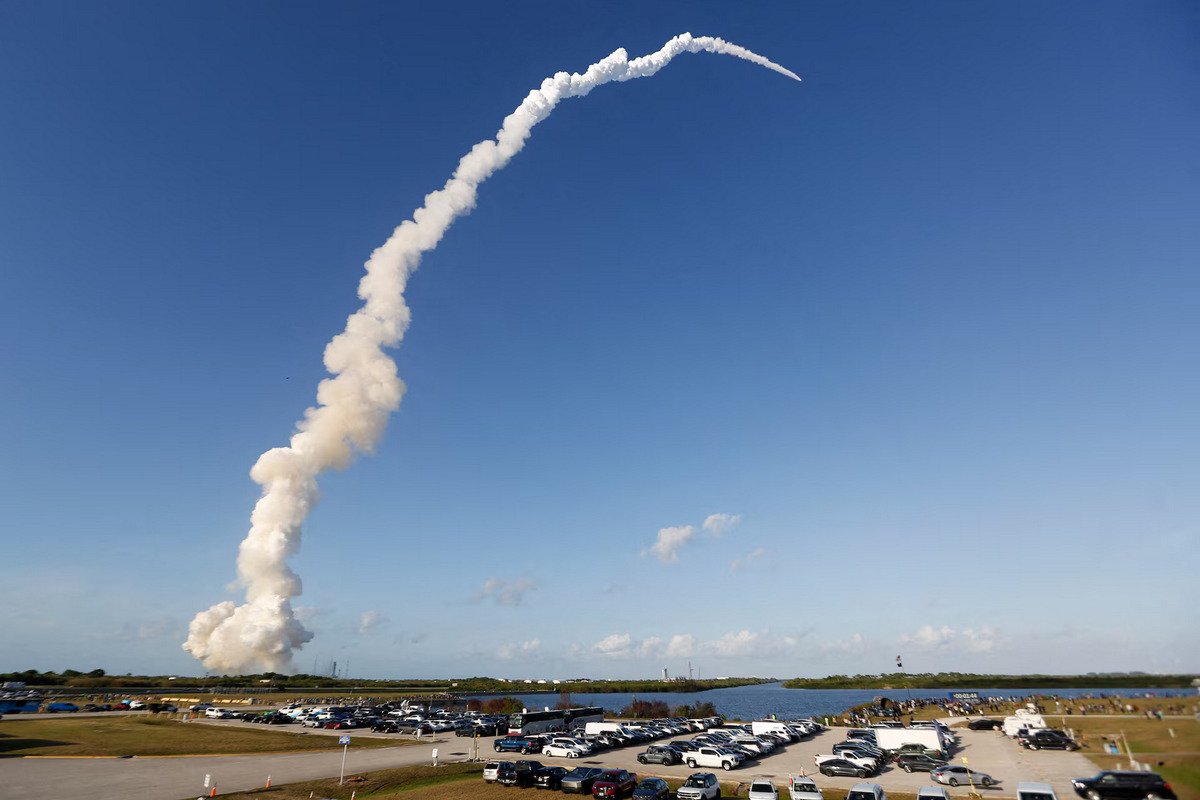
Florida. Four astronauts have embarked on a lunar journey from Florida, USA, as part of NASA's ambitious 'Artemis-II' mission. Launched on Wednesday, local time, this 10-day mission is viewed as America's boldest step yet to return humans to the moon this decade and reach the lunar surface before China.
_qzScDzb521.jpg)
The mission was successfully launched at 6:35 PM Eastern Daylight Time (EDT) from NASA's Kennedy Space Center, with the Orion crew capsule mounted atop the Space Launch System (SLS) rocket. The mission includes NASA astronauts Reid Wiseman, Victor Glover, and Christina Koch, along with Canadian Space Agency astronaut Jeremy Hansen.
_5xcFTNmNKT.jpg)
Their journey will last approximately 10 days, during which they will orbit the moon and return to Earth. This trip will reach the farthest point from Earth ever traveled by humans in history.
_gFQNGxGqti.jpg)
Minutes before launch, Canada's Hansen informed launch control from inside the Orion capsule that this journey is for all of humanity. Similarly, Launch Director Charlie Blackwell-Thompson stated that in this historic mission, they carry the heart of the Artemis team, the adventurous spirit of the American people, and the hopes and dreams of partners worldwide and the new generation. She wished the mission success and gave the go-ahead for launch.
_Hqsx4D5wjc.jpg)
After nearly three years of continuous training, this team has become the first to fly into space under NASA's Artemis program. The main objective of this multi-billion dollar project, which began in 2017, is to establish a long-term American presence on the moon for the coming decade and beyond.
_gwc3AdcFeH.jpg)
This launch is a major achievement for the SLS rocket after more than a decade of development. While NASA has recently been increasing its reliance on new and cheaper rockets like Elon Musk's SpaceX, the 30-story tall system has been proven by its main contractors, Boeing and Northrop Grumman, to be capable of safely carrying humans into space.
_xXVXshrK8U.jpg)
The gumdrop-shaped Orion capsule, built by Lockheed Martin, will separate from the upper stage of the SLS in Earth's orbit three and a half hours after liftoff. The astronauts will then manually take control of Orion and test its steering and maneuverability around the separated stage. This will be the first of dozens of test objectives set for the mission.
_cvxX2N5RD9.jpg)
The Artemis-II mission is a key preliminary phase of the American lunar campaign. The US aims to land humans on the lunar surface for the first time via the Artemis-IV mission in 2028.
_hmcgQWBVRW.jpg)
NASA is under intense pressure to land humans on the moon for the first time since the final Apollo mission in 1972, as China is also expanding its lunar program with plans to land its own astronauts on the moon by 2030.
_Sz7YuClZid.jpg)
This mission will take astronauts approximately 406,000 kilometers into space, the longest distance humans have ever traveled. Previously, the record for the farthest space flight was held by the three-member crew of Apollo 13 in 1970, which reached about 248,000 miles away. That mission, which faced technical problems after an oxygen tank explosion, failed to land on the moon as planned.
_rUsJwkWtSA.jpg)
Previously, NASA successfully completed the uncrewed Artemis-I mission in 2022. Artemis-II will conduct an even greater test of the Orion and SLS rocket. The rocket system, estimated to cost between $2 billion and $4 billion per launch, has been under development by Boeing and Northrop Grumman since 2010.
_qpo1tRA9WU.jpg)
Meanwhile, Elon Musk's SpaceX and Jeff Bezos' Blue Origin are competing to develop the landers required to put NASA astronauts on the lunar surface. Although the goal was initially to land humans on the moon via Artemis-III, NASA's new administrator Jared Isaacman added an extra test mission last February before the main landing.
_1gkWyUhjNG.jpg)
_AvD2dvI6Gt.jpg)
_hF3D7antTm.jpg)
This specific news has been automatically translated by AI. As a result, there may be some inaccuracies or language errors.