
Internal Dissent Within CPN-UML Following Selection of Ram Bahadur Thapa as Parliamentary Party Leader

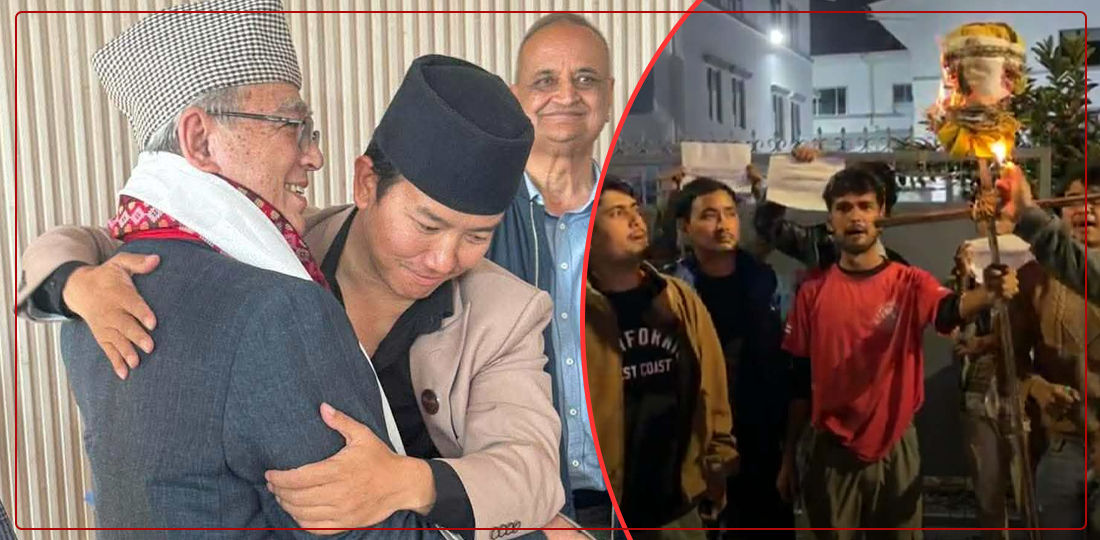
Kathmandu. Dissatisfaction has emerged within the CPN-UML after the party bypassed young lawmaker Suhang Nembang to appoint veteran leader Ram Bahadur Thapa 'Badal' as the parliamentary party leader.
In protest against the selection, party members and cadres have not only criticized the leadership on social media but have also taken to the streets, organizing torch rallies.
During the election held on Wednesday at the UML party office in Chyasal, Vice-Chairman Badal was 'unanimously' elected as the parliamentary party leader. Although young lawmaker Suhang Nembang had expressed interest and filled out a nomination form, he did not register his candidacy at the last moment. Suhang himself stated that he refrained from registering because he realized he would not win.
After Thapa was elected, Suhang addressed the media, urging the youth and party supporters not to be discouraged. He emphasized that this was only his first step and committed to continuing his work for the benefit of the country and its people.
'We attempted to follow democratic practices while selecting the party leader from within the party. There was no pressure here,' Suhang remarked.
Suhang noted that while the result was not what he expected, he accepted it, acknowledging that the other candidate might have been considered more capable. 'Today's result provides an opportunity for self-reflection and introspection to correct the weaknesses within the CPN-UML. This will strengthen the party in the future,' he added.
It is reported that Suhang did not register his candidacy after learning that Chairman K.P. Sharma Oli, Vice-Chairman Bishnu Paudel, and General Secretary Shankar Pokharel were pressuring lawmakers to support Thapa.
This has been revealed by leaders including UML Deputy General Secretary Yogesh Bhattarai and former Vice-Chairman Surendra Pandey.
With other parties holding a majority in the new parliament, there had been calls for the UML to appoint a youth as its parliamentary party leader. Party members and cadres believed this would send a message of transformation and generational shift.
However, contrary to these expectations, the selection of 70-year-old Thapa has suppressed that voice within the UML. There is widespread discussion that the party's rigid, archaic tendencies remain unchanged with the selection of the 70-year-old Thapa over 36-year-old Suhang.
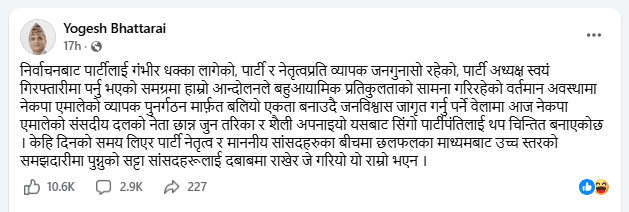
Following Thapa's election, Deputy General Secretary Bhattarai publicly stated that the method and style used to select the leader have further worried the entire party rank and file. 'Instead of taking a few days to reach a high-level understanding through discussions between the party leadership and honorable lawmakers, what was done by keeping lawmakers under pressure was not right,' Bhattarai expressed his dissatisfaction on social media.
Bhattarai stated that the party has suffered a serious blow from the election, faces widespread public grievances, and the party chairman himself has been arrested. He argued that at a time when the movement is facing multidimensional adversity, the party should have focused on building strong unity through comprehensive reorganization to restore public trust, rather than making mistakes by selecting a leader under pressure.
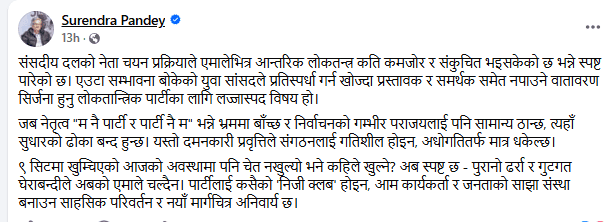
Similarly, former Vice-Chairman Surendra Pandey also criticized the selection, highlighting how weak and narrow internal democracy has become within the UML.
He also strongly criticized the leadership, noting that they have not learned any lessons even after the party was reduced to 9 seats in the last election. 'The process of selecting the parliamentary party leader has made it clear how weak and narrow internal democracy has become within the UML,' Pandey wrote on social media. 'It is shameful for a democratic party that a promising young lawmaker could not even find a proposer and supporter when attempting to compete.'
Leader Pandey stated that when the leadership lives in the illusion that 'I am the party and the party is me' and treats a serious electoral defeat as normal, the door to reform closes. He warned that such oppressive tendencies will not make the organization dynamic but will only push it toward decline.
'If there is no realization even in today's situation where we are reduced to 9 seats, when will there be? It is now clear – the old ways and factional encirclement will not work for the UML anymore. Bold change and a new roadmap are mandatory to make the party a common institution for general workers and the public, not someone's 'private club',' Pandey said.
Former lawmaker and UML leader from Lumbini, Basudev Ghimire, also commented that this style of leadership will not improve the party but will lead to its disappearance.
Ghimire, who is also a former lawmaker, made this comment while referring to the unopposed election of proportional representative lawmaker Ram Bahadur Thapa 'Badal' as the UML parliamentary party leader.
When he was the Mayor of Tilottama, leader Ghimire had issued a statement on the municipality's letterhead opposing the dissolution of parliament by party chairman K.P. Sharma Oli. He had also questioned the government's role during the movement on 23 and 24 Bhadra and had stood with the Ishwor Pokharel faction during the party's general convention.
Looking at social media on Wednesday, it seemed as if the UML, which had been protesting against the government, was now protesting against its own leadership following Badal's selection. A group from the UML's sister organization, All Nepal National Free Students Union (ANNFSU), even burned an effigy of General Secretary Shankar Pokharel on Wednesday evening.
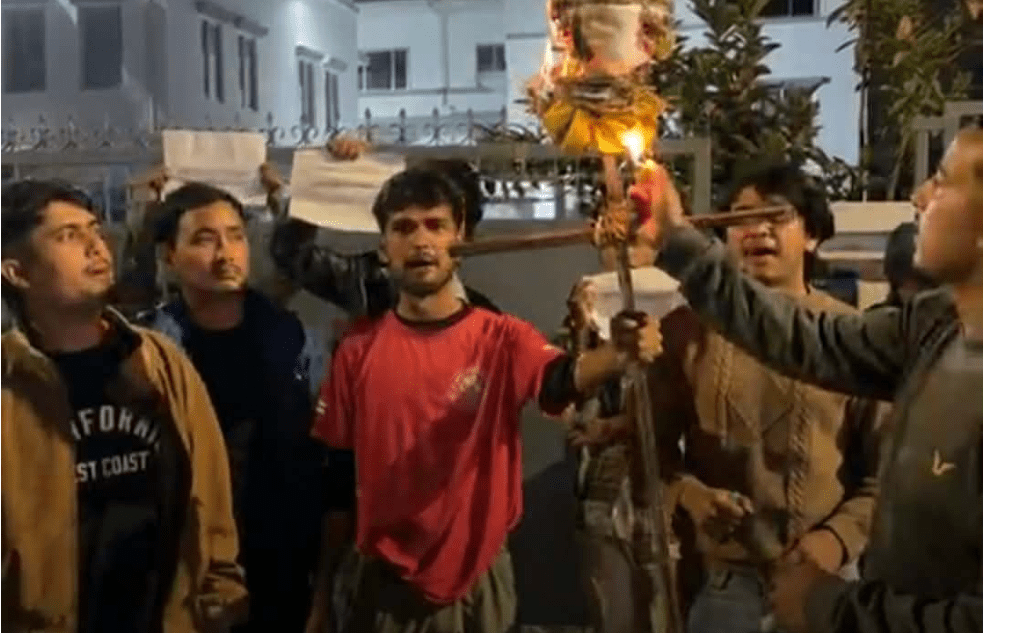
The Amrit Science Campus committee of the UML burned the effigy of General Secretary Pokharel. They marched from the campus to the party's central office, chanting slogans against the General Secretary before burning the effigy.
Gopaljung Shahi, president of the ANNFSU Amrit Campus committee, said that they had to burn the General Secretary's effigy in protest against the situation created by the party leadership, which left Suhang Nembang unable to even find a proposer and supporter for the parliamentary party election.
Not only that, other responsible leaders and cadres of sister organizations and committees are also protesting, claiming that the UML has not transformed.
They argue that since the leadership has not corrected itself even after the election on 21 Falgun brought about political generational change, there is no alternative but to express their outrage.
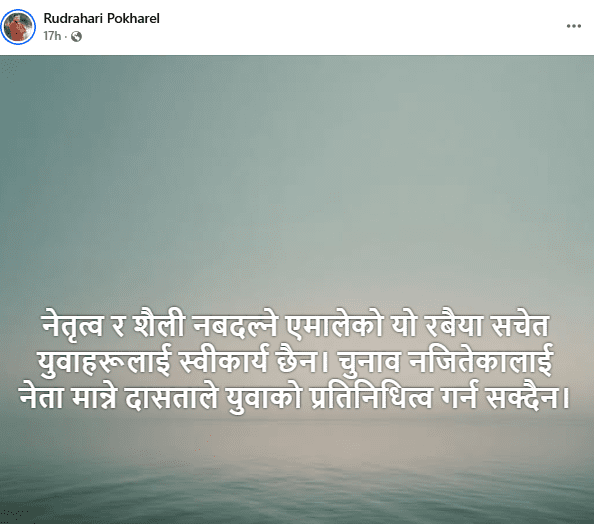
Similarly, ANNFSU secretariat member Rudrahari Pokharel warned that the UML's attitude of not changing its leadership and style will not be accepted by conscious youth.
He wrote on social media that the servitude of accepting those who have not won elections as leaders cannot represent the youth, stating, 'This attitude of the UML, which does not change its leadership and style, is not acceptable to conscious youth. The servitude of accepting those who have not won elections as leaders cannot represent the youth.'
This specific news has been automatically translated by AI. As a result, there may be some inaccuracies or language errors.



_sHSpnAljCR.jpg)