
Ongoing Conflict in West Asia Disrupts Infrastructure Projects in Nepal


Kathmandu. The ongoing conflict in West Asia has impacted infrastructure development in Nepal. Specifically, there have been disruptions in the import of bitumen (asphalt), a petroleum product essential for road paving.
The Department of Roads stated that road construction projects are being affected due to the shortage and rising costs of bitumen. Shyam Bahadur Khadka, Deputy Director General and spokesperson for the department, noted that road projects across the country are facing delays.
‘Even though it is the peak season for paving after preparing the road base, the lack of easy access to bitumen has increased the risk of projects being left in limbo,’ spokesperson Khadka said. ‘Construction entrepreneurs currently have very little bitumen in stock. They have complained that rising market prices and limited availability are making it difficult to proceed with work.’
Important ongoing road projects, including Nagdhunga-Mugling, Mugling-Pokhara, and the Hulaki Highway, have been affected by the bitumen shortage. With bitumen being available only once or twice a week, completing work on time has become challenging.
Spokesperson Khadka mentioned that the department is gathering more information and assessing the situation. Although road construction should gain momentum during the winter, the lack of necessary materials is expected to push back timelines.
The Road Division continues its campaign to make Kathmandu's roads pothole-free. Division Chief Subodh Kumar Devkota stated that the road ambulance service, launched to address road issues immediately, is working effectively to fill potholes and carry out repairs and upgrades.
He added that while road expansion work under the division is being accelerated, the recent disruption in petroleum product supply has slowed down maintenance, upgrades, and paving.
‘Construction entrepreneurs are complaining that they are finding it difficult to work due to the price hike of petroleum products and bitumen,’ said Division Chief Devkota. ‘I am directing them to work according to the contract. Work cannot be stopped just because prices have risen.’
Devkota stated that if there is a ‘price adjustment’ provision in the contract, claims can be made accordingly; otherwise, work must be completed on time as per the Public Procurement Regulations.
Bitumen Shortage for Nagdhunga-Mugling Eastern Section
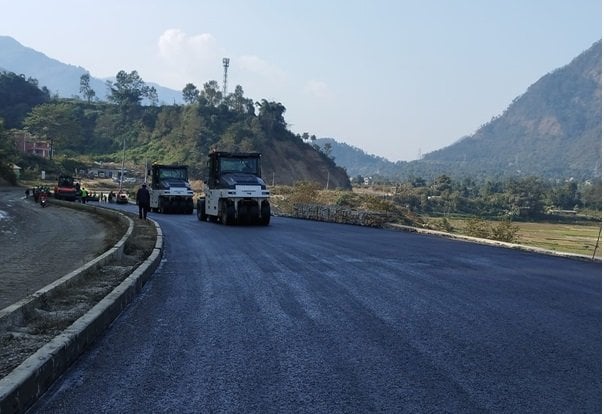
The Nagdhunga-Mugling road expansion project has also been affected by the disruption in the supply of construction materials. The project is on the verge of stalling due to the lack of bitumen supply required for paving.
According to Keshav Prasad Ojha, Chief of the Nagdhunga-Mugling Road Project (Eastern Section), the paving work has been directly affected by the interrupted supply of bitumen from foreign markets. Although the two sections of the project require two tankers of bitumen daily, only one or two tankers are currently available per week.
‘Given the current situation, it does not seem that the work can continue for a very long time,’ Ojha said. ‘Contractors are unable to get bitumen on time even after paying for it in advance.’
Problems have also been observed in the supply of other petroleum-based by-products, such as polythene pipes, in addition to bitumen.
Due to the shortage and price hike of construction materials, it appears that the ‘aggressive’ progress target set for the current year will not be met.
Slow Progress on Malekhu-Mugling Section
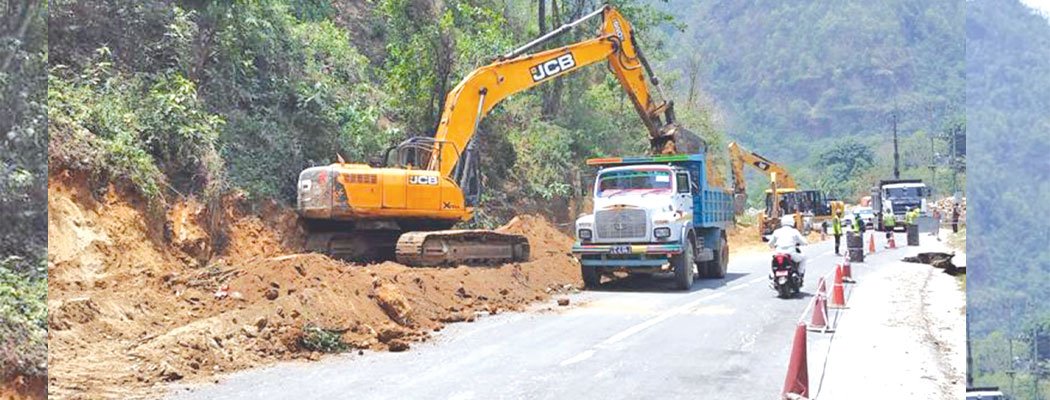
The expansion work of the western section (Malekhu-Mugling) under the Nagdhunga-Mugling road project is 43 percent complete. According to Information Officer and Engineer Sachendra Mishra, there is a slight slowdown in the pace of work due to some challenges.
Currently, work is underway to cut difficult curves on that section. Engineer Mishra informed that the road is being closed from 10 PM to 4 AM to cut 10 to 12 curves in the 3-kilometer area near Mugling.
‘Since we have to cut difficult curves, we are working by issuing notices to close the road at night for safety,’ he said.
Paving work appears somewhat slow. The increase in the price of construction materials, especially bitumen, and higher transportation costs have caused contractors to delay purchasing materials, which has impacted the pace of work. ‘Due to the price hike, contractors are in a wait-and-see mode, which has caused some slowdown in work, but it has not stopped completely,’ Mishra said.
The western section has achieved 43 percent physical progress so far.
Narayanghat-Butwal Western Section 80 Percent Complete
The physical progress of the western section under the Narayanghat-Butwal road expansion project has reached 80.5 percent. Information Officer and Engineer Bikash Khanal stated that work has continued despite the challenges of price hikes and shortages of construction materials.
About 3 kilometers of paving has been completed in the Daunne area. Currently, work on service lanes and dividers is underway in the market area. Along with these tasks, ‘road marking’ work will also begin. The project stated that workers and equipment have been mobilized to complete most of the work on the Daunne section before the monsoon.
Currently, work on the Daunne section is being prioritized. According to Engineer Khanal, 2.7 kilometers of road paving (rigid pavement) remains to be done in Daunne.
‘The goal is to fully clear one side of the road in Daunne by the end of Baisakh,’ he said. ‘Once the one-way road is opened, vehicle movement will be easier, and it will also be easier to work on the other side.’
A few days ago, a team including the Chief District Officer (CDO) of West Nawalparasi conducted an on-site inspection of the road. During the inspection, the contractors were directed to increase the pace of work.
Khanal informed that half of the work on the three culverts in Daunne has been completed, and all work on the culverts will be finished in the next one and a half to two months. Similarly, landslide management work at kilometer 71 has also begun. The project plans to complete this before the monsoon starts.
About 3 kilometers of paving has been completed in the Daunne area. Currently, work on service lanes and dividers is underway in the market area. Along with these tasks, ‘road marking’ work will also begin. The project stated that workers and equipment have been mobilized to complete most of the work on the Daunne section before the monsoon.
No Issues on BP Highway, Dhulikhel-Khawa Road May Be Affected
Suman Yogesh, Senior Divisional Engineer and Chief of the Bhaktapur Road Division Office, stated that construction work on the BP Highway and the Dhulikhel-Khawa road section is progressing rapidly. He clarified that despite the rise in the price of construction materials, there has been no significant obstruction in the work of those projects.
Engineer Yogesh mentioned that while there are complaints of contractors stopping work on many projects due to the rising cost of construction materials, there is no such problem on the BP Highway. According to him, contractors are continuing the work because there is a provision for price adjustment in the contract agreement. ‘The construction work of the BP Highway is moving forward very well,’ Yogesh said. ‘There has been no delay in work due to price adjustments.’
However, the team has not yet been mobilized to the site for the section that was supposed to be built by JICA. He informed that work has gained momentum in the remaining three sections.
Preparations for paving on the Dhulikhel-Khawa road section are also in the final stages. A one-lane CTB (base) has been prepared on a section of about two and a half kilometers, and all preparations for pitching are complete.
_tlHWNmedfD.jpg)
According to Engineer Yogesh, the paving that was stopped due to rain will start tomorrow if the weather is clear. ‘Although its contract period is until Mangsir, we are working with the goal of finishing the pitch within Baisakh,’ he said.
After the pitching is finished, the remaining work of road marking and slope protection will be done. However, he indicated that if the price of materials like bitumen increases excessively, it could have some impact.
Hulaki Highway: 74 Percent Progress

The physical progress of the Hulaki Highway project has reached 74 percent. Kuber Nepali, Chief of the Project Directorate, stated that the highway construction work has gained momentum and efforts are being made to resolve the main problems seen in the project.
He said that since work is stuck in some places, the technical team is currently paying special attention to those areas.
Although the work on the highway has progressed satisfactorily so far, it appears that the impact of the ongoing conflict in West Asia could affect the project. Chief Nepali said that the supply of construction materials could be problematic due to the rise in fuel prices in the international market.
‘Now it seems that the conflict will have an impact on the project. The import of construction materials, especially bitumen and diesel, may stop,’ he said.
Nepali said that diesel and bitumen cannot be stored for a long time, and the price per liter has also increased significantly, adding challenges to the work.
For now, he said, construction work is being continued with materials that were already in stock. He informed that since new goods have not been imported and prices in the market have also increased, the pace of construction could be affected in the coming days.
How Much Have Construction Material Prices Increased?
Due to the sharp rise in crude oil prices in the international market caused by the ongoing conflict in West Asia, the prices of essential materials for the construction sector such as cement, steel rods, and bitumen have skyrocketed unexpectedly. According to the Federation of Contractors' Associations of Nepal, development and construction works across the country have been affected by inflation and are now almost at a standstill.
Rabi Singh, President of the Federation of Contractors' Associations, informed that recently the price of cement has been increased by 50 rupees per bag, steel rods by 20 rupees per kg, and bitumen by up to 45 rupees. The price of bitumen, which previously cost 85 rupees, has now reached 130 rupees, while the price of steel rods, which cost 72 rupees, has reached 85 rupees. Similarly, the price of OPC cement has reached 700 rupees per bag and PPC 800 rupees, which is a significant increase compared to the previous rates.
President Singh also accused industrialists of increasing prices by creating ‘carteling’ and artificial shortages. He argues that it is not fair to increase the price of goods that are already in stock as soon as the price of crude oil rises in the international market.
He alleged that industrialists have reduced production to show a shortage of materials in the market, and although it takes time for new raw materials to arrive from outside, they have increased prices now, putting contractors in a difficult position.
This specific news has been automatically translated by AI. As a result, there may be some inaccuracies or language errors.





_sHSpnAljCR.jpg)