Hanuman Jayanti Celebrated Across Nepal

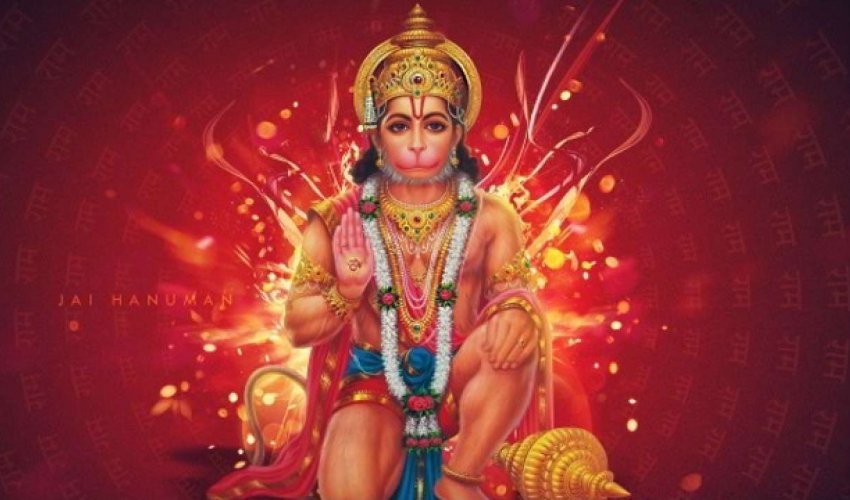
Kathmandu. Hanuman Jayanti, the birth anniversary of Lord Hanuman, is being celebrated across the country today with various programs on the occasion of Chaitra Shukla Purnima.
It is believed that worshipping Hanuman on Chaitra Shukla Purnima brings strength, wisdom, and knowledge, and provides liberation from suffering and crisis. On this occasion, special prayers are held at Hanuman temples nationwide, including the idol at Hanuman Dhoka, the Pashupati Hanuman temple, and the Panchamukhi Hanuman in Gokarneshwor Municipality. It is customary for only priests to perform worship at the Panchamukhi Hanuman temple near Nasal Chowk in Hanuman Dhoka Palace.
According to Sanskrit grammar, the word 'Hanuman' is derived from the root 'Hanu' with the suffix 'Matup'. 'Hanu' means chin. It is derived from the root 'Han', which means violence or movement. Thus, the word Hanuman signifies a powerful being with swift movement. 'Hanu' also implies an obedient servant, which is why Hanuman is known as a devotee of Lord Rama. Scriptures mention that the events in Lord Rama's life established Hanuman as a highly revered deity.
Fear is a fundamental human instinct. Hanuman is the power that protects against the influence of evil spirits. In the past, seeing or remembering a monkey was considered inauspicious, while elephants were seen as auspicious. Hanuman began to be worshipped as 'Mangalmurat' or the 'Sankat Mochan' (troubleshooter). Experts say this is why the tradition of reciting 'Hanuman Chalisa' for liberation from fear began among people of all ages.
Hanuman is considered the son of the wind god (Vayu). It is believed that he can assume any form. In the Shatrudra Samhita, Hanuman is considered the eleventh form among the eleven Rudras. It is said that the Rudras existed before the development of the Hanuman sect. Thus, classical opinion holds that Hanuman existed before the Ramayana. The Ramayana is the most authoritative source of information about Hanuman. Vedic texts also describe Hanuman as an incarnation of Shiva, born to assist Ramchandra, who was an incarnation of Vishnu.
The Avanti Khanda of the Skanda Purana states that there is no greater being in the world than Hanuman. He is described as unmatched in areas such as supreme consciousness, enthusiasm, intellect, valor, gentleness, sweetness, policy, depth, cleverness, strength, and patience.
On this occasion, men, women, children, and the elderly bathe in holy rivers and perform fasting and worship. Hanuman is also called Bajrangbali because his body was as strong as a thunderbolt (Vajra). He is known as Pavanputra.
Pandit Balmukunda Devkota states that scriptures mention that meditating on the five-faced, radiant, powerful, and fierce form of Hanuman fulfills all tasks. It is believed that worshipping Hanuman provides liberation from diseases, obstacles, fear of rulers, natural disasters, evil spirits, ghosts, negative elements, and dangers from wind, water, fire, and demonic forces.
Hanuman attained closeness to Rama through Bhakti Yoga and Karma Yoga. In the Vaishnava tradition, Hanuman is also worshipped to attain various yogic powers. He possessed the eight types of yogic powers: Anima, Mahima, Garima, Laghima, Prapti, Prakamya, Ishitva, and Vashitva. Hanuman is remembered in both his supreme and fierce forms.
Hanuman's idols are adorned with vermilion (sindoor), which symbolizes the strengthening of bones and muscles. On this day, besides worship at temples, processions are also organized across the country. Special worship of Hanuman is typically performed on Tuesdays and Saturdays.
This specific news has been automatically translated by AI. As a result, there may be some inaccuracies or language errors.
_shBQSnE9IK.jpg)
_fkg5u05PqN.jpg)