Sudhan Gurung Appointed Home Minister in Balen Shah's Cabinet Amidst Significant Challenges


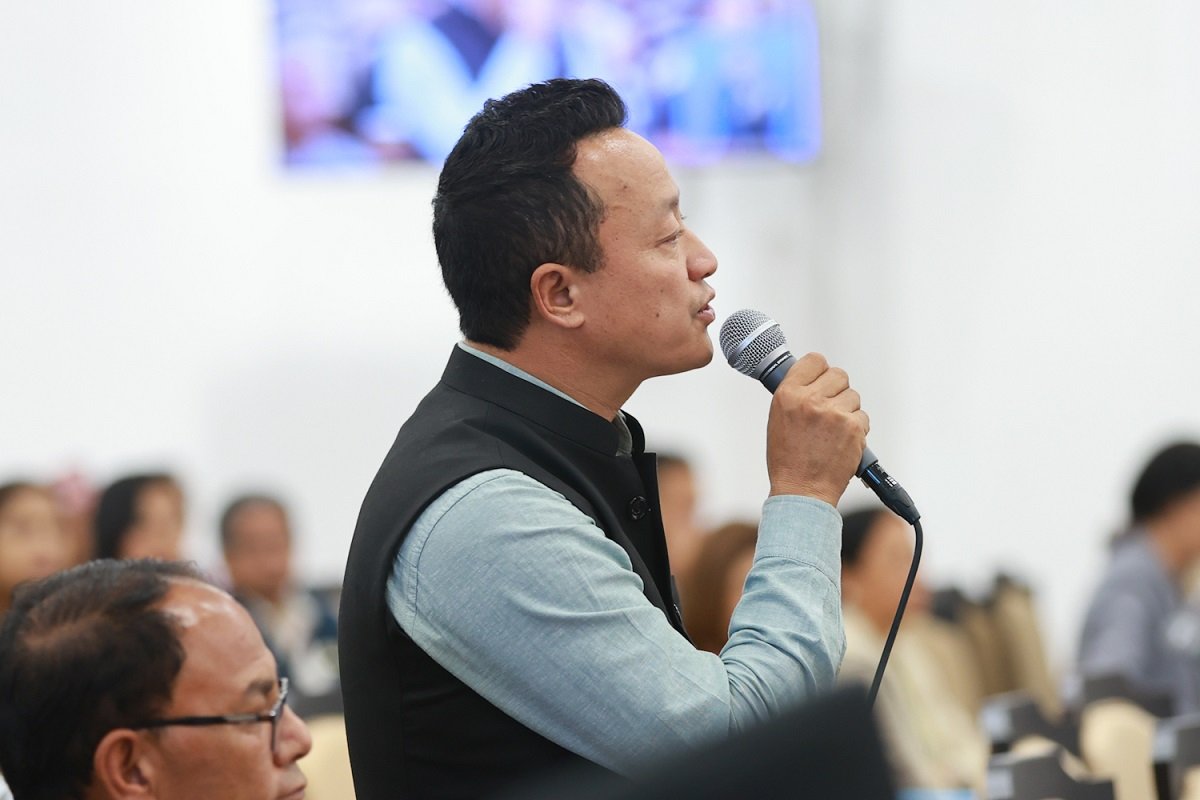
Kathmandu. Sudhan Gurung has become the Home Minister in the cabinet led by Balen Shah. Gurung, a leader of the 'Gen Z' movement that took place on Bhadra 23 and 24, was elected to the House of Representatives from Gorkha Constituency-1. President Ramchandra Paudel appointed Gurung as the Home Minister upon the recommendation of the Prime Minister.
Born and raised in Thahiti, Kathmandu, Gurung's parents are divorced. When he was six months old, his parents left him with his grandmother. His grandfather worked at the Annapurna Hotel. He did not receive parental affection from school days. Having studied in a hostel since nursery, Gurung spent his school life up to grade 10 in a hostel. During festivals, when family members did not come to pick him up, he would celebrate with the mothers at the hostel. Recalling those days in the hostel, Gurung told Ratopati, "I became strong by crying so much."
He studied up to grade 4 at Alice Covent in Kathmandu. He studied in Dhankuta for two years. After passing SLC from Kalika Gurukul English Secondary Boarding School in Chitwan, his father enrolled Sudhan in A-Levels at Kathmandu's Multi International School. However, he could not continue his studies after the second year of A-Levels. After finishing A-Levels, his father wanted to send Sudhan to America, but he preferred to stay around Thamel in Kathmandu.
To make a living, Gurung's first job was in a call center. After that, he learned dance and DJing. He built his own 'collection' as a DJ. Before getting involved in volunteerism, Gurung earned money by organizing parties. Sometimes he also worked as a DJ. Then, in Thamel, Kathmandu, he opened the OMG Club with people older than him. Dinesh Adhikari 'Chari', who was killed in a police encounter, was his friend. In a conversation with Ratopati, he said, "Chari was my friend."
Gurung's routine of DJing and running clubs in Thamel until before 2072 BS changed to volunteerism afterward. At the beginning of his career, he was a rapper. He told Ratopati, "After the earthquake, DJing and B-boying didn't appeal to me."
Hundreds of people were injured in the Kathmandu Valley due to the earthquake. He led the rescue of the earthquake victims and took them to the hospital. While volunteering, he established an organization named 'Hami Nepal' (We Nepal). Through this organization, he also worked during the Jajarkot earthquake. Claiming to have been involved in social service for the last 10 years, Sudhan also went to Turkey when the earthquake struck there. At that time, the Hami Nepali organization, in collaboration with the Government of Nepal, took 23 tons of supplies and worked for the affected people there.
An agitation began at B.P. Koirala Institute of Health Sciences after COVID-19. Gurung was also part of the months-long movement under the banner of 'Save GHOPA'. Sudhan continuously participated in the 'Enough is Enough' and 'Occupy Baluwatar' movements held in Kathmandu. During both movements, KP Oli was leading the government. He says, "That was a faceless movement."
While raising his voice against irregularities, Gurung realized, "The country doesn't work through the 'system'." Gurung, who is knowledgeable about IT, was at the forefront of the Gen Z movement on Bhadra 23 and 24. He was one of the leaders of the movement. He played a role in uniting the then Mayor of Kathmandu, Balen Shah, with Sushila Karki's interim government formation and subsequently with Rabi Lamichhane, the chairman of the Rastriya Swatantra Party (RSP).
He received a ticket from the Rastriya Swatantra Party in the election. He contested from Gorkha Constituency No. 1 and was elected, securing 29,829 votes. During the election campaign, Sudhan used to say, "Circumstances brought us to this position; we are ordinary people."
Sudhan, who previously had no interest in politics, has entered mainstream politics through agitation and social service.
A Pile of Challenges
The newly appointed Home Minister Sudhan Gurung faces many challenges in reforming the home administration. He will have to lead the District Administration Office, Nepal Police, Armed Police Force, and National Investigation Department under the Ministry of Home Affairs. The command of 79,541 personnel responsible for investigating criminal incidents is now in Sudhan's hands.
During the Gen Z demonstrations, police barracks and other resources were damaged. Security personnel, who returned to the barracks after repairing the office with local support, successfully conducted the House of Representatives election on Falgun 21. However, the morale of the security personnel has not returned to its previous state. Due to the lack of necessary equipment for crowd control, the police are in a state of being 'intimidated' by large crowds. The challenge of making the security personnel 'excellent' in crowd control rests on Gurung's shoulders.
The challenge of ending the current situation where there is a prejudiced attitude towards investigators also rests on his shoulders. Although civil servants have been adjusted, the Nepal Police is still in a central structure. According to the federal governance system, DIGs of the police command in the provinces, but they are powerless. The challenge of adjusting the police to the provinces lies ahead of him. Police officers themselves are dissatisfied with the adjustment. Inspectors and DSPs do not see their careers advancing if they move to provincial postings.
Although the Police and Armed Police Bills have reached Parliament, they have not been passed. The challenge of moving both bills forward to create new laws rests on Sudhan's shoulders.
It is an 'open secret' that there is political interference in the security agencies. Police officers do not want to admit that transfers and promotions happen based on influence. The notion that one must ask a 'power center' to get a transfer to a desired location is established within the police force. Officers without connections are always marginalized. Their morale is low. The challenge of ending the perennial interference in transfers and promotions and boosting the morale of the officers now falls on the shoulders of the newly appointed Home Minister Gurung.
RSP Chairman and former Home Minister Rabi Lamichhane publicly stated, "GB Rai has been located in Malaysia." However, the police have not yet brought Jitendra Babu (GB) Rai, the founding chairman of the Suryadarshan Cooperative in Pokhara, back. An Interpol Red Notice has been issued against him for the offense of misappropriating cooperative deposits. The challenge of arresting Rai has also come to Sudhan's plate.
This specific news has been automatically translated by AI. As a result, there may be some inaccuracies or language errors.