Inquiry Commission Holds Former Police Chief Chandra Kuber Khapung Primarily Responsible for Violence During Gen Z Protests

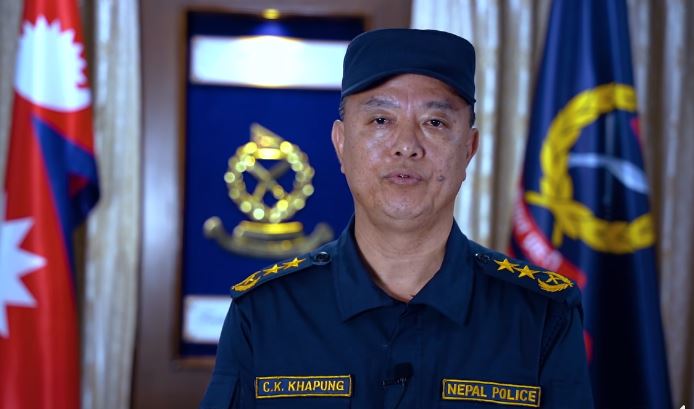
The inquiry commission has determined that former Inspector General of Police, Chandra Kuber Khapung, bears the primary responsibility for the crackdown during the Gen Z movement and the subsequent security chaos.
The report states that Khapung, who held the supreme command of the police organization, failed to provide effective command during a sensitive time and erred in coordinating with his subordinate units, leading to the deaths of 29 protesters in total—17 at the scene and 12 later.
A serious fact has emerged: while blood was being spilled on the streets and clashes were occurring in front of the Parliament building during the protests, Khapung, as the police chief, instead of taking initiative to normalize the situation, allegedly incited indiscriminate use of force via communication sets.
According to the commission's report, Khapung had received information via communication channels like Discord that protesters would become aggressive. However, he failed to timely relay this crucial information to his district chiefs, which resulted in a weak security plan.
Later, during his testimony, he appeared to try and evade responsibility by falsely claiming he had not anticipated the protests would be this aggressive. On Bhadra 23, after the prohibited zone in the Parliament complex was breached, he explicitly instructed via communication sets, "Curfew has been imposed, so you do not need to ask for orders; use necessary force." The timeline of the Police Headquarters confirms this order from Khapung, which opened the way for field police to use lethal weapons.
As the police chief, Khapung also showed no interest in managing necessary crowd control equipment such as pepper spray, tasers, and other non-lethal materials. The report points out that the lack of sufficient non-lethal weapons forced the police to resort directly to lethal weapons, causing a large number of deaths among unarmed students and youths. Furthermore, his failure to implement Rules of Engagement led the Police Special Task Force (STF) to use indiscriminate force due to confusion. During the four-hour clash, he made no attempt to stop the firing or negotiate, considering only the use of force as the final option.
When the commission requested records of arms and ammunition from Bhadra 23 and 24 for investigation, the police headquarters under Khapung's leadership delayed compliance. Although excuses were made that some records were destroyed by arson, this appeared to be an attempt to conceal the identity of the security personnel who fired the shots.
Khapung demonstrated extreme negligence by failing to issue instructions to secure or destroy weapons even when his own office was at risk of being looted. Taking the issue of weapon looting lightly, he also failed to initiate the process of forming a special court to prosecute the guilty as per the Police Act.
On Bhadra 24, one of Khapung's orders reportedly plummeted police morale. From the Army Headquarters, he issued a haphazard order to release detainees on personal bonds, which emptied police stations and outposts across the country.
According to the commission, Khapung's ambiguous order was responsible for creating a situation where police personnel had to abandon their posts and flee. The commission concluded that he pushed the country into crisis by creating circumstances where the police had to surrender and government property was looted.
Overall, the commission asserts that the massive human and material damage suffered by the Gen Z movement was due to Khapung's inability to lead the organization, his concealment of information, and his incitement to indiscriminate use of force.
This specific news has been automatically translated by AI. As a result, there may be some inaccuracies or language errors.
_Yq85YOxh21.jpg)