Rural Areas in Baglung Face Abandonment and Escalating Monkey Menace Amidst Migration

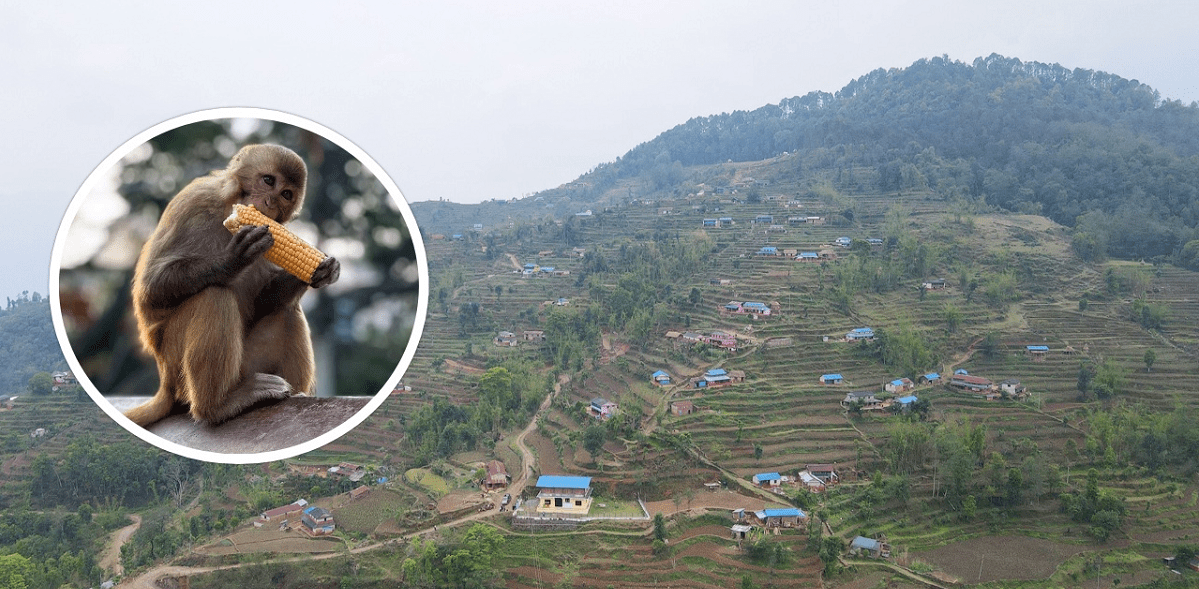
Baglung. Rural settlements are deserted. Bushes have grown all around. Within those bushes lie dilapidated houses. It is difficult to find neighbors to attend funerals or offer support during times of need.
There is a continuous stream of people moving from the rural areas of Baglung to the towns and markets. Those who remain in the villages are bearing the brunt of this exodus. When villagers chose the market, monkeys began to rule the villages. Although it sounds surprising, this is the reality in the rural areas of Baglung.
Monkey terror has increased in many places, including Kathekhola, Bareng Rural Municipality, Jaimini, and Galekot Municipality of the district. Despite the addition of facilities in the villages, migration has not stopped. Monkey terror has increased due to migration.
As locals begin to leave the villages, arable land is lying fallow. Monkeys now inhabit the deserted villages. Monkeys reach up to the eaves of empty houses and sheds. The harassment caused by monkeys forces the remaining locals to consider migration as an option.
Tam Bahadur Thapa of Jaimini Municipality-6 spends his daily routine chasing away monkeys. Since hundreds of monkeys from the nearby forest enter the village at once and destroy crops, Thapa does not have time to leave his house for anywhere else.
The monkeys that enter the village destroy not only the fields but also the grains kept inside the houses. Since they destroy all the belongings if one steps out for a short while, he stays guarding the house all day. Neighbors have either gone abroad or migrated to the Terai region. He has not been able to leave the village for anywhere.
_CwZ49b2nJz.jpg)
The houses in the village are emptying. Monkeys are reigning in the empty houses. The villages are becoming deserted as more people migrate in search of services and facilities. Besides monkeys, locals also complain that other wild animals occasionally trouble them in the deserted villages. Many people in the village, like Thapa, do not leave their homes all day. If they must go out, they have to leave someone behind to guard the house.
Farmers are also suffering as monkeys destroy the crops, fruits, and vegetables planted in the fields. Villagers have tried many methods to scare away the monkeys. Sometimes they clanged metal plates, sometimes they set off sound-making firecrackers, and sometimes they placed dummies in various spots in the fields. Although the monkeys were scared away initially, they eventually stopped being afraid. Thapa shared that nowadays the monkeys even try to attack.
He said, “In the past, they used to run away upon seeing a person. Now they rush towards us. Many people have left the village because of the monkeys. Our situation in the village has become unbearable; the monkeys eat all the crops. What will we eat to survive in the village? If this cannot be controlled, perhaps no one will be left living in the village anymore.”
_FRsF8r9WG4.jpg)
While the monkey population was smaller five years ago, it has been increasing now. Motiprasad Kandel of Kathekhola Rural Municipality-8 stated that besides eating crops, they also attack people. He said that if one does not stay to guard the house, nothing will be left by evening.
Kandel mentioned that although they used many tactics to scare the monkeys, they have stopped fleeing as they are becoming smarter. “If I have to go somewhere for some work related to the house or field, I have to leave someone to guard the house. It is also hard to find people in the village willing to guard the house. It has become very difficult to even earn a living in the village,” he added. “Because of the monkeys, people have to leave a guard behind even when attending weddings or funerals. We are very troubled.”
_Z4Xvn9Oq5s.jpg)
Keshab Bahadur Bik of Bareng Rural Municipality-1 said that monkeys have increased as the number of people in the village has decreased. He mentioned that monkeys, which were previously only found in the forest, now bother them at home. He stated that if long-term management of monkeys is not done, many people will be forced to leave the village. He added that the village is becoming desolate as forests grow and arable land turns fallow.
Bik said, “Monkeys do not let us earn a living. If we plant anything in the field, they destroy it as soon as it starts to sprout. They enter through the windows to eat grains and tear clothes. There were many people in the village before. It was not as deserted as it is now. That is probably why monkeys did not come back then.”
_0Sw3V0Fwd4.jpg)
In many parts of the district, arable land is covered by invasive grasses due to migration. Trees and vegetation around are growing and starting to engulf the villages. Only the elderly remain in the villages; the youth have gone abroad, and children have moved to the markets, causing the rural areas of Baglung to become deserted. Villages that were lively a decade ago are now desolate. Services and facilities have reached the doorsteps, but very few people are there to utilize them.
Purna Prasad Kandel of Kathekhola Rural Municipality stated that monkey terror has increased after many locals migrated from the village to the market. He mentioned that monkeys did not come when there were many people in the village, creating hustle and bustle, but the terror has increased as the village becomes deserted now. Kandel suggests that if the situation continues with increasing monkey numbers and ongoing migration, the villages might end up populated only by monkeys.
_mS4wWuxowf.jpg)
“There is every possibility in the village, but monkeys have become the main problem. How can this be solved?” Kandel asked. “There is a law that prevents killing monkeys that cause so much trouble to the people; if killed, one can even go to jail.”
This specific news has been automatically translated by AI. As a result, there may be some inaccuracies or language errors.



_SnDDedfgP3.jpg)