
Author Amar Neupane Discusses Literary Inspirations and the Journey to Becoming a Full-Time Writer


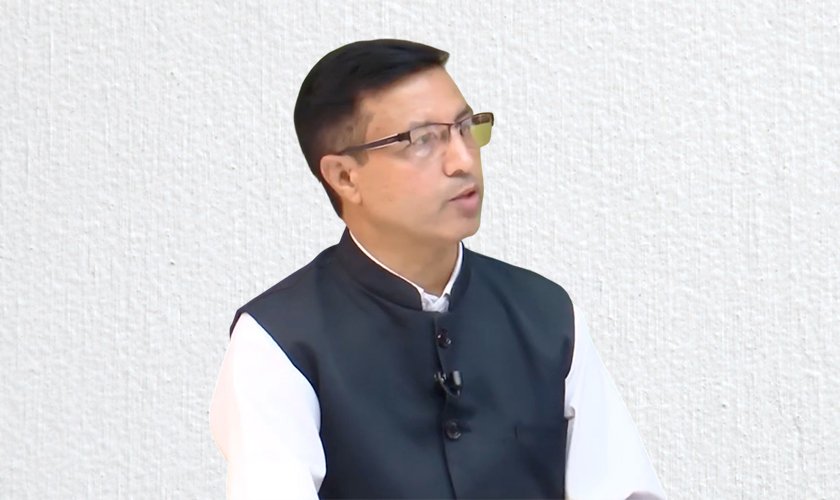
Amar Neupane is a popular contemporary Nepali writer. He exposes various facets of society primarily through his novels and short stories. He is popular among readers due to his simple language and a style that subtly presents human emotions.
His writing effectively portrays stories of marginalized communities, social discrimination, and human suffering. Neupane, who emerged in Nepali literature in 2066 BS with the novel 'Pani Ko Gham' (Sunlight on Water), received the Madan Puraskar literary award for this work in the same year.
His novel 'Seto Dharati' (White Earth) (2068 BS) was honored with the Madan Puraskar. Neupane's 'Karodau Kasturi' (Millions of Musk Deer) (2072 BS) is also very popular among readers. This is a conversation with Amar Neupane conducted by Rama Subedi for Ratopati's 'Kitab Ka Kura' (Talks on Books) series.
_zJJmCCzlDD.jpg)
- Were there any specific books or authors who inspired you when you were starting your writing journey?
In my childhood, I was inspired by reading the books of Lekhnath Poudyal, Madhav Ghimire, Guruprasad Mainali, Diamond Shamsher Rana, Bishweshwar Prasad Koirala, Govinda Gothale, Ramesh Bikal, Parijat, Indra Bahadur Rai, and others. I still feel inspired by them. Later, my world of study broadened. I started choosing authors and books according to my interests.
Books of world literature provided a new window. Studying various literary theories, '-isms,' and trends prevalent in the world helped me reach deeper insights. The narratives of authors like Leo Tolstoy, Chekhov, Hermann Hesse, Fyodor Dostoevsky, Kahlil Gibran, Nietzsche, Camus, as well as Khaled Hosseini, Jhumpa Lahiri, Kiran Desai, and Aravind Adiga have had a special impact on me.
_unAVpJ1m1x.jpg)
- Was the decision to become a writer easy or full of struggle?
I never made a decision to become a writer. This is because I didn't realize when I fell in love with writing. When I did realize it, I was already deeply in love. Perhaps because it is the field I love, I never felt the need to struggle. Whether it was when my first story was published or my first book, I didn't have to go through hardship. I didn't have to chase after publishers.
However, in recent days, due to not being able to dedicate time, I haven't been able to organize the raw material I have. Even though publishers and readers are demanding, I haven't been able to deliver manuscripts. This has happened due to practical reasons and my own laziness. I am forever grateful for the love I receive from publishers and readers.
_p9xxjyasz2.jpg)
- When did the decisive moment come to leave your job and become a full-time writer?
I don't know how I became attracted to writing. By the time I realized it, I was completely captivated. It feels like the love for writing or literature was born with me. It takes time to realize what you possess. You see many things, but it takes time to realize, 'This is exactly that.' Many things are with us, but we only feel their presence much later. Literature was like my heart, eyes, and ears. It was with me, but I only realized it later.
Before 'Seto Dharati,' the novel 'Pani Ko Gham' had been published. The salary of an officer wasn't enough to make a living in Kathmandu. I was just an ordinary employee. Seeing the success of momo shops in Kathmandu, I was thinking of leaving my job to run such a shop to make a living. I planned to work hard for three or four years to make the shop successful and then turn to writing once I was financially stable.
But, after the novel 'Seto Dharati,' published in 2068 BS, won the Madan Puraskar, something unusual happened in my life. The book sold well, and it improved my financial situation. Then I realized that books could sell, and publishers would make offers to write. After that, I never had to chase publishers. I quit my job that same year and became a full-time writer.
_HaYsMlP0tT.jpg)
- When did you have that realization?
When I was young, my mother used to recite verses from poems like 'Gauri.' In the summer, sitting under the large neem tree in front of our house, my father would read aloud stories from 'Naso.' Electricity hadn't reached our area then. Even in that heat, we would be playing in the dust. But when my father read the stories, his voice would captivate our play. I would come closer and sit to listen to the stories.
I was in the seventh grade. One day, I found 'Naso' under my father's pillow. When no one was home, I quietly took the book and sat on the veranda to read it. On one hand, there was the fear of when my father might return, and on the other, the moving stories. I read the story amidst fear. While reading, I cried many times.
- What was the mental fluctuation like inside you while writing 'Seto Dharati'?
My father's paternal aunt, whom I called grandmother, was a child widow. Married at nine, she became a widow at eleven. She loved me more than my own grandmother. I used to visit her in Devghat. At that time, I hadn't decided to write about this. But those things were lingering somewhere in my mind. After she passed away, the thought of writing about this subject came to me. I didn't know all the ups and downs of her life. I had to go to Devghat to understand the struggle of her life. By going there, I began to internalize the mental, cultural, social, and psychological struggles of that community.
_jSrUFg9KYl.jpg)
- Are the strong female characters in your novels intentionally made strong, or did they naturally become strong as you wrote the story?
Sometimes I am asked, 'Why are women portrayed as weak or men as so virtuous?' But I only want to show the reality of society; I do not intend to preach. I do not want to change society through my writing. But this does not mean I don't want to impart awareness.
You might have seen a spring of water emerge. The spring doesn't emerge to quench anyone's thirst, nor does it dream of making plants lush by irrigating them. As a writer, I also have my limitations. Therefore, I feel that I should be able to emerge just as the spring flows. If this is achieved, there is no need to carry the desire to make someone strong or someone weak.
- In which genre or field do you feel like writing lately?
Nepal has 124 languages. This means there are 124 types of cultural lifestyles and traditions. The Rai language alone has 26 variations, and each has its own culture and way of life. We have numerous subjects to write about. The job of a writer is to write about these cultural stories. Humans have been evolving from primitive times to today, but tigers, elephants, and rhinos remain the same because they lack language and culture. But humans are connected to their civilization and culture.
Nepal is extremely rich in this diversity, and this is the main subject of writing. Michael Hart once told me, 'Your country has so many subjects to write about; we don't have that many.' In reality, the more we develop, the more our cultural aspects disappear. If we can preserve this cultural heritage, it becomes even more valuable.
_JMbEpDnjcE.jpg)
- Your early works reflect rural sensibilities, but you have been living in the city for a long time. Has this created a contradiction in your writing?
The question you raise does bring a change to writing. But for me, the village is the biggest university. Life is open in the village. I knew the stories of every person where I was born, raised, and grew up. What is happening in whose house, what someone's life is like—everything is like an open book in the village. But it's not like that in the city. Neighbors living in the same building don't even talk to each other. When I lived in Babar Mahal, I never had a conversation with my neighbors beyond exchanging smiles. Therefore, I didn't get to know anything about their lives. The habit of living socially, as in the village, has been disappearing after coming to the city. The city gradually makes people 'private.' The concept of privacy comes up here—the thought of why visit someone's house or talk to someone without a reason prevails. People smile when they see each other, but the relationship doesn't progress beyond that. In this way, the city makes people somewhat lonely and sluggish. In terms of writing, the village is still more appealing.
- Speaking of reading culture, what kind of books influence you?
One cannot write literature just by being interested in literature. Many elements are necessary to keep that interest alive. Reading is an important element among them. When I read good books, I feel that I wish I could write like this too. I felt this way since childhood. That's why the role of reading is significant. Specifically, literature written on cultural, social, spiritual, and psychological subjects has influenced me the most.
_lcIFrbeVNh.jpg)
- How does the process of birthing your new book begin? Could you tell our readers something about it?
The design and composition process for every book is different. The method I adopted for the first book, I didn't use for the second. The methods for the third and fourth were different. Like people, every book is different. They have different faces and behaviors. The writer must work accordingly.
Regarding 'Pani Ko Gham,' I wrote the beginning and the end before going to Nepalgunj. I went to Nepalgunj after preparing the theoretical foundation, ideological thread, and philosophical basis for that book. I stayed in Nepalgunj for two months, studying the society and people there on-site while writing the book, feeling like I was gathering gravel, sand, stones, mud, rods, and cement for the house I had designed.
_RUR1q5Qsao.jpg)
- Finally, please share the most interesting feedback you have received from a reader.
There are many. If I were to write them all, it would become a book itself. A decade ago, I went to Harmibhanjyang in Gorkha. There was a literary program on the occasion of the golden jubilee of Mahendra Lila Secondary School. An elderly woman, over eighty years old, came up to me leaning on a stick and stopped. She tried to stand straight, but her stooped body didn't support her. Raising only her head, she lovingly touched my left cheek with her right hand and said, 'I heard your book is Seto Dharati.'
I asked her, 'Did you listen on YouTube, Mother?' She replied, 'When I came home for Dashain, my elder granddaughter brought the book. She wouldn't read it for me, so I made my younger granddaughter read it, and I listened to your book like the Swasthani Brata Katha. How did you write about the stories of our time as if you had seen them yourself, son!'
This specific news has been automatically translated by AI. As a result, there may be some inaccuracies or language errors.
_Eqo5W0NMVM.jpg)