Beyond Fasting: Understanding the 'Divine Nine Vows' for Nepal's New Leadership


When we hear the word 'vow' (Brat), one might think of abstaining from food or consuming only fruits. Here, 'vow' is taken in the sense of conduct. Before discussing the Divine Nine Vows, let's set the context: a general election in a multi-party system.
Every general election answers a broad question. Sometimes, the same question is asked of many people. Sometimes, many questions are asked of one person. Asking the same question to many people happens during a referendum and a general election. In a general election, although the question appears singular on the surface, many dimensions are hidden within the answer.
Similarly, asking many questions to one individual is done in various national surveys or censuses conducted at different times. The answers derived from these questions provide guidance on the steps needed to determine the future direction. Governments are formed to work for the public good.
- A Series of Questions and Answers in Nepal
In B.S. 2037, citizens voted in favor of a non-party system over a multi-party system in response to the question. Because their voices were not fully heard, the people were dissatisfied. Without a question being posed, an agitation occurred, leading to the establishment of a multi-party system in B.S. 2047. After this, many leaders and parties received votes. The intention behind casting the vote was the hope for comprehensive capacity building in the country and becoming citizens of a prosperous nation. Citizens were not satisfied with the realization of this expectation.
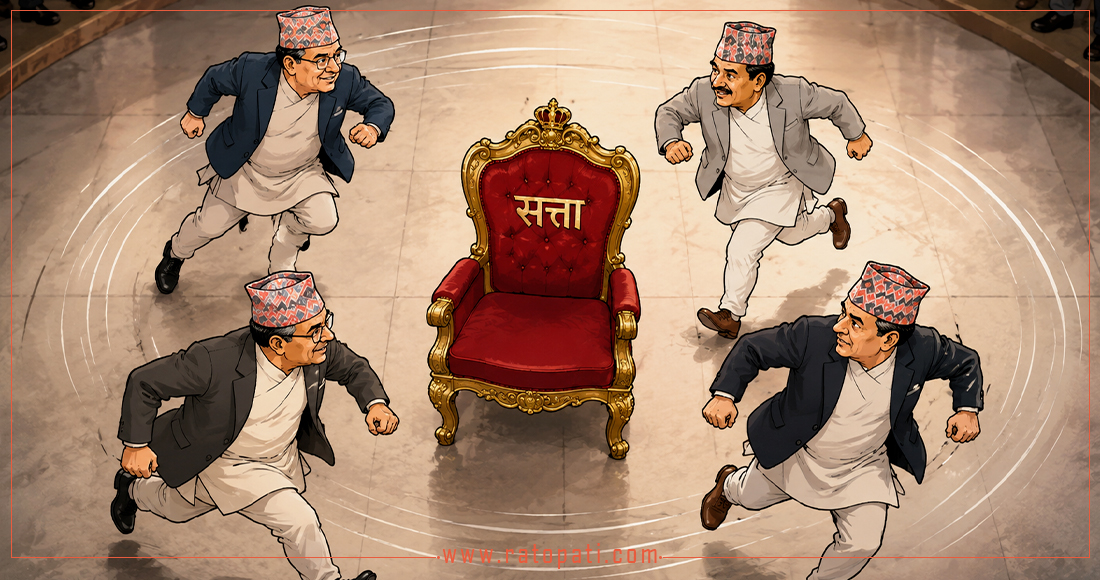
A general election was recently held in Nepal on Falgun 21. The process of answering who will remain in government and who will represent for the next five years has concluded. Parties and candidates who were expected to work for the good of Nepal and Nepalis received overwhelming votes from the citizens.
What is the Expectation of the Mandate?
The new parties and leaders now have a clear opportunity to work without hesitation. The votes were certainly not cast with the sentiment, 'Others ran things before; now it's your turn, go ahead.' If leaders are not mindful of this, even if they don't ask questions, the answer might come in the form of an agitation. The core issues of the agitation that occurred on Bhadra 23 and 24 last year were the end of corruption, good governance, job creation, and the desire for national prosperity. This is why the youth showed more enthusiasm in this election. The elected parties must understand the reason behind receiving their votes.
Our sages established a code of conduct for individuals to fulfill their duties and responsibilities. Among these, the tasks required of leadership were taken as political conduct. Nowadays, many spiritual and psychological organizations highlight the required conduct for various professions and businesses. The Life Science Foundation presents this as the Divine Nine Vows. If the upcoming leadership adheres to these, there will be no doubt that the public mandate will be utilized well, leading to national prosperity.
The Divine Nine Vows
1) Truthfulness: People prefer the truth, not being deceived. However, even those who deceive often feel remorse internally for lying. Moreover, the younger generation can only tolerate straightforwardness or candor. The party that secured nearly a two-thirds majority now must prove its manifesto true. There should be no gap between words and actions. An environment must be created where the general public is confident that all leaders are fulfilling their responsibilities truthfully.
2) Self-Study (Svadhyaya): Initially, self-study was understood as studying at home without attending a Gurukul. However, this meaning is no longer so narrow. The core essence is the need to evaluate one's own feelings, thoughts, and self-work. One must keep in mind: Why did I come here? What is my job, what am I doing, and what are the voters' expectations? Complete evaluation of such matters is self-study. Unless one understands oneself first, one cannot be a basis for knowing others.
3) Humility (Nirhankarita): Humility is the only means to prevent a person from becoming autocratic. The arrogance and boastfulness that 'I know more than anyone, and everyone must respect me' prevent both leaders and the public from being human. The upcoming leadership must remain constantly thoughtful, being aware of every feeling, thought, and action. When citizens scrutinize the alignment of speech and behavior, it must stand the test. Humility is the path that allows a statesman to speak tomorrow.
4) Forgiveness (Kshamashilata): During the pre-election competition, attempts to portray oneself as capable and others as incapable might have strained relationships. Now, regardless of which party wins the majority and runs the government, it is everyone's government. One can sustain oneself only by maintaining a balanced attitude towards others. At this time, triple forgiveness is necessary: one party must forgive another, leaders must forgive the public, and the public must forgive the leaders.
5) Spirit of Universal Welfare (Sarvakalyan Bhava): Not everyone gets to exercise their right to vote in a general election. Factors like location, environment, and circumstances might align or misalign. Once a party receives a mandate to run the government according to the electoral system, an environment must be created where all sectors, classes, and genders can claim it as 'my government.' Leaders must especially maintain a vision and behavior of universal welfare in every matter and at all times. If even a hint of discrimination arises, the path for the next term may be closed.
6) Spirit of Service (Seva Bhava): Political leaders are referred to as 'Marmavetta' (those who know the core/pulse) in the Shukla Yajurveda. A Marmavetta is one who understands the pulse of the common citizen. They must know the citizens' condition, what can be achieved, and where equality and equity are needed. While carrying out the duties entrusted by the people, efforts must be made to the extent the nation's capacity allows. Leaders must see their success in the happiness and joy of the people.
7) Sweet Speech (Madhur Vani): The ability to do what citizens desire might be influenced by geographical, economic, social, and practical factors. However, the reasons for not being able to accomplish something must be explained with good words to satisfy them. Speech must contain sweetness, positivity, and respect. Appropriate expression must be used to awaken all citizens. The strength of leadership lies in pleasant and sweet speech.
8) Unification with the Goal: The goal of a person in leadership must be centered on the welfare of the nation and its people. National surveys repeatedly show the state of the nation and its people. Based on this, the National Planning Commission sets targets and objectives. Currently, Nepal is in the midst of its Sixteenth Five-Year Plan. Success in execution and discipline can be maintained together through the advice and suggestions of subject matter experts. The leadership must introduce policies that unify with national goals and objectives.
9) Desire for Liberation (Mumuksha): For a person engaged in spiritual awakening, their own path to liberation and salvation remains the priority. For an individual, the guidance of one Guru might be primary. However, for political leadership, the nation and the people are the Gurus, and thus, there must be fidelity, devotion, and dedication to them. Having the opportunity to perform the great task of freeing the country and citizens from suffering by prioritizing their happiness is a blessing from God.
In conclusion, it is not entirely true that previous leaders or governments did nothing. A foundational groundwork has been laid up to this point. It is just that the alignment between needs and achievements has been lacking. The path for the upcoming leadership is truthful conduct and humility. They must be able to create an environment where citizens of all age groups become automatically aware for the comprehensive development of the country. If they evaluate their own work and serve with a spirit of universal welfare, the citizens will not be dissatisfied.
Sweet and pleasant speech is an internal ornament for all human beings. For those holding public office, it also becomes an external ornament. After every agitation, the people have changed their votes in the subsequent general elections. This time too, the people have cast their mandate in the same manner. For this, it seems necessary for all leaders to adhere to the Divine Nine Vows and honor the mandate by working for the benefit of the nation, the citizens, and the leadership.
May everyone be victorious!
This specific news has been automatically translated by AI. As a result, there may be some inaccuracies or language errors.