
Communist Movement Suffers Historic Blow in Recent Federal Parliament Elections

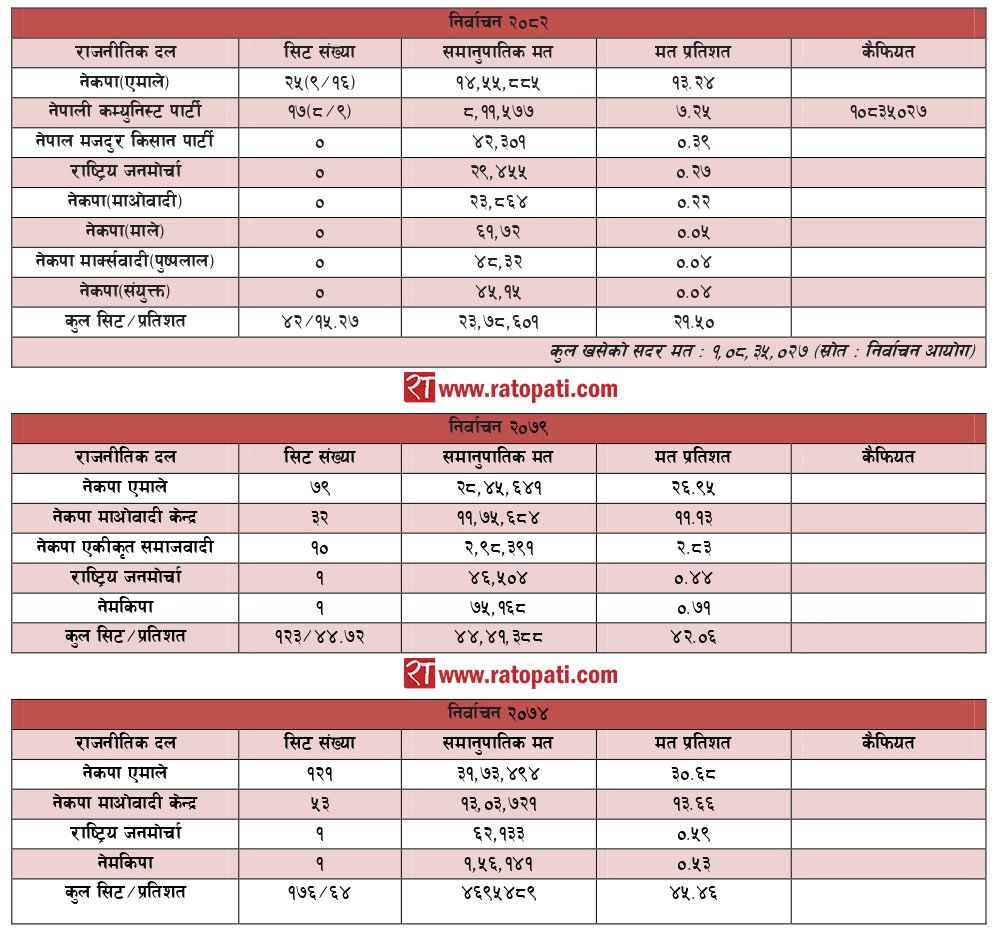
Kathmandu. The communist movement has suffered the biggest blow in its history in the House of Representatives election held on Falgun 21. According to the vote counting completed on Tuesday, CPN-UML won only 9 seats under the first-past-the-post system. In the proportional representation category, it is in third place with 1,455,885 votes.
The Communist Party, formed by the merger of 25 leftist factions, secured 8 seats and came in fourth place with 811,577 votes in the proportional representation category. The unexpected results in favor of the Rastriya Swatantra Party (RSP), which was established three years ago, show that communist parties are facing an existential crisis.
RSP has come close to a two-thirds majority by securing 125 seats in first-past-the-post and over 5.183 million popular votes in proportional representation. Nepal is considered fertile ground for the communist movement. However, communist parties have faced a humiliating defeat because their leaders deviated from issues concerning class character, nationality, people's livelihood, and pro-people agendas.
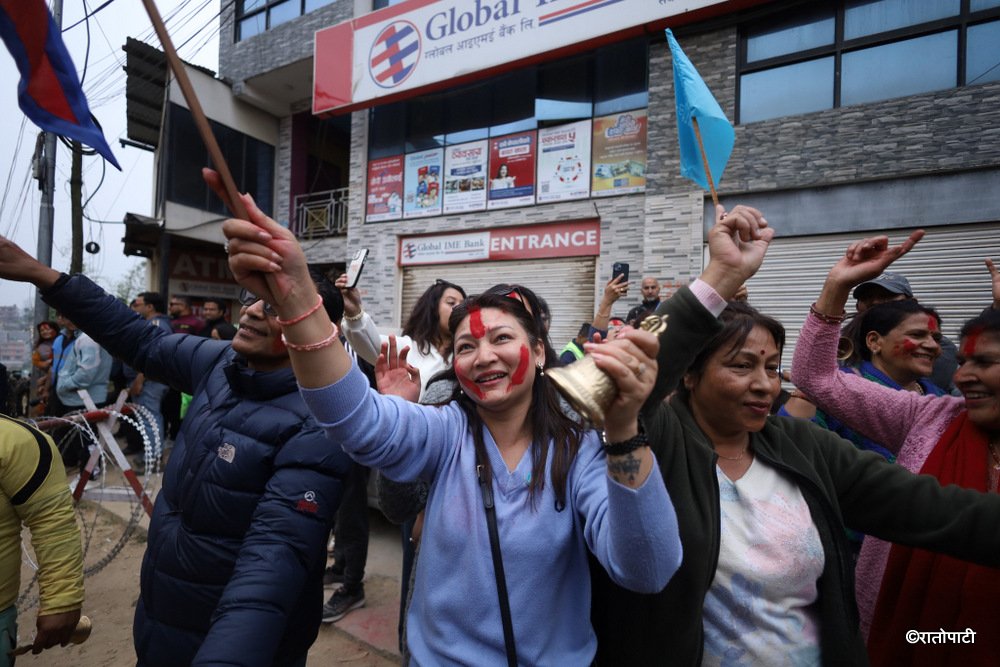
In the 2079 election, UML became the leading party in parliament by securing the highest popular vote of over 2.8 million. CPN (formerly CPN (Maoist Centre), CPN (Unified Socialist)) received around 1.5 million votes. Political circles suggest that the major loss is due to the failure of communist leaders, who have been in power almost continuously since the political change of 2046 BS, to understand the sentiments of the people. However, analyst Dambar Khatiwada argues that it is incorrect to declare the communist movement finished based on the loss of one election. Nevertheless, he states that if the 50 percent drop in popular mandate in this election is not recovered in the next election, the communist movement will end.
“No political party is finished forever just because it becomes weak in one election. But in Nepal, various communist or leftist groups used to secure around 40 to 50 percent of the vote; this time, it appears to be below 20 percent,” says Khatiwada. “This means the communist mandate has directly halved. This is a very big crisis from the perspective of electoral politics. If this trend continues in the future, the communist groups will be finished by the third election. If they can cover this gap in the immediate next election, they might survive.”
For 34 years, Nepali politics revolved around the main parliamentary leftist components, UML and Maoist Centre. UML, established by the Jhapa Rebellion in 2028 BS, and the Maoists, established by the armed rebellion (2052-62 BS), led the government alternately after the establishment of the Federal Democratic Republic in 2062/63 BS. There is a public grievance that despite being in power for 18 years after the establishment of the Republic, they failed to work for good governance, social justice, and prosperity. The peaceful demonstration by the Gen Z generation on Bhadra 23 against corruption and irregularities was brutally suppressed by the K.P. Oli-led UML government, resulting in the people staging a peaceful rebellion through the ballot box.
_md0BJOF5jO.jpg)
In the previous parliament, Oli became Prime Minister with the support of the Congress party, which was the largest party. On Bhadra 24, after 23 youths were killed by security forces' bullets during a demonstration at the Parliament Building in New Baneshwor, the protests escalated, and state structures were destroyed. After protesters destroyed the Singha Durbar central administrative building, the Supreme Court, and the Parliament Building, then-Prime Minister Oli resigned and fled to a safe location with the help of the Nepali Army. Following the overthrow of the government by the force of the rebellion, the interim government formed under former Chief Justice Sushila Karki dissolved the parliament and announced elections.
While communist rule is collapsing globally, communist parties in Nepal have been swept away through legal means. Communist parties appear most unpopular due to the Gen Z movement. Khatiwada argues that the major damage was caused by the suppression of the Gen Z movement by the K.P. Sharma Oli government in particular.
“By the time of the Gen Z movement, communists were established as oppressors or oppressive forces, as anti-revolutionary forces. The government led by Oli was in power at that time. Because of that, the communist mandate weakened,” says political analyst Khatiwada.
Another political analyst, Mumaram Khanal, accuses Oli of being the architect of the Gen Z movement. His analysis suggests that the communist movement has been deeply affected because of Oli.'
“Mr. Oli was, in a way, the creator of this process. All these events happened during his tenure as Prime Minister. This has had a profound impact on politics,” he told Ratopati. “Old parties have reached a point where they cannot even speak up against the new political parties. Glorifying past achievements, except for capitalizing on history, resulted in the opposite outcome.”
Khanal concluded that when the faction supporting the Fourth General Convention of the Communist Party of Nepal and the faction supporting the 2028 BS Jhapa movement united in 2075 BS, leftist cadres felt a sense of completion, but that vote, which had been entrenched for years, has now moved towards alienation following the dissolution of that party.
Analyst Arun Kumar Subedi states that the election results are relatively as expected, except for a few places. Subedi asserts that the leaders of all parties were less serious than the information he received suggested. “I had told all party members that an adverse situation beyond your imagination would arise in this election. I told some individuals they were losing by a large margin, and that is what happened,” he says. Subedi analyzes that there is no sign of communists being re-established in Nepal.
_fuU3ywJI7N.jpg)
“The communists are finished now, and frankly, it was necessary for the progress of Nepal and Nepalis that they finish. The main cause of Nepal's plight is the election and foreign policy operation based on leftist impulse. Since 2063 BS, the main cause of the plight has been Prachanda Ji,” Subedi says. “Now, if they come together and renounce the slogan of democratic socialism, it will be a great justice to the country and the Nepali people. If the people deem the leftist force necessary, they will return someday.”
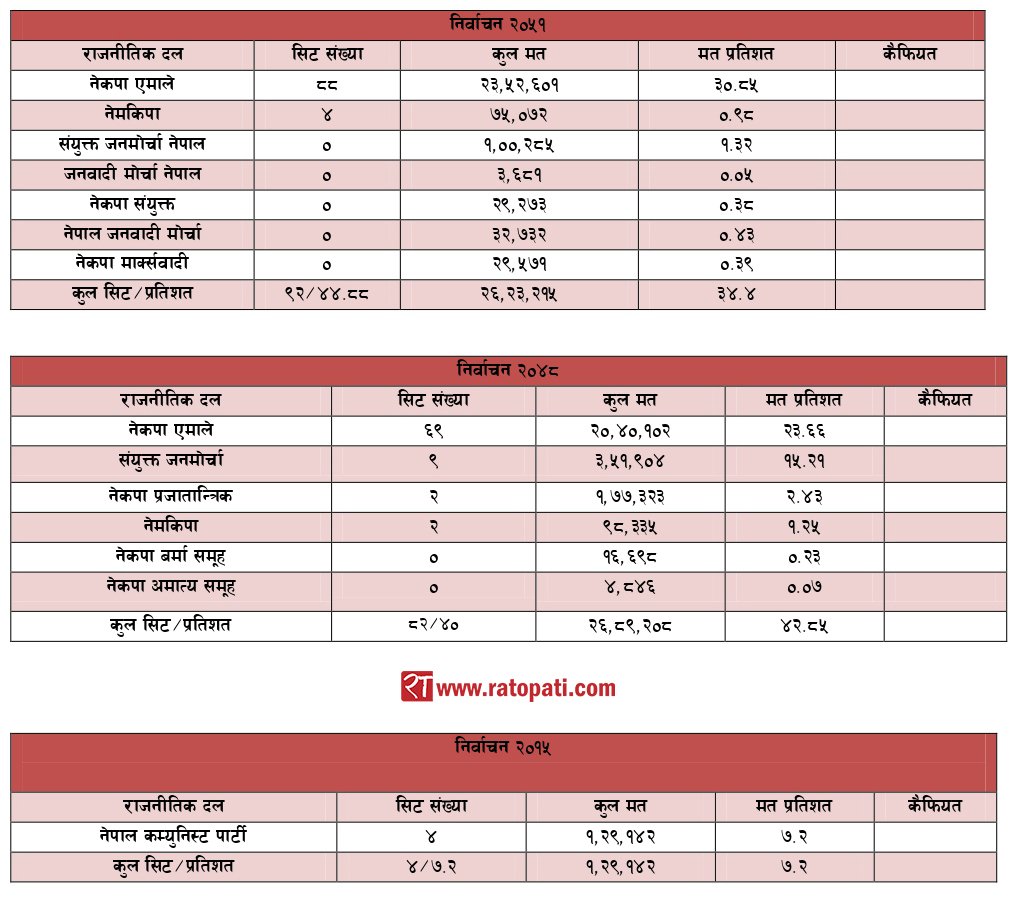
The communist movement has a long history in Nepal. Communist parties played a significant role in the political revolutions of 2007, 2017, 2037, 2046, 2052, and 2062/63 BS. After the founding General Secretary Pushpa Lal Shrestha established the Communist Party of Nepal in 2006 BS, four members were elected in the first general election held in 2015 BS. As King Mahendra deposed the popularly elected government and banned political parties in 2017 BS, the communist movement faced various ups and downs. After the political change of 2046 BS, the leftists maintained a strong presence in every parliamentary election.
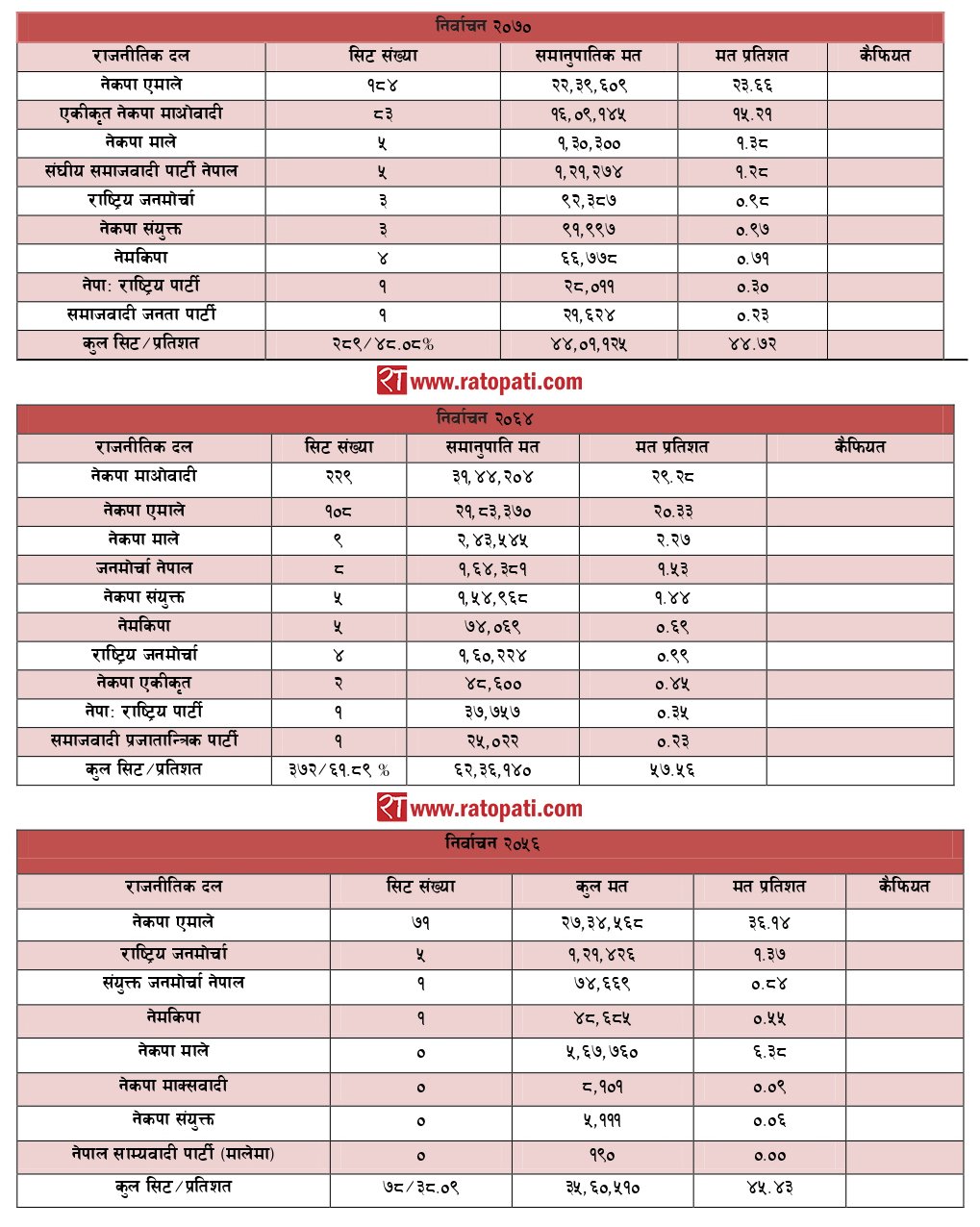
The communist party played a decisive role in overthrowing the monarchy in 2062/63 BS. Leftists had a 62 percent representation in the first Constituent Assembly in 2064 BS. In the second Constituent Assembly in 2070 BS, their popular mandate dropped to 48 percent. In the 2074 election, the then UML and Maoist Centre formed a leftist alliance, resulting in a 64 percent representation in parliament. After the dissolution of the CPN in 2077 BS, the popular mandate shrank to 45 percent in the 2079 election.
In the 2082 election, they received only 21 percent of the vote. UML, which had consistently received the highest popular vote since 2064 BS, suffered its most shameful defeat this time. CPN, which had been running its vehicle with makeshift servicing, received a major shock. The Nepal Workers' and Peasants' Party, limited to Bhaktapur-1 since 2048 BS, and the Rastriya Janamorcha, which had a strong base in Western Nepal's Baglung, ended up with zero seats in this election.
The CPN (Maoist) led by Biplav, which boycotted the second Constituent Assembly in 2070 BS, and the House of Representatives elections in 2074 and 2079, could not even cross 30,000 votes. The fact that the Communist Party, which had a 7.2 percent presence in parliament in the first general election of 2015 BS, has continuously declined is evident. Nine general elections have been held in 67 years from 2015 to 2082, excluding the National Panchayat elections of 2038 and 2043. The leftist popular mandate received in each election is shown in the table below.
This specific news has been automatically translated by AI. As a result, there may be some inaccuracies or language errors.

_hXuKAenRlA.jpg)

