Rastriya Swatantra Party's Nisha Dangi Overcomes Proportional Representation Tag with Decisive Direct Election Victory in Jhapa-1
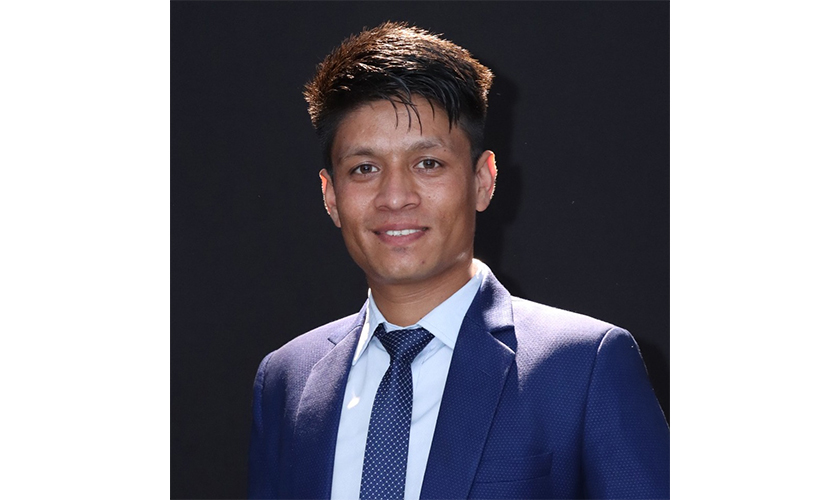

Kathmandu. A narrative is very prevalent in politics: 'The political weight of being a proportional representative is different from being directly elected.'
However, the young leader of the Rastriya Swatantra Party (RSP), Nisha Dangi, not only embraced this narrative but also spectacularly washed away the 'proportional tag' attached to her through the direct mandate of the people.
Dangi has been elected as a member of the House of Representatives from Jhapa Constituency No. 1 with a massive vote count. In that constituency, she not only won but also severely dismantled the traditional strongholds of established and powerful parties like the Nepali Congress and CPN-UML. She secured a landslide victory with 45,680 votes. Her rival, Keshav Raj Pandey of the Nepali Congress, received 10,550 votes. Thus, she won by a margin of 35,130 votes over Pandey.
Similarly, Kebalram Rai of the Shram Sanskriti Party received 10,004 votes. Ramchandra Uprety of CPN-UML garnered 7,659 votes. In the 2079 elections, she became the youngest parliamentarian through the proportional representation quota from RSP.
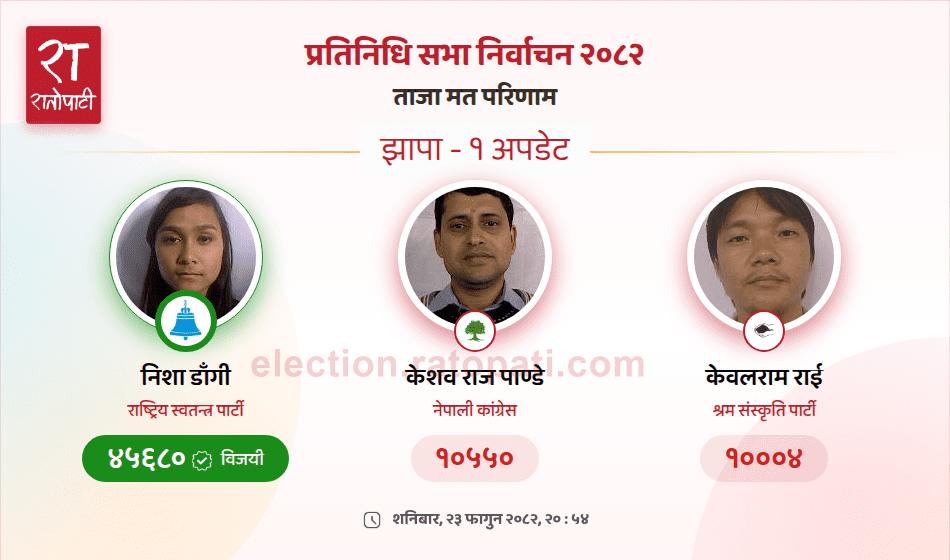
But she entered the electoral arena vowing to break the tag of a proportional representative. She succeeded in securing an easy victory in Jhapa-1 amidst the nationwide wave for RSP. The attraction towards the younger generation and the disillusionment with old parties in Nepali politics appear to be the basis for her victory.
Entry of Gen Z Parliamentarian into Old Parties' Stronghold
Jhapa Constituency No. 1 has historically been an area dominated by old parties. In the 2079 elections, the then General Secretary of the Congress, Bishwa Prakash Sharma, won from this constituency. At that time, Sharma defeated Agni Prasad Kharel of UML by securing 39,624 votes. Looking at the gap between Nisha's 45,680 votes this time and the 10,550 votes received by the nearest rival Keshavraj Pandey of the Congress in such a strong and competitive stronghold, Jhapa-1 looks significantly different. She won 'unanimously'.
Kebalram Rai of the Shram Sanskriti Party, who finished third, received 10,004 votes, and Ramchandra Uprety of UML, relegated to fourth place, received 7,659 votes. This result shows the public wave that came for Nisha even in a multi-party contest.
First Term 'Capital' and Whip's Role
Nisha's victory was not an overnight miracle. Born in 1996 (Bikram Sambat 2053) in Bhadrapur, Jhapa, to Bhim Bahadur and Devi Maya Dangi, the 29-year-old Nisha stepped into the 2079 parliament as the 'Youngest Honorable Member'. Although she entered parliament as a proportional representative, she never confined herself to being a 'backbencher'. She was active in policy-making debates and raised issues pertinent to the Gen Z generation. The party also trusted her and gave her the responsibility of the RSP Whip. She discharged that responsibility skillfully.
The mature image she displayed in parliamentary activities as a proportional representative in the previous parliament made the voters of Jhapa-1 trust her easily.
From Journalism to Second Parliamentary Journey
Nisha holds a Master's degree in Journalism from Tribhuvan University. Before entering politics, she was active in journalism for about five years. During her five years in journalism, she got the opportunity to closely understand the pains of society, public discourse, and policy flaws. That consciousness from journalism and her study of social work made it easier for her to connect with development construction and public aspirations.
Nisha faced many adversities this time. The risk of moving from proportional representation to direct election, the strong roots of the old parties, and the clash with multi-party candidates including Congress, UML, and RPP were major challenges for her.
However, by establishing herself as a symbol of youth, intellectual personality, and change, she turned all those adversities into advantages. She committed to addressing the local problems of Jhapa-1, development priorities, and the frustration of the younger generation, which the voters endorsed.
This specific news has been automatically translated by AI. As a result, there may be some inaccuracies or language errors.