Analyzing the Potential Cost and Weaponry of the Escalating US-Iran Conflict

How much could the Iran war cost the United States? This is a question on many minds. While estimating the total cost of this military campaign is difficult, experts warn that a bigger challenge might be the depletion of weapon stockpiles.
The long-standing conflict between the US and Iran has entered a new phase following joint US-Israel airstrikes on Iran on Saturday, marking the beginning of open military hostility.
With US President Donald Trump signaling that this operation could last four to five weeks, here is an analysis of whether Washington can sustain a new war in the Middle East and what its ultimate cost might be.
What is 'Operation Epic Fury'?
On February 28, Trump confirmed in an 8-minute video posted on Truth Social that the US was engaging in a major war campaign inside Iran. The Pentagon later identified the mission as Operation Epic Fury.
Trump stated that the objective was to ensure Iran does not acquire nuclear weapons. He added, 'We will destroy their missiles and demolish their missile industry. It will be total annihilation.'
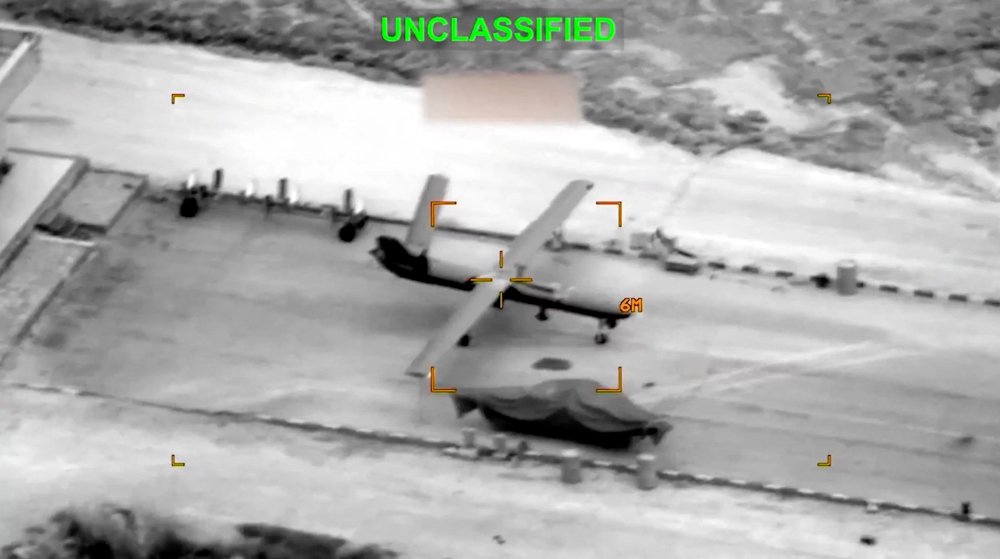
The US military stated that since the operation began on Saturday, more than 1,250 locations in Iran have been struck. In a separate statement, the US Central Command (CENTCOM) reported attacking and destroying 11 Iranian naval vessels.
The operation reportedly involved coordinated strikes including airstrikes, sea-launched cruise missiles, targets related to nuclear facilities, and high-ranking individuals connected to Iran's defense apparatus. Iran's Supreme Leader Ayatollah Ali Khamenei, who has led the country since 1989, was reportedly killed in the first phase of the US and Israeli attack on his residence in Tehran.
On Monday, Trump vowed to fight the war for as long as necessary, signaling it could extend for many weeks. The Iranian Red Crescent reported on Monday that 555 people had died across 130 locations in Iran.
How much has the US spent on Israel and the wider Middle East since 2023?
According to Brown University's Costs of War 2025 report, the US has provided approximately $21.7 billion in military aid to Israel since October 7, 2023.
In addition, $9.65 billion to $12.07 billion of US taxpayer money has already been spent on US operations supporting Israel in Yemen, Iran, and the broader Middle East. This brings the total US expenditure related to this conflict to between $31.35 billion and $33.77 billion, and it continues to rise.
Which weapon systems are being used in the Iran war?
According to CENTCOM, Operation Epic Fury involves more than 20 weapon systems from air, sea, land, and missile defense forces. CENTCOM reported striking over 1,000 locations inside Iran using more than 20 different systems.
Kevin Donnellan, former Operations Director at CENTCOM, told Al Jazeera, 'The main focus for the US and Israel right now is to destroy or degrade the Iranian capacity to attack as quickly as possible. They want to stop these attacks or at least minimize them.'
Some of the weapon systems used are as follows:
Air Power:
This campaign has heavily utilized US air assets, including:
- B-1 Bombers
- B-2 Stealth Bombers: Used to strike critical nuclear and military infrastructure.
- F-35 Lightning II and F-22 Raptor: Advanced stealth fighter jets.
- F-15 Fighter Jets: Widely used; three aircraft were lost in a crash in Kuwait on March 1.
- F-16 Fighting Falcon, F/A-18 Super Hornet, and A-10 Warthog: Confirmed use in attack and support roles.
- EA-18G Growler: Used for electronic attack and suppressing enemy air defense systems.
- AWACS: Aircraft providing command, control, and battlefield management.
Last night, U.S. B-2 stealth bombers, armed with 2,000 lb. bombs, struck Iran’s hardened ballistic missile facilities. No nation should ever doubt America's resolve. pic.twitter.com/6JpG73lHYW
— U.S. Central Command (@CENTCOM) March 1, 2026
Drones and Long-Range Weapon Systems:
Unmanned systems and rocket artillery are also part of this operation:
- LUCAS Drone: This low-cost 'one-way' (suicide) drone, reverse-engineered from Iranian designs, marks its first combat use.
- MQ-9 Reaper Drone: Active in surveillance and precision strike roles.
- HIMARS: Ground-based rocket artillery.
- Tomahawk Cruise Missile: Launched from naval vessels.
The Iranian regime was warned. CENTCOM is now delivering swift and decisive action as directed. pic.twitter.com/nNDoDexH6g
— U.S. Central Command (@CENTCOM) March 1, 2026
Missile Defense Systems:
- Patriot and THAAD: Used to destroy Iranian ballistic missiles and drones in the air.
- Counter-drone systems.
Naval Power:
- Two Carrier Strike Groups: Led by the USS Gerald R. Ford and USS Abraham Lincoln, providing massive sea-based power.
- P-8 Poseidon: For maritime patrol and reconnaissance operations.
- Cargo and Tankers: C-17 Globemaster, C-130 Hercules, and various aerial refueling tankers are providing logistical support.
Operation Epic Fury: The first 48 hours pic.twitter.com/uCQqHq5Ajx
— U.S. Central Command (@CENTCOM) March 2, 2026
How much could the Iran war cost the US?
It is difficult to estimate the total cost of the ongoing military campaign. According to experts, it would be premature to state exactly how much this new war will cost the US right now.
Christopher Preble, a Senior Fellow at the Stimson Center, told Al Jazeera, 'The Pentagon has not released that information, so we can only speculate... We can make estimates about the cost of individual weapon and naval operations.'
According to a report by Anadolu Agency, the US is estimated to have spent approximately $779 million in the first 24 hours of Operation Epic Fury. An additional $630 million is estimated to have been spent on pre-attack military preparations (including aircraft repositioning, deployment of over a dozen naval vessels, and mobilization of regional assets).
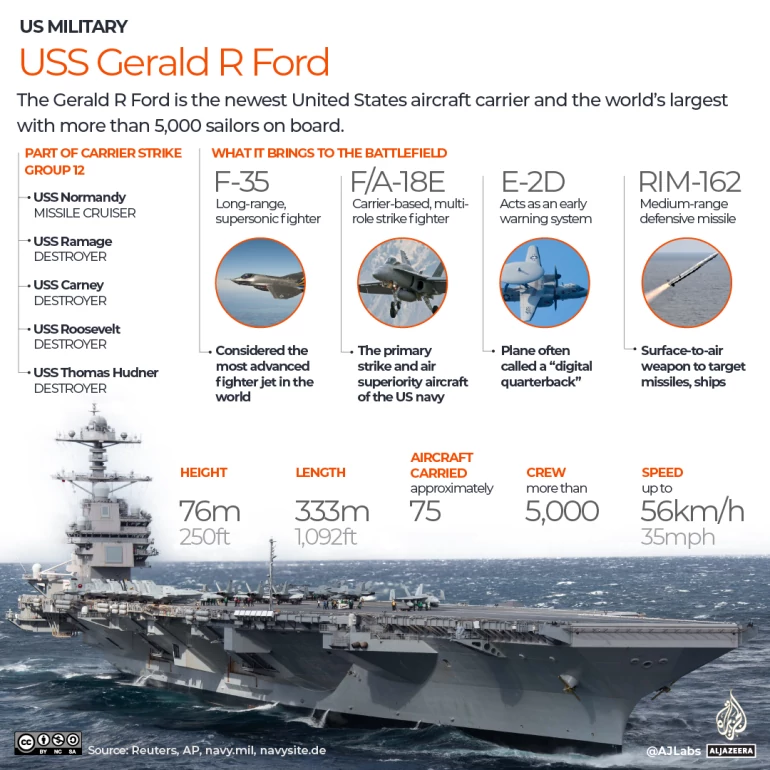
According to the Center for a New American Security, operating a Carrier Strike Group like the USS Gerald R. Ford costs about $6.5 million daily.
There are also costs associated with equipment losses. At least three US fighter jets were downed in Kuwait, which US officials attributed to 'friendly fire' accidents.
However, experts say the biggest concern is not the financial cost but the stockpile of weapons.
Preble stated, 'In terms of cost, it is manageable. The US defense budget is one trillion dollars and is proposed to reach $1.5 trillion, which I find alarming, but the President is committed to it. So, one trillion dollars goes a long way. The main issue is the weapons in US inventory, especially interceptors like Patriot missiles or SM-6 used to stop ballistic missiles.'
Preble warned that the high rate of missile interception cannot continue indefinitely. 'Looking at the current rate of interception, it cannot go on indefinitely; it is reasonable to assume it might not continue for more than a few weeks,' he said.
He noted that similar concerns arose during the 12-day conflict with Iran in June, when both US and Israeli forces were estimated to be running low on interceptors. Although some supplies may have been replenished later, these interceptors are also earmarked for other regions.
'Some of these interceptors were planned to be sent to Ukraine to counter the Russian invasion. Some are being used in Asia and the Indo-Pacific region. They are crucial if an emergency arises there,' he said. 'So, bringing those weapons from other regions here could add another layer of concern.'
It is not immediately possible to produce new weapons to replace those expended. 'Patriot missiles or SM-6... are very complex pieces of equipment,' Preble added. 'It's not like they are producing hundreds or thousands of these weapons daily. The rate of production is not that fast.'
This specific news has been automatically translated by AI. As a result, there may be some inaccuracies or language errors.