Partial Lunar Eclipse Visible in Nepal This Evening

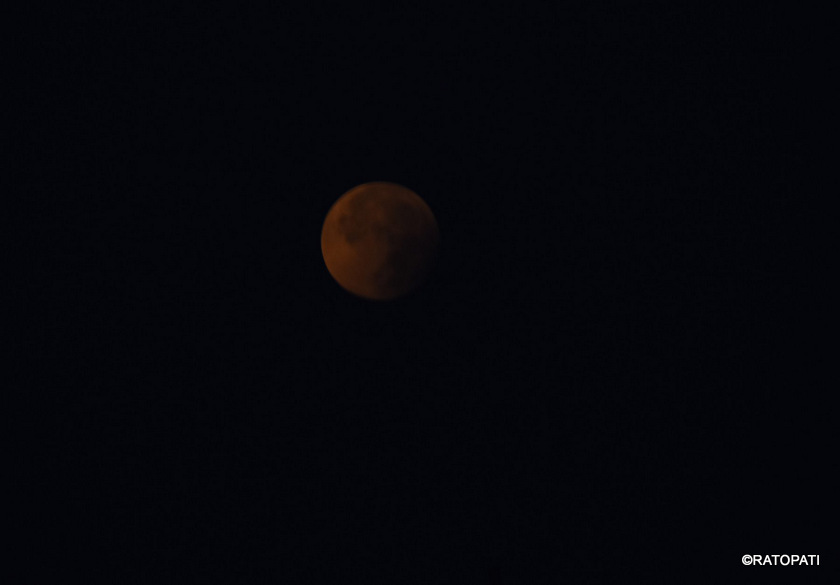
Kathmandu. A partial lunar eclipse, where the rising moon is partially covered by the eclipse (Grastodit Khandagrahas), is set to occur this evening. According to the Nepal Panchanga Nirnayak Bikas Samiti, the eclipse will begin at 3:34 PM, as mentioned in the calendar (Panchanga) approved by the committee.
Although the eclipse will be total (Khagras) at the time of contact, it will be visible as a partial eclipse (Khandagrahas) in Nepal after the moonrise, informed the committee's chairman, Prof. Shambhu Prasad Dhakal. When the moon rises at 6:03 PM, it will already be in the state of Grastodit Khandagrahas. The lunar eclipse will end at 7:02 PM. The lunar eclipse will be visible from Nepal for about an hour.
A total lunar eclipse (Khagras Chandra Grahan) occurs when the Earth completely blocks the Sun, covering the entire moon. A partial lunar eclipse (Khandagrahas Chandra Grahan) occurs when only half or a portion of the moon is covered. A lunar eclipse occurs when the Earth, Sun, and Moon align in a straight line, causing the Earth's shadow to fall on the Moon.
This will be the second time an eclipse is visible from Nepal this year. Previously, a total lunar eclipse occurred on Bhadra 22. Lunar eclipses occur during the full moon (Purnima) and solar eclipses during the new moon (Aunsi) tithi.
According to scriptural texts, performing rituals such as chanting, bathing, meditation, and recitation during an eclipse is considered fruitful. It is also considered auspicious to receive initiation mantras during an eclipse. Religious texts like Nirnayashindhu, Hemadri, Kalmadhav, and Veermitrodaya mention that one should bathe at a pilgrimage site during an eclipse, or if not possible, in a nearby river, lake, pond, or even at home if other options are unavailable.
Religious scholar Prof. Toyaraj Nepal stated that the period of Sutak (inauspicious period) begins nine hours before a lunar eclipse and twelve hours before a solar eclipse. There is a religious belief that one should not eat during the Sutak period. He also mentioned that according to scriptures, eating is prohibited for everyone except children, the elderly, and the sick during an eclipse.
The calendar approved by the committee mentions that according to scriptural belief, except for children, the elderly, and those in urgent need, eating should be avoided after 9:03 AM on Tuesday.
Lunar Eclipse Can Be Viewed Without Special Equipment
Among the four eclipses occurring in the world in 2026—two lunar and two solar—only the lunar eclipse tomorrow will be visible from Nepal as a partial lunar eclipse. The Nepal Astronomical Society, which works in the field of astronomy, stated that if the weather permits, the partial lunar eclipse will be clearly visible from all parts of the country. No special equipment is required to view the lunar eclipse.
The partial lunar eclipse occurring in Nepal on Tuesday, visible until 7:02 PM after moonrise, can be clearly observed if the weather is favorable. Suresh Bhattarai, President of the Nepal Astronomical Society, informed that this is the only eclipse visible from Nepal in 2026.
The eclipse observation can be done from one's rooftop, an open field, or a nearby hill. He suggested that higher ground near the time of moonrise when the eclipse begins in Nepal would be ideal for viewing.
As the Earth revolves around the Sun, the Moon also revolves around the Earth. In this process, when the Earth comes between the Sun and the Moon, the Earth's shadow falls on the Moon. Since the Moon does not have its own light, the Earth's shadow obscures the Moon; this is called a lunar eclipse.
Although the Sun, Earth, and Moon can align in a straight line during Purnima or Aunsi, not every Purnima results in a lunar eclipse because the Moon's orbital plane makes an angle of about 5 degrees with the Earth's orbital plane.
Furthermore, the Moon's orbit intersects the Earth's orbital plane at two points. These two points are named Rahu and Ketu in ancient astrology, he explained.
This specific news has been automatically translated by AI. As a result, there may be some inaccuracies or language errors.