Progressive Democratic Party Backs Nepali Congress Candidates in Gorkha Elections


The electoral contest in Gorkha is set to become interesting after the Progressive Democratic Party (PrLoPa) decided to support the Nepali Congress candidates in both constituencies of Gorkha.
The PrLoPa Gorkha District Committee had decided to support Prem Kumar Khatri in Gorkha-1 and Prakashchandra Dawadi in Gorkha-2. PrLoPa District Chairman Narayan Khatri publicly issued a circular on Sunday announcing support for the Congress candidates in both constituencies as per the party's decision.
'We direct the concerned friends not to stage dramas where positive cooperation should be provided in the efforts we have continuously made. We request the entire party rank and file and voters to stand firm on the decision we have made without hesitation and engage in election campaigning,' the circular stated.
'In the context of the upcoming House of Representatives election, as the direct candidacy in Gorkha district was unfortunately vacant, the party rank and file have been informed after intensive discussions with all sections of the district,' Chairman Khatri clarified.
'After discussing deeply with friends ten times and taking permission, intensive discussions were held with various parties in the district at different stages. The matters discussed with those parties were openly communicated to the party rank and file,' he said, 'Since there is no candidate from our party, we will not go with an open declaration, but it is true that the decision has been made to vote for the Nepali Congress in this direct election.'
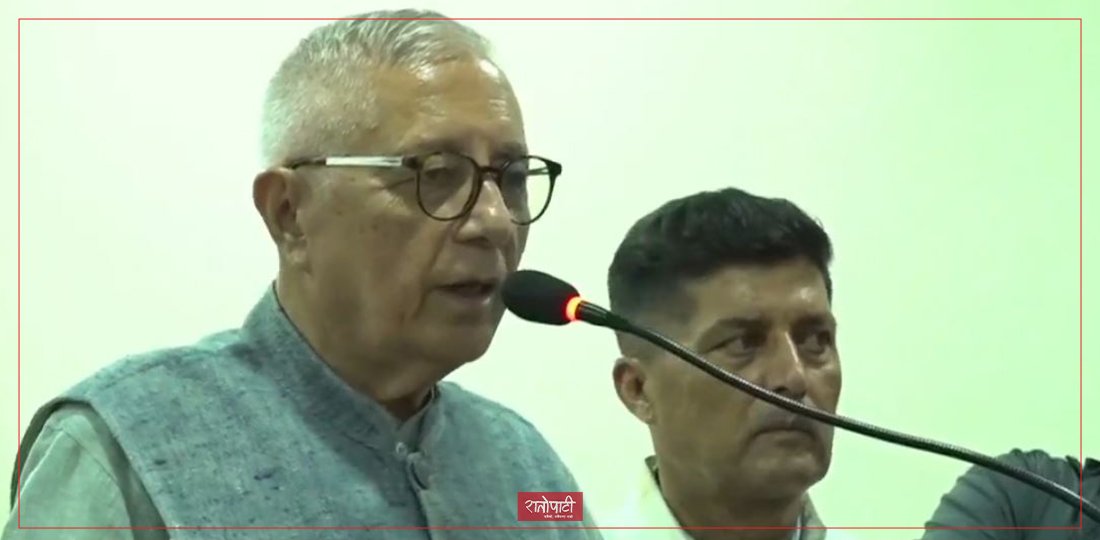
Previously, PrLoPa had nominated former Prime Minister and patron Dr. Baburam Bhattarai as a candidate in Gorkha-2 and Gopalbabu Shrestha in Gorkha-1. However, on Magh 9, Bhattarai withdrew his candidacy, leaving the field open for competitors. Following Bhattarai's withdrawal, Shrestha, the candidate for Gorkha-1, also withdrew his candidacy. PrLoPa had expressed dissatisfaction with Bhattarai's decision. Even after withdrawing the candidacy, the party had not decided which party to support. However, Bhattarai's secretariat stated that he was informed about the decision to support the Congress candidate.
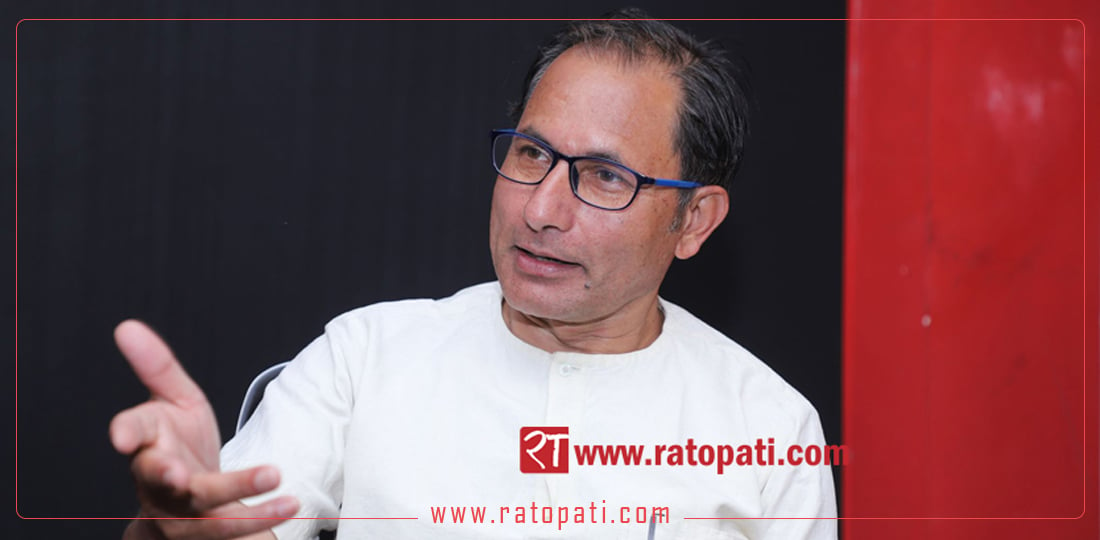
'First, the Doctor withdrew his candidacy at the request of the district committee. Even now, he does not interfere in whatever decision the district committee makes. The party policy allows the lower committee the right to coordinate based on local relativity. The decision has been made that the center will not interfere in that, and accordingly, he will not interfere in the decision,' Gurung told Ratopati.
However, political analyst Yadav Devkota, who is from Gorkha, asserts that the PrLoPa's decision to support Congress will not significantly affect the votes. He argues that in both Gorkha constituencies, Bhattarai's personal vote holds more weight than PrLoPa's organizational votes. Devkota is not confident that the party's decision will be implemented after Bhattarai himself left the field.
'PrLoPa does not have decisive votes in either constituency. If Baburam had contested, he could have secured 10-12 thousand votes. The party organization is weak, and I don't think everyone will vote just because the party says so,' he said. 'At this time, it seems that swing votes influence the result more than organizational votes. Organizational votes rarely swing. The neutral voters who have remained silent appear decisive in the victory or defeat. Those voters have not yet revealed their stance.'
According to Devkota, a tough competition is expected between the CPN (UML), Rastriya Swatantra Party (RSP), and Nepali Congress in both Gorkha constituencies.
He states, 'In the case of Gorkha, a triangular battle between CPN (UML), RSP, and Congress seems likely. In Gorkha-2, a tough competition is seen between CPN (UML) and RSP. CPN (UML) appears strong in Gorkha-1. With three days remaining, neutral votes might still be influenced.'
After the then CPN (Maoist) joined the peace process in 2062 BS, former Prime Minister Bhattarai won elections in 2064, 2070, and 2074 BS. In the 2079 election, based on his proposal, he left the field open for former Prime Minister and then CPN (Maoist Centre) Chairman Pushpa Kamal Dahal 'Prachanda.'

At that time, Prachanda won with 26,109 votes, while his closest rival, RSP's General Secretary Kabindra Burlakoti, received 12,639 votes. UML's Abdus Salam Mia got 7,395 votes. RPP's Sunil Pant received 1,813 votes. In the previous election, Prachanda's personality, support from Congress and Unified Socialist, and Baburam's cooperation made it easier for the Maoists to win.
This time, RSP has fielded Burlakoti again. CPN (Unified Socialist) leader Lekhnath Neupane, who is considered an intellectual leader from the former Maoist Centre, is in the field. UML has nominated Milan Gurung alias Chakre Milan, who has a reputation as a gangster. Congress has nominated Prakashchandra Dawadi. Kul Bahadur Baisnet is contesting from RPP.
CPN (Unified Socialist) candidate Neupane is popular among the general voters as a young, intellectual, and dedicated personality. However, RSP candidate Burlakoti is a strong contender, and due to the nationwide wave, Neupane will have to work very hard to secure a win. Neupane, who believes he will receive support as Bhattarai's successor, is in further difficulty due to PrLoPa's decision. However, analyst Devkota states that PrLoPa's votes in both Gorkha constituencies are less than a thousand, so the impact will be minimal.
'In Gorkha-2, PrLoPa's organized vote is around 500-600. In Gorkha-1, it might be 300-400. I don't think all those votes will go to Congress just because the party decides. To win the election, one needs to attract silent voters. Whoever influences those voters seems to have the upper hand,' he said.

In the 2079 election, the Maoists seem to have received the popular vote in proportional representation. While the Maoists received 19,000 votes, Congress received 11,882, RSP 8,999, UML 6,185, RPP 1,846, and Unified Socialist 370 votes.
Gorkha-2 comprises Wards No. 8, 9, 10, 11, 12, 13, 14 of Gorkha Municipality, Palungtar Municipality, Shiranchowk Rural Municipality, Sulikot Rural Municipality, and Ajirkot Rural Municipality.
Gorkha-1, which was allocated to Congress in the previous seat-sharing arrangement, saw Rajendra Bajagai win with 33,428 votes. His closest rival, UML's Ramsharan Basnet, received 16,785 votes. RSP's Subarna Rokaha got 4,892 votes, and RPP's Uday Prasad Bhat received 852 votes.
This time, CPN (Unified Socialist) has fielded experienced leader Hariraj Adhikari. UML has nominated young leader Ramchandra Lamichhane. Congress has nominated Prem Kumar Khatri, while RSP has fielded Sudhan Gurung, an activist of the Genji movement. RPP has fielded Kedarmani Khanal.

Analyst Devkota sees a good atmosphere for CPN (Unified Socialist) in Gorkha-1.
'In Gorkha-1, in the triangular fight between CPN (Unified Socialist), RSP, and Congress, Hariraj Adhikari seems to have a good atmosphere. With four days left until the election, the votes might fluctuate a bit,' he said.
In the previous election, Maoists received the popular vote in this constituency under proportional representation. With Maoists leading with 18,471 votes, Congress received 15,271, UML 11,893, RSP 7,246, RPP 1,344, and Unified Socialist 226 votes.
Gorkha-1 includes Gandaki Rural Municipality, Sahid Lakhan Rural Municipality, Wards No. 1, 2, 3, 4, 5, 6, 7 of Gorkha Municipality, Bhimsen Rural Municipality, Arughat Rural Municipality, Dharche Rural Municipality, and Chumanubri Rural Municipality.
This specific news has been automatically translated by AI. As a result, there may be some inaccuracies or language errors.