Kanchanpur Landless Families Demand Secure Housing and Land Ownership Ahead of Elections, Citing Decades of Unfulfilled Promises

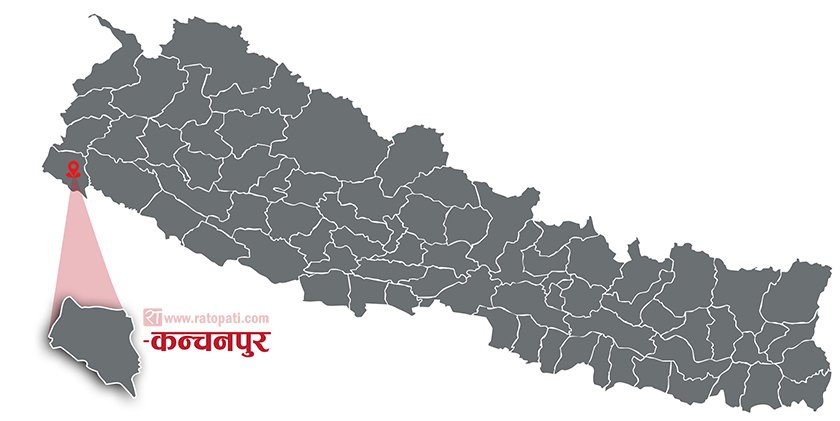
Kanchanpur. With four days remaining until the House of Representatives election, landless families in the Banahara camp in Kanchanpur have stated that candidates in every election promise to address their issues but fail to deliver.
The families, who have been living in temporary shelters near community forests adjacent to the East-West Highway for over three decades, are demanding assurance of secure housing with land ownership from the candidates this time.
Camp residents say that in every election, candidates from various parties and independent contenders visit the camp, assure them of land deeds, safe settlement, and organized housing plans, but these promises remain confined to paper after the election concludes.
“Candidates have been using us as a vote bank for years,” said Mandhvaj Luhar, “but no one comes to solve our problems.” The landless families residing in the camp for nearly three decades are still forced to live a difficult life in huts made of tarpaulin and tree leaves, without legal ownership.
Kalawati Damai stated that living near the East-West Highway poses the risk of traffic accidents, and being close to the community forest increases the danger of attacks by wild animals. She mentioned that wild animals approach the settlement at night and attack.
“We are afraid to go out at night,” Damai said. “If an elephant or a tiger comes, there is no place to run; whom do we call for help? Since the settlement is near the forest area, there is no permanent security arrangement. Living near the highway and riverbanks also carries the equal fear of being swept away by floods during the monsoon season.”
Maghi Rawat explained that because the settlement is not organized, houses get flooded even with normal rain. She shared the experience that during the summer, some families are forced to sleep on cots strung with ropes under a bridge over the river because they cannot bear to stay in the tarpaulin huts.
“We need education, health, secure housing, and reliable employment, but when will we get our rights?” Rawat questioned. Most landless families depend on daily wages and labor. The young men in the households work as porters and watchmen in India. Rawat informed that the lack of a permanent source of income also affects the education, health, and nutrition of their children.
The residents here face problems such as being unable to take loans from banks, start businesses, or be fully included in the social security net due to not having a permanent home. Camp residents stated that they have applied for land and housing through the Land Problem Resolution Commission and received a 'Nissha' (proof of application/entitlement).
“We have the Nissha in hand, but no land to live on,” said Ranjit Rawat. “Elections come, assurances come, but work doesn't happen. We need secure housing with land ownership, access to basic services and livelihood opportunities, safe and organized settlement minimizing flood risk, drinking water, sanitation, electricity, and access to schools for children. We have been waiting for this for years; we need a candidate who will fulfill these needs.”
This time too, candidates from various political parties claim to have prioritized solving the landless problem. Some candidates have committed to moving forward with land surveying, distribution of land deeds, and housing construction programs in coordination with the federal government.
Meanwhile, voters residing in the camp stated that written commitments and timelines are necessary. “Now, not just assurances and speeches, work must be done with a set date,” said camp leader Dal Bahadur Bohara. “We don't want charity; we want rights. It is enough if they provide land and secure our settlement.”
He mentioned that the children's education is affected due to the temporary settlement, and many children are deprived of school enrollment and scholarship benefits because they have lacked a permanent address for years. Access to health services is also limited as the basic health post is far away, causing problems in emergency treatment. There are 28 families residing in the camp; previously, there were only 12 families. Now, families displaced by floods and landslides have been added. Bohara said, “Emotional assurances are not enough now; we need land documents. We need safe houses.”
The camp residents complain that despite living by the highway and riverbank for over three decades, no long-term solution has been sought. They express frustration that leaders and cadres from various parties visit the camp during elections to give assurances that yield no visible results.
“Names are noted and photos are taken in every election, but our lives remain the same,” said Prakash Saud. “We have demanded written commitment and an action plan from the candidates; it must be clear who will do what and when. We will vote for the candidate who commits to finalizing land, housing, and employment.”
Ram Bahadur Chunara, General Secretary of the National Land Rights Forum, Sudurpashchim Province, emphasized the need to move forward simultaneously with the identification of genuine landless people, their resettlement in safe locations, construction of housing with basic infrastructure, and livelihood programs. He stated that landless families in the municipality have applied to the Land Commission for this purpose, but there has been no hearing yet.
“With only four days left for the House of Representatives election, landless families in Kanchanpur have brought their demands to the center of the election agenda this time,” Chunara said. “For these families who have been living temporarily for three decades, secure housing and land ownership are not just election slogans but the basis of their livelihood. Therefore, the candidate who fulfills their commitments will be the choice of the camp residents.”
This specific news has been automatically translated by AI. As a result, there may be some inaccuracies or language errors.