Artist Sangi's Solo Exhibition 'Antardrishti' Showcases Spiritual Depth Through Paintings and Sculptures

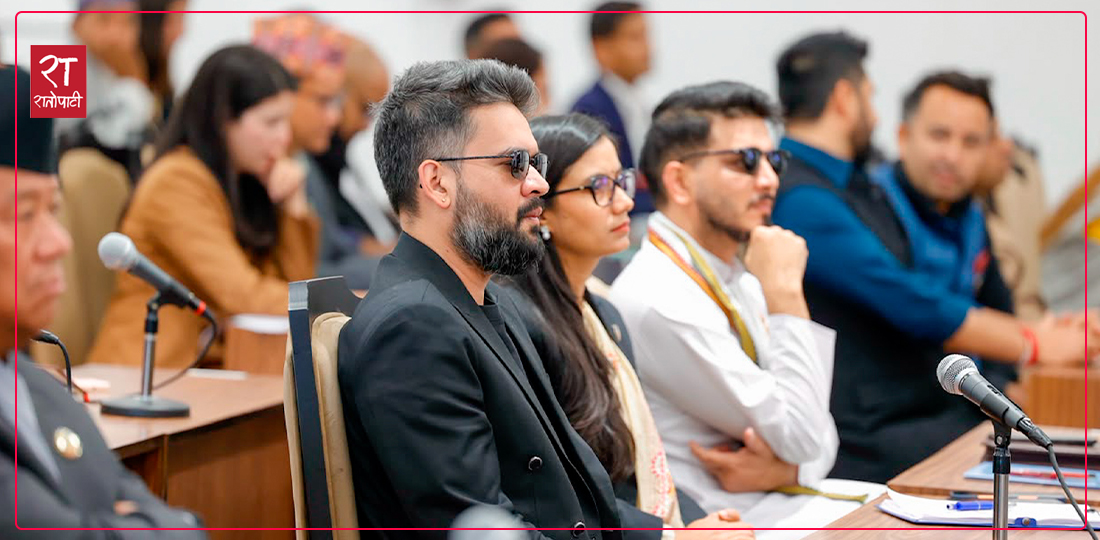
Sangi's captivating works were unveiled on February 19th amidst a large gathering under the title 'Antardrishti' (Insight). A large exhibition hall, bustling crowds, a throng of people. At first glance, it looked like an art fair. However, there wasn't much of a formal program. Although there were some brief discussions about the art, they were not easily understood.
It seems that observing art directly brings more joy than trying to articulate it with words. This is because the artworks were beautiful and appealing. The artist herself preferred that her works be directly absorbed by the audience in their own way, rather than being explained by words. That the art and the audience should converse directly.
This is not just her solo art; this program is a shared letter of intent designed to connect closely with the audience. The hope is that by viewing it, the audience can also discover their own feelings. For this reason, I felt it was unnecessary to elaborate much.
Nevertheless, art has its own history. Therefore, nowadays, the concept, intention, and perspective of the artist are beginning to be documented. It is also necessary to bring to the surface the life and thoughts the artist has lived, because their art is a reflection of this.
Thus, discussions about the artist's viewpoint are also necessary. For example, taking up the context of 'Antardrishti.' Antardrishti means the vision of the artist's own inner mind. Her thoughts formed through dialogue with herself. Her perspective built from this. Simply put, the thought within the mind.
This can also imply the meaning of deities (Dev-Devi). When this context is linked with art, her work appears even more brilliant. The process by which the audience understands and internalizes it becomes sharper. This is why debate about art, whether oral or written, is necessary.
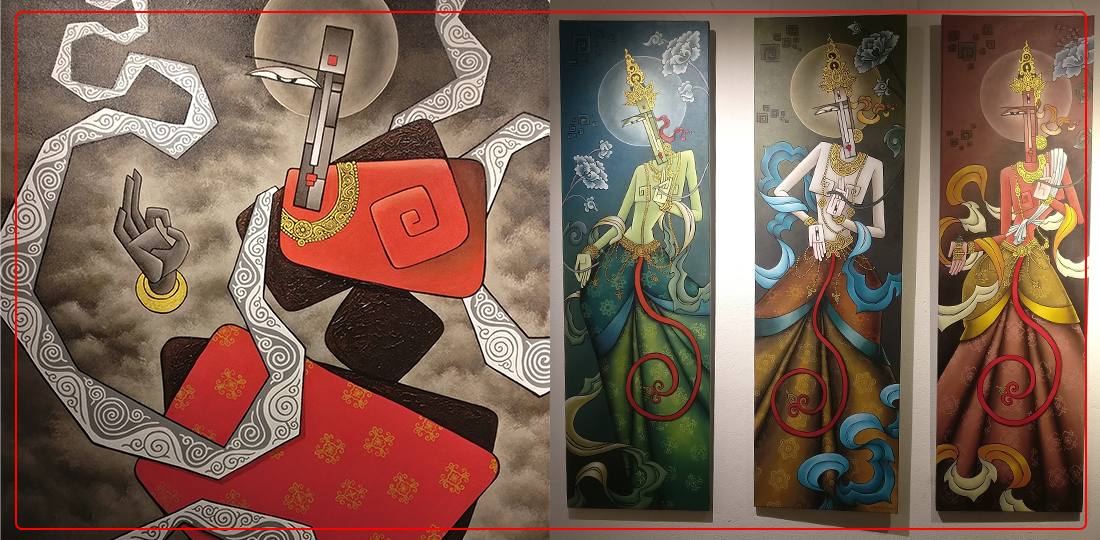
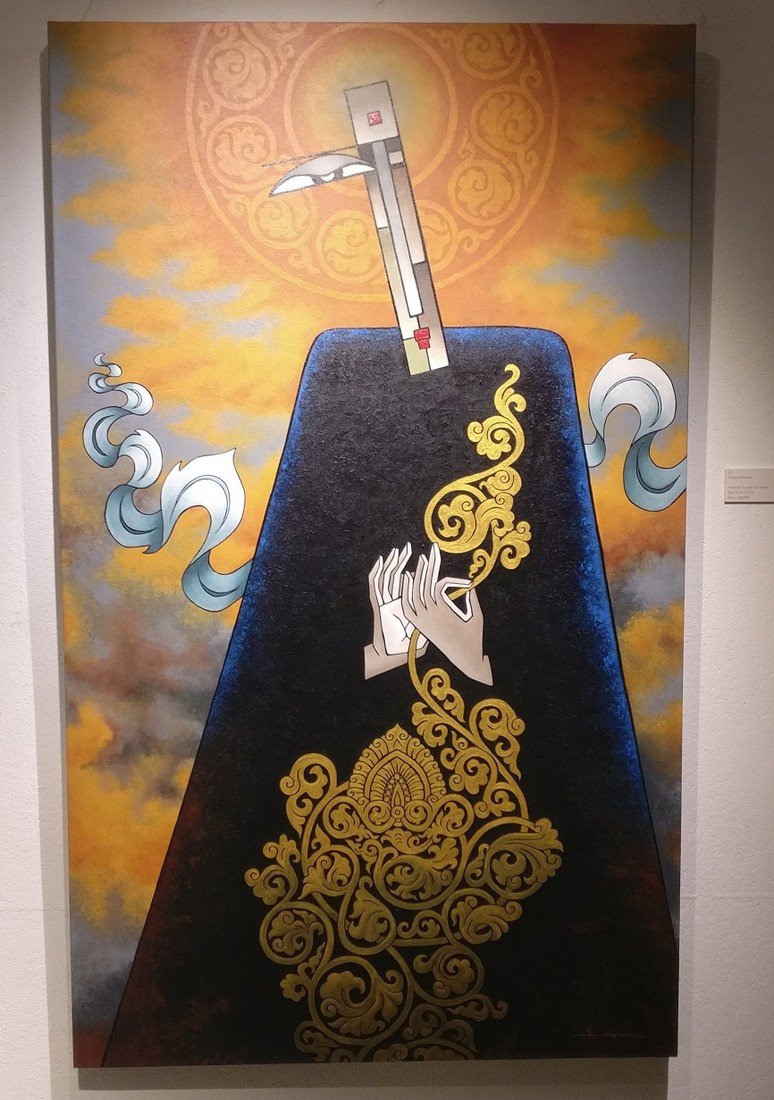
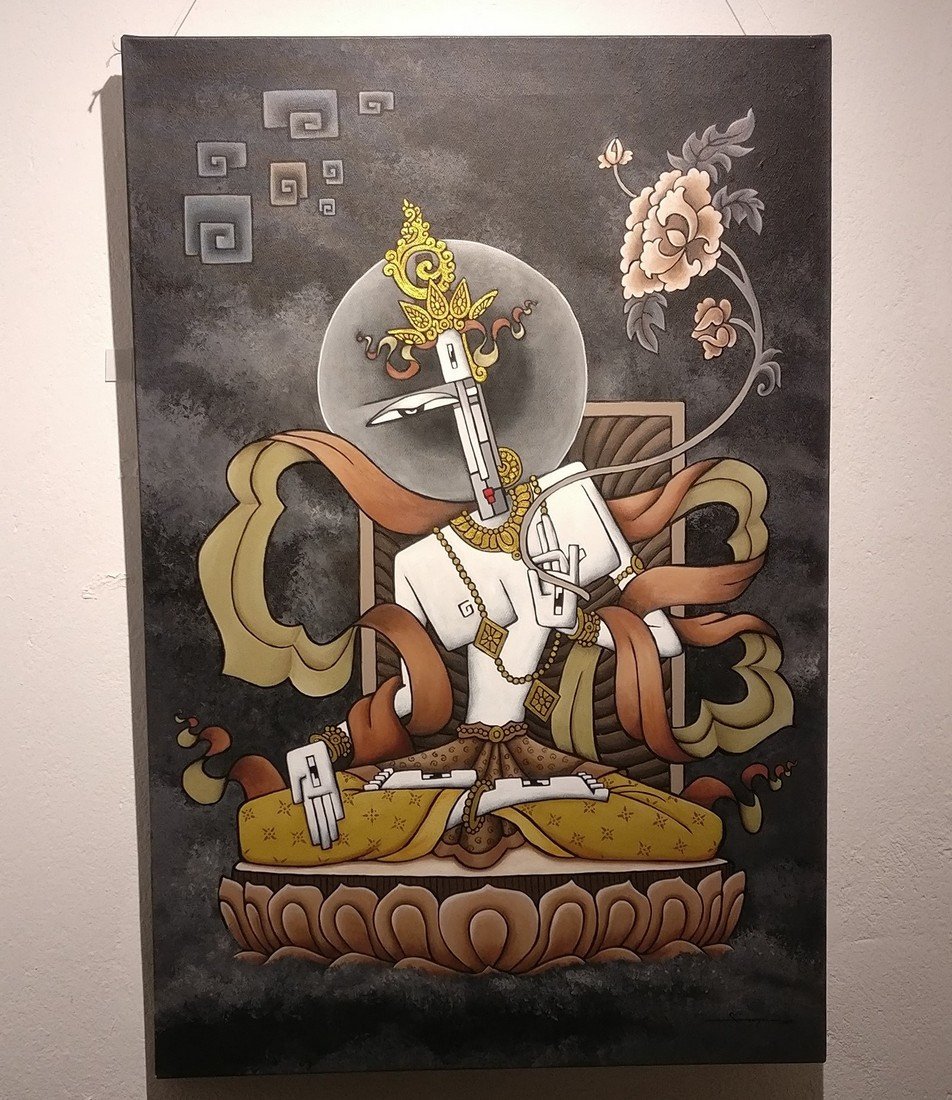
When the context of deities arose, many things immediately appeared. Nevertheless, the plea for the art itself to converse with the audience was sufficiently evident. In other words, the desire for direct dialogue between the audience and the art became clearly visible. The captivating forms of the deities and the attractively positioned limbs were observed closely by the audience.
The audience savored the paintings in silence, without noise, as if mesmerized. The noise from a moment before seemed to have vanished. A positive flow of emotion was visible among them. The significance of her art was that the audience was engrossed in this influence.
The fact that the audience appeared mesmerized, as if worshipping at a Devi Sthan with devotion, must be considered a strong aspect of these paintings. The intention of her art was to present the spiritual deity, the deity residing in the artist's mind, and the deity residing today with our faith.
Fundamentally, the artist has been raising issues concerning women for many years. However, at that time, the deities were not created in this style and composition. Her art depicted contemporary women more than imagination. It showed the life experienced by women.
Yesterday's subject has changed today. Today, the subject has taken the form of this present-day deity. Although they appear similar when comparing the past and the present, these paintings have become more attractive because spirituality has entered them this time.
Sangi's nearly three-decade-long artistic journey has seen many ups and downs. Around the beginning of 2000, she emerged as a prominent practitioner of alternative art. Her postmodern works, which experimentally presented installations, performances, and interactive art, garnered considerable interest from the general public.
Today, she is attempting to bring this back towards spiritual dialogue. Consequently, our traditional aesthetic is also seen to have found a place. The appearance of such folk narratives and religious elements, which are deep beliefs for the common person, in a modern form is a distinct characteristic.
In this sense, even when purely traditional art, i.e., Paubha painting, appears in a modern form, it carries a distinct significance. It is also about how Paubha paintings can be reinterpreted in the contemporary context. In the true sense, this is her specific artistic identity. In the old days, such paintings were made based on specific meanings and conventions described in slokas by classical pandits for religious purposes.
When contemporary artists present this painting bound with their own thoughts, it naturally looks a bit different. Sangi's paintings are like this.
Her first solo art exhibition was in 2009. Following that, this is her fourth solo exhibition, having had two or three before. By the time she reached her fourth exhibition, her refined thoughts are strongly visible. No matter how much she seeks emotion or aesthetics in form, the expressions and concepts that emerged when the things her inner soul wanted to convey, and the country, time, and circumstances began to grip her, have made these artworks poignant this time.
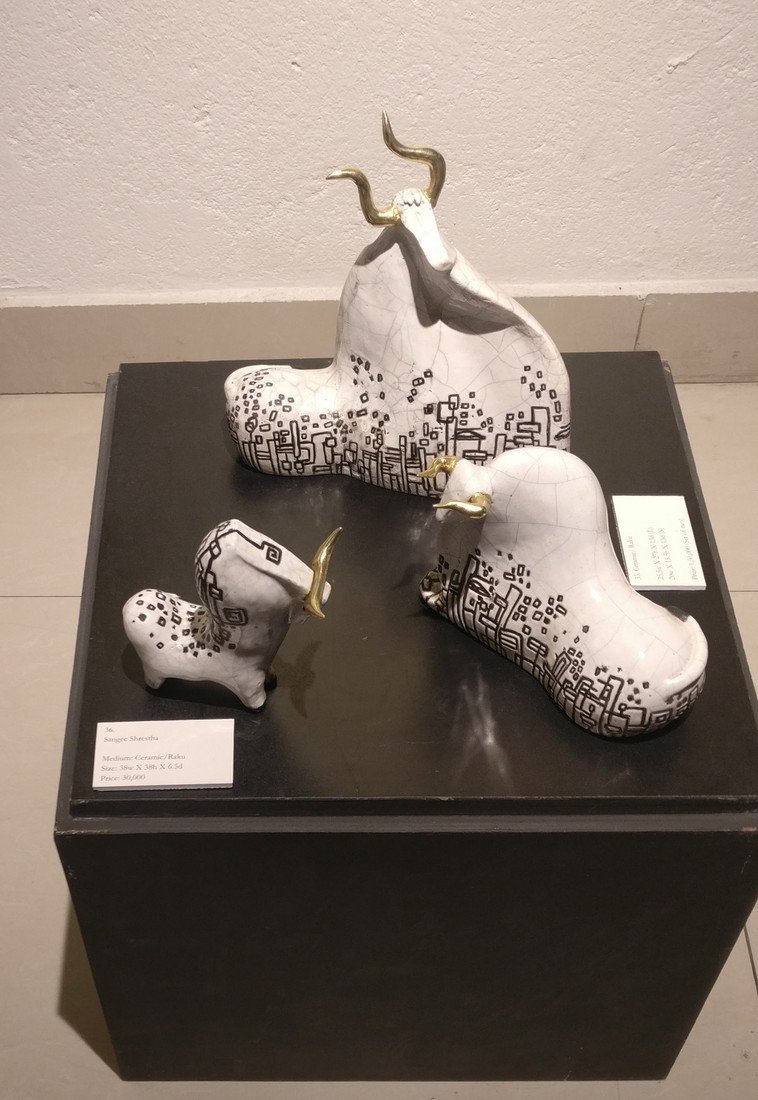
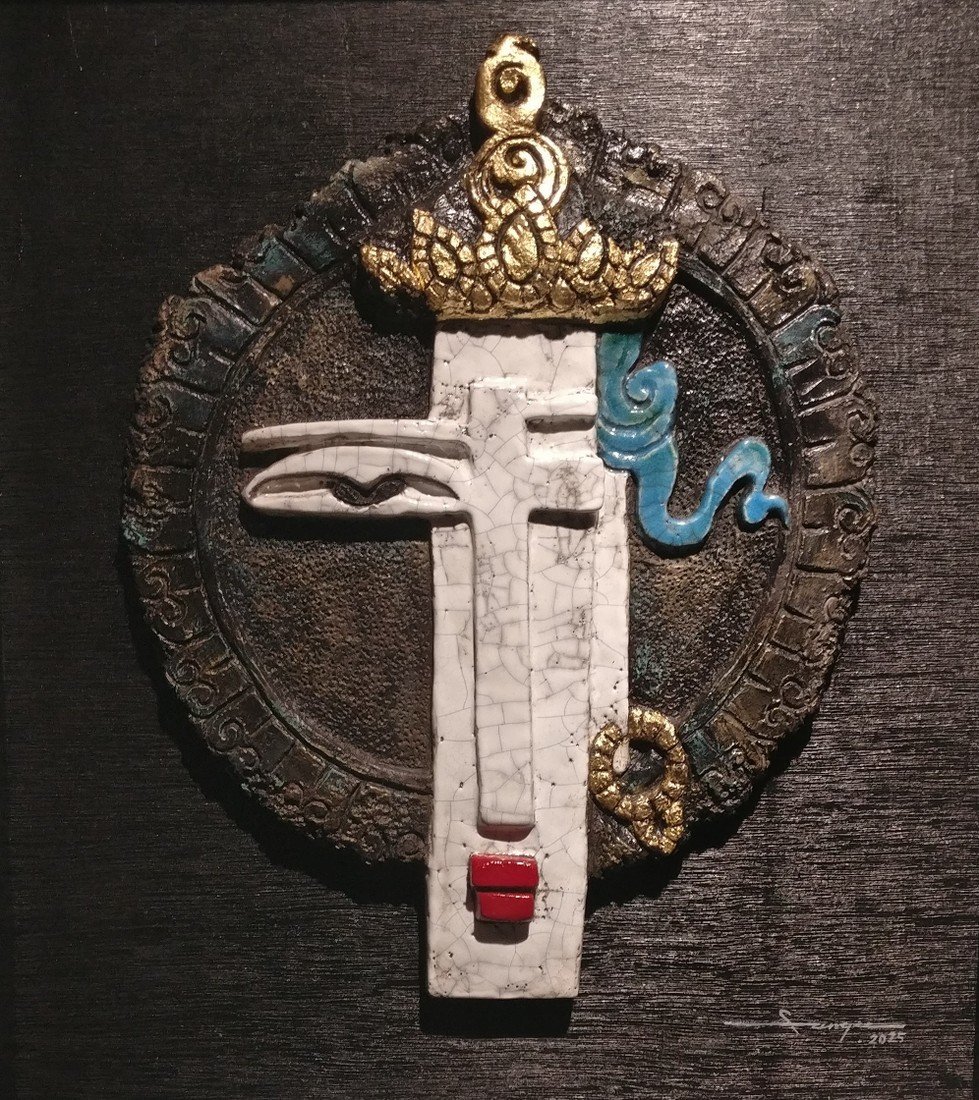
On the other hand, her sculptures this time have also appeared in a completely new style. Fundamentally, she is not a sculptor. However, the emotional sculptures presented this time show that she has a strong command in this medium as well. She attempts to connect the emotional context of the earth and the hand in the sculptures.
She herself desires coordination with the soil she lives in. And as a result, such sculptures of hers have come into existence. While playing with the soil, while physically touching the soil, she feels a greater sense of intimacy with her soil. And this is symbolically reflected in her art. Even when irregularly shaped clay vessels appear, she fills them with numerous emotional embellishments. And numerous emotions give birth to abstract forms.
The lines jump around, running everywhere, and an abstract form is created. Perhaps this is a symbol of her intimacy and belonging. The beauty that appears when these spontaneously born lines run wildly seems to be what she desires.
Sangi herself says, 'Art is born where words end. Where the soul itself begins to speak through color and line. For me, art is not just visual expression; it is the medicine of the soul. It is a source of energy in the form of meditation.'
Her perspective on art does not end there; she adds, 'I converse with visible and invisible elements. This results in an emergence of emotion. It takes a form and appears in this light. Fundamentally, my art is a reflection of this.'
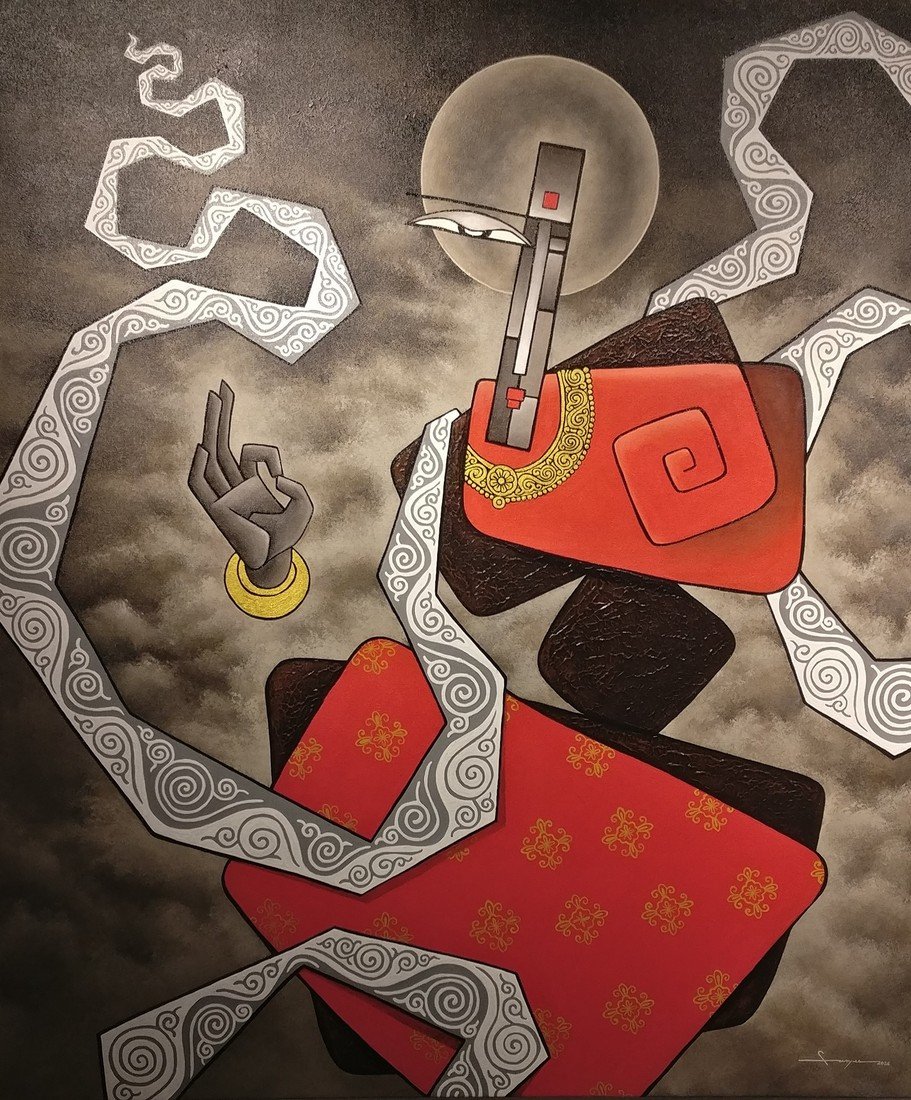
Looking at her thoughts and art, her specialty is naturally seen as spiritual contemplation, awakening the self within. Considering the ideas she holds and the meaning of having God within oneself, she also considers parents as forms of God. Therefore, even though deities appear in numerous weapons and postures, her art has emerged to preserve a clean, pure mind and reverence.
Her religious figures, especially those made in geometric forms, appear to be speaking about contemporary matters. Through them, beauty is directly conveyed to the audience with meaning. Overall, this is the insight hidden within the inner mind. She further says that this is why her artworks are spiritual dialogues themselves, which create interaction between me and my audience. And this conversation between my soul and the audience's soul is not seen, but it is constantly felt.
The art salon is located in the bustling Thamel as an art gallery. In this exhibition held at this art salon, Sangi's paintings and sculptures carrying the same theme have come together. Seeing sculptures and paintings side by side is also her first experimental presentation. The form of the sculptures was slightly different from the paintings. Nevertheless, sufficient coordination was maintained in both. Meditative seriousness was incorporated into both.
Furthermore, paintings were also visible on several ceramic sculptures. This fully exposed the interrelationship between these two. Especially these ceramic works, immersed in emotional depth, could be experienced as the impulses of the inner mind being spilled out.
Her ceramic sculptures were not seen before. This time, she does not intend to put complexity into her sculptures. By making them in a simple, easy manner, she desires that what flows from them carries honesty. The slightly different style of sculptures this time also supports this, making the dimension of her art stretch and become broader. The fact that both share the inner sound of being absorbed in a serious meditative posture is also substantiated.
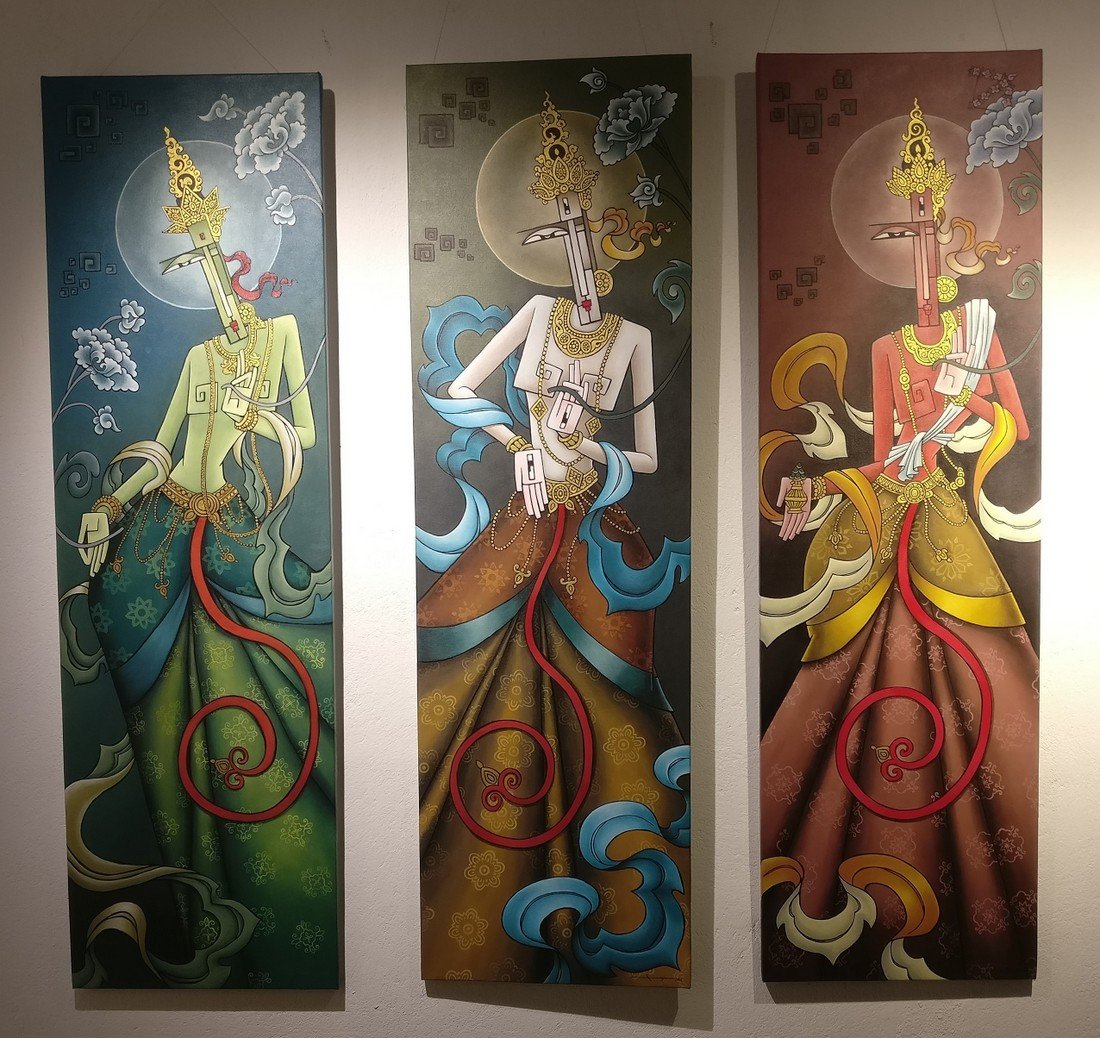
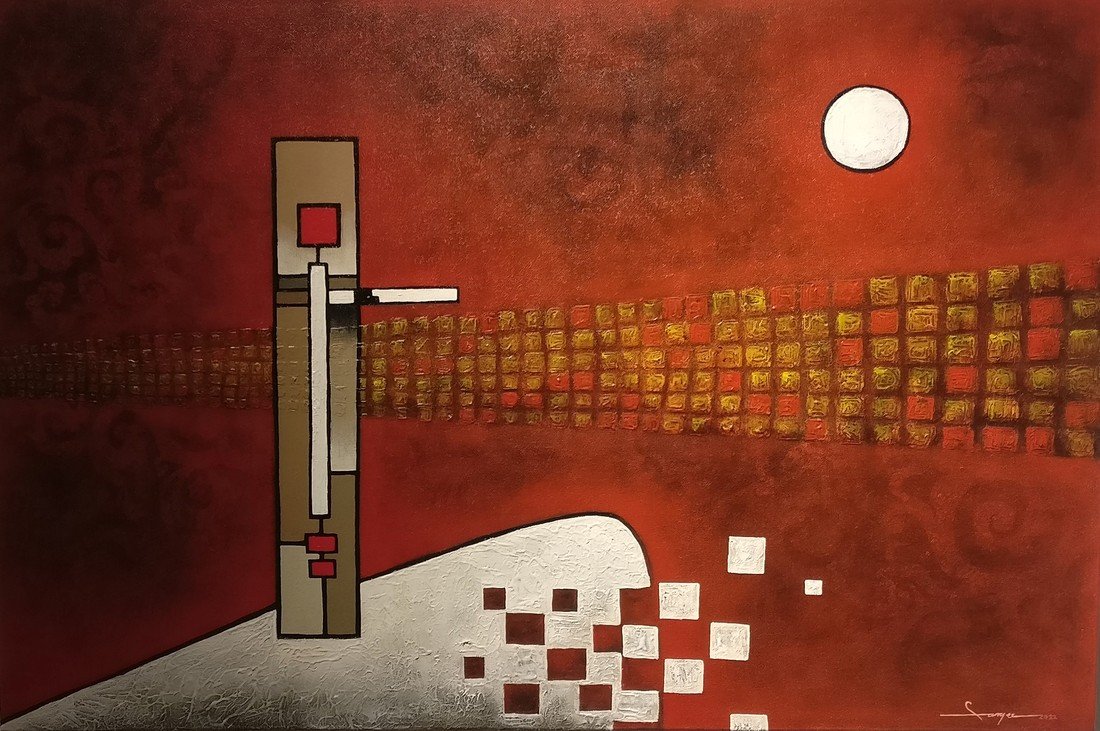
Her artworks playing with lines in a right-angled shape within a geometric form are presented in an even more interesting manner. What is more interesting is that even within abstraction, the presence of form, and being surrounded by artistic traditional flourishes and peaks, her works appear cohesive. Where beauty is also felt.
And her own original symbols of belonging are also visible. Even so, these artworks are seen to be filled with sufficient grace. As the forms of deities are adorned with our own traditional motifs, the audience also experiences the awakening of devotion. Experiencing and gaining many things from a single subject is also a key characteristic of her art.
She says—I do not experience spirituality, religion, or purity in abstraction. This is the thread that binds me in one place. Which is incorporated into every piece of my art. My artworks have not come to tell the audience anything. Rather, they desire interaction with the audience. And they enjoy being engrossed in mutual dialogue.
(Malla is an artist and art critic.)
This specific news has been automatically translated by AI. As a result, there may be some inaccuracies or language errors.